
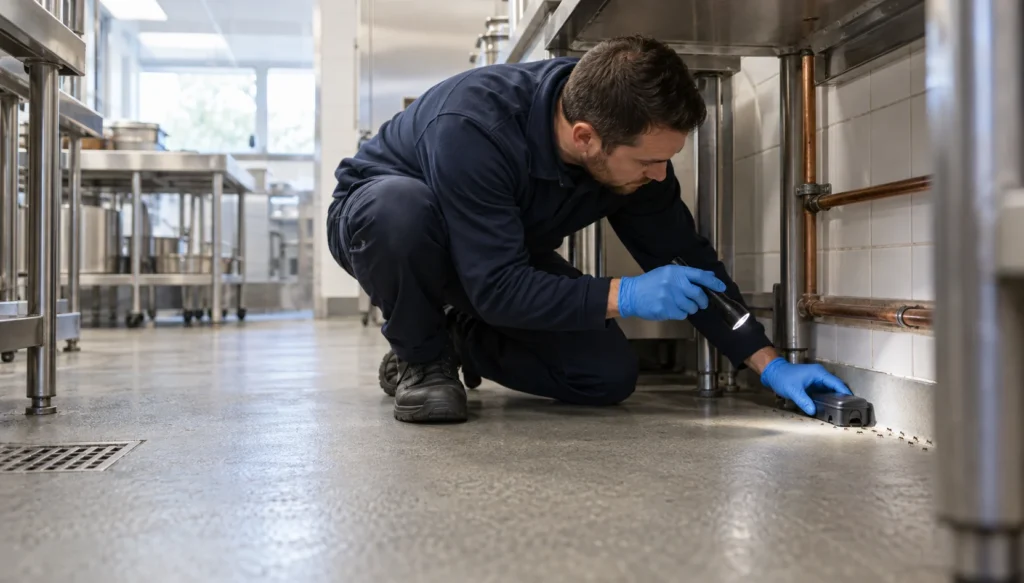
Commercial Ant Control for Kitchens and Wards
Professional kitchens and clinical wards demand exacting hygiene standards. Crawling insects still exploit service ducts, wall voids and preparation surfaces. Effective commercial ant control begins by separating common perimeter foragers from tropical species that nest inside the building fabric. Cleaning regimes alone never reach the hidden reproductive core. Facilities managers need biologically sound methods to protect public health.
Ant infestations in sensitive environments create severe operational constraints. Vulnerable patients recuperate in these buildings. Catering teams produce hundreds of meals a day. Uninformed chemical treatment usually makes the problem worse, not better. So how can estates teams tell contrasting ant species apart and deploy targeted, audit-compliant treatment before contamination spreads?
Key Takeaways
- Correct species identification decides whether a site needs external barrier exclusion or a full non-repellent internal baiting programme.
- Pharaoh ants build multi-queen satellite colonies in warm structural voids, so slow-acting baits work where knockdown sprays do not.
- Synthetic pyrethroid sprays trigger colony budding, fracturing one infestation into multiple active nests across adjacent clinical wards.
- Healthcare sites face acute risk because invasive ants seek protein from dressing packs, surgical wounds and intravenous access sites.
- Integrated pest management pairs monitoring, proofing, sanitation discipline and digital reporting to satisfy UK food safety audit standards.
Species Traits, Harbourage and Matched Treatment Methods
Commercial sites face very different risks depending on which species has invaded. Black garden ants forage indoors from colonies in soil or turf outside. Tropical species behave differently. They nest inside service risers, cavity walls, ceiling voids and underfloor heating runs. The table below sets biological traits against the treatment each species demands.
Selecting the wrong protocol carries a real cost. Site hygiene suffers, labour expenditure climbs and clinical workflows stall. Enforcement risk rises under UK food hygiene law. In practice, we find that most failed treatments trace back to a single misidentified specimen. Species confirmation therefore precedes every chemical or baiting decision on site.
| Pest Species | Primary Harbourage | Colony Structure | Treatment Mechanism |
|---|---|---|---|
| Black Garden Ant | External soil, patios, foundation footings | Single queen per colony | Perimeter proofing and external residual baiting |
| Pharaoh Ant | Internal service ducts, wall voids, boiler rooms | Multiple queens per colony | Slow-acting growth regulator or bait matrix across all zones |
| Ghost Ant | Heated pipe chases, voids behind kitchen splashbacks | Multiple queens, opportunistic nests | Non-repellent baiting and structural moisture control |
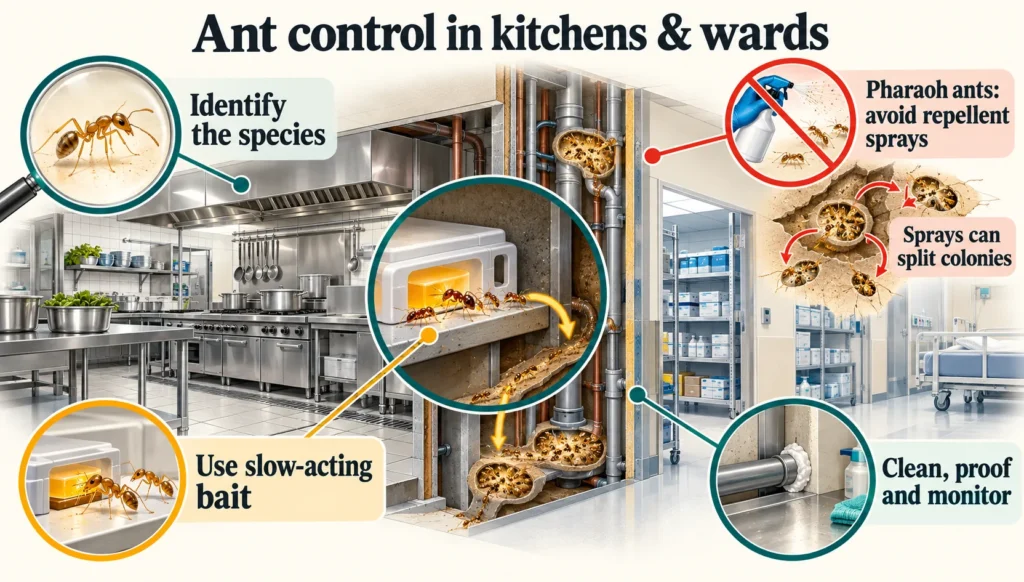
Ant Identification and Biological Characteristics
Species Differentiation in Commercial Environments
Accurate morphological identification separates black garden ants from tropical indoor invaders. Garden ants measure around four millimetres and show dark brown colouration. They build single-queen nests outdoors. Pharaoh ants measure under two millimetres and appear yellow-brown. They live only inside heated internal voids within modern commercial buildings.
Estates teams often mistake small garden ant workers for structural invaders during spring foraging. Magnification settles the question quickly. Pharaoh ants carry a two-segmented petiole and a darker posterior tip to the abdomen. Ghost ants show pale, translucent legs and abdomens. Control protocols diverge completely on colony structure. Technicians must therefore confirm the species before any bait matrix is deployed.
Harbourage Preferences and Environmental Drivers
Indoor ant populations thrive inside protected voids with steady warmth and moisture. Typical harbourage includes hollow partition walls and insulation wrapped around steam lines. Boiler rooms and the cavities beneath heavy cooking appliances serve equally well. These microclimates support year-round reproduction, independent of outdoor weather or seasonal temperature swings.
Healthcare estates run heating pipes and electrical ducting continuously through ceiling voids. Those utility networks become transit corridors. They link wards, catering units and waste stores across very large footprints. Without structural barriers, foraging workers move between soiled utility rooms and sterile preparation tables. Resolving harbourage demands joint inspection by cleaning staff, maintenance engineers and qualified pest technicians.
Risks in Food Preparation and Healthcare Facilities
Clinical and Cross-Contamination Risks
Invasive ants act as mechanical vectors. They collect pathogenic bacteria on their bodies whilst foraging across drains and waste bins. In healthcare settings, pharaoh ants reach sterile dressing stores, catheters and surgical packs. That transfer introduces serious infection control risk into high-dependency units and immunocompromised wards.
Pharaoh ants also show a marked preference for fluids, including wound exudate and blood. Patient care literature records workers penetrating standard adhesive dressings to reach moisture and protein. The behaviour distresses patients directly. It also raises the probability of healthcare-associated infection. Clinical infestations are not an aesthetic nuisance. Estates teams should treat them as infection control emergencies.
Food Safety Legislation and Due Diligence Defence
Food businesses must run documented pest prevention programmes under the Food Safety and Hygiene (England) Regulations 2013. Environmental Health Officers may serve Hygiene Improvement Notices. They can also close premises where an active infestation threatens food safety. Under the Food Safety Act 1990, pest records underpin a statutory due diligence defence.
Controlling ants in kitchens and healthcare sites demands auditable evidence. Third-party schemes such as BRCGS Issue 9 and SALSA Issue 7 examine risk assessments, device mapping and trend analysis. Auditors look for professional codes of practice in daily use. Uncontrolled ant activity in meal production zones produces formal non-conformances. Consumer complaints and reputational damage across regional supply chains follow.
Did You Know?
Breaching the Food Safety and Hygiene (England) Regulations 2013 is triable either way. Organisations convicted face an unlimited fine. The Sentencing Council guideline sets an offence range running from £100 to £3 million, scaled by turnover, culpability and harm.
Colony Budding and Why Sprays Fail
Chemical Repellency and Colony Fragmentation
Synthetic pyrethroid sprays repel foraging workers without touching the reproductive core. Applied to a visible trail, a broad-spectrum spray kills only a small fraction of the foraging force. Surviving workers detect the chemical residue. They then release volatile alarm pheromones throughout the hidden nest network.
That chemical stress triggers budding. Fertile queens and attendant workers disperse and found independent satellite nests. One central nest can fracture into dozens of autonomous sub-colonies inside neighbouring wall cavities. A localised problem in a single ward kitchen then spreads through the whole hospital block. From experience across the sector, this happens within days of pesticide contact.
Systemic Failure of Conventional Residual Sprays
Residual insecticides fail against polygynous species because the queens sit deep inside architectural crevices. Those queens continue laying whilst foraging trails simply reroute around treated zones. The population rebounds quickly. It returns with wider spatial dispersion and greater resilience to the next eradication attempt across the premises.
Estates managers must prohibit domestic aerosols and routine contractor spraying in sensitive zones. Any short-term drop in visible ant numbers is misleading. It masks an expanding, multi-focal infestation behind the plasterboard. Eradication depends on non-repellent methods instead. Those methods exploit the social behaviour of the target species rather than relying on contact toxicity.
Free Pest Control Audit Review
We will review your risk assessment, site plan, visit reports, trend analysis, open recommendations, product records and demo our AI Pest management System.
Hidden Nest Detection in Building Fabric
Internal Transit Route Surveys
Nest detection relies on non-destructive survey work that traces worker traffic back to its source. Technicians map foraging trails during peak operating hours, when heating and cooking raise insect metabolism. Foraging lines follow structural straight edges. Skirting board seams, cable trays and copper hot-water pipework all serve as highways.
Non-toxic attractant lures with carbohydrate and protein bases reveal transit density and direction of travel. Technicians place monitoring stations along suspected corridors and record worker counts at set intervals. Trail vectors are then plotted onto building drawings. That exercise isolates the cracks where workers penetrate dry-lined walls. It also shows where they drop through suspended ceiling tiles.
Diagnostic Tools and Structural Investigations
Advanced commercial inspections combine digital moisture metres, thermal imaging cameras and optical endoscopes. Moisture metres find hidden condensation behind wall panelling, where ants build satellite brood chambers. Thermal imaging locates heating pipes buried in concrete subfloors. Those pipes supply the constant warmth a tropical colony needs to survive.
Flexible endoscopes let technicians inspect service voids through existing socket faceplates or access hatches. Wall finishes stay intact. Confirming nest sites shows whether the site has an isolated external incursion or an entrenched internal colony. That diagnostic baseline prevents wasted expenditure. It also ensures each bait matrix sits directly alongside an active transit run.
AI Pest Management
AI pest management is pest control delivered with continuous digital monitoring and analytics rather than paper records, with real time data access across a single or multiple sites.
Strategic Baiting Protocols and Trophallaxis
Trophallaxis and Social Food Sharing
Effective baiting depends on trophallaxis, the process by which social insects regurgitate food for nestmates. Foraging workers ingest non-repellent gel or liquid bait and carry the active ingredient deep into the nest. Over hours and days, they pass it to developing larvae and to non-foraging queens.
The active ingredient must act slowly. Workers need to survive long enough to complete repeated feeding cycles. A fast-acting bait kills them on the trail and severs the supply line to the queens. Pharaoh ant treatment therefore relies on slow-acting insect growth regulators or metabolic inhibitors. These dismantle the reproductive capacity of the whole colony.
Matrix Selection and Bait Placement Rigour
Ant dietary preference shifts between sweet carbohydrates and animal protein as the brood develops. During peak reproductive phases, colonies demand protein to rear larvae. Adult workers favour carbohydrate to fuel movement. Professional programmes therefore deploy dual-attractant matrices, or alternate the nutritional profile across successive visits to hold consumption steady.
Bait stations belong directly on foraging lines, not in open floor space. In catering environments, technicians secure tamper-resistant stations beneath service counters and behind refrigeration compressors. Pipe penetrations are another reliable placement. Competing food debris must be removed first. Immaculate sanitation ensures foraging insects feed on the bait matrix and nothing else.
Site Hygiene, Structural Proofing and Source Exclusion
Operational Attractants and Competing Food Sources
Impeccable catering hygiene removes the competing food that undermines a baiting campaign. Sugar residue beneath beverage dispensers feeds foraging workers. So do oil films behind fryers and unsealed organic waste bins. Rigorous deep-cleaning schedules must strip out these alternatives so that ants target the deployed bait stations instead.
Healthcare wards bring their own hygiene problems. Bedside snacks, discarded juice cartons and floral water all sustain foraging ants. Ward managers should enforce clear-surface policies. Organic waste bins need tight-fitting lids and daily collection. Denying moisture and simple sugars restricts worker vitality. It also accelerates uptake of the applied bait products.
Physical Exclusion and Envelope Sealing
Exclusion work seals the entry points between building cavities and occupied work zones. Silicone sealants, metal mesh and elastomeric compounds close gaps around pipe collars, electrical conduits and window sills. In commercial food stores, heavy-duty brush strips along external door thresholds block crawling insects at the threshold itself.
Proofing also stops garden ants entering through masonry weepholes and defective mortar joints. External landscaping should maintain a clear gravel inspection border. Vegetation touching the elevation must be cut back. Defective rainwater goods need repair. Controlling dampness removes the external moisture reservoirs that sustain perimeter colonies next to production premises.
Audit Readiness and Integrated Pest Management
Documentation and Regulatory Compliance
Compliance frameworks require transparent records of every monitoring result, product application and corrective action. Environmental health inspections and food safety audits examine the site pest file for evidence of active oversight. A complete folder holds technician accreditation, safety data sheets, COSHH assessments and dated site maps showing all monitoring points.
BRCGS Issue 9 requires written trend analysis with technical interpretation, not raw activity counts. A qualified provider confirms whether pest thresholds were breached and sets out the corrective action taken. Digital reporting platforms matter here. They give facilities managers instant access to treatment records, site diagrams and inspection logs during an unannounced audit.
Action Thresholds and Staff Monitoring
Integrated pest management sets action thresholds zone by zone across a facility. An external delivery bay carries a different acceptable threshold from a high-care packing hall. A hospital sterile services unit is stricter again. A single foraging ant in an intensive care ward triggers immediate investigation under most site protocols.
Trained staff give the earliest warning of pest activity between scheduled contractor visits. Structured awareness programmes teach internal teams to recognise early signs and log sightings promptly. Reporting should flow both ways between the site team and BPCA-qualified contractors. That collaboration catches minor incursions early, before they become widespread regulatory non-conformances.
Final Thoughts
Protecting commercial food environments and clinical estates calls for an integrated biological approach. Successful commercial ant control rests on accurate species identification. It avoids repellent sprays that induce colony budding. It deploys targeted bait matrices that exploit social trophallaxis. Physical proofing, sanitation and structured monitoring then hold the gains.
Reactive habits no longer meet the standard expected by auditors or by patients. Continuous compliance demands disciplined documentation and cross-departmental hygiene cooperation. Data-driven monitoring gives visibility across every structural zone. Preventive, scientifically validated programmes protect operational continuity, patient welfare and food safety compliance.
Request a Free Site Survey
Frequently Asked Questions
A:
Household insecticides and synthetic pyrethroids act as repellents. They kill only a small fraction of the foraging workers. Survivors detect the residue and release alarm pheromones through the nest. Multi-queen colonies respond by budding. Reproductive queens leave the main nest with attendant workers and establish several new satellite colonies in wall voids. One contained problem becomes many scattered ones, often across areas that were previously unaffected.
A:
Full eradication usually takes four to eight weeks of continuous, systematic baiting. The exact period depends on the site footprint and structural complexity. Bait must circulate by trophallaxis to every queen and every developing larva, so results are never immediate. Technicians return regularly to replenish consumed bait. They also switch between carbohydrate and protein formulations as dietary demand changes. Treatment closes only once monitoring stations show zero activity.
A:
Pharaoh ants are small enough to penetrate sterile packaging, wound dressings and intravenous tubing connections. They act as mechanical vectors. They carry pathogenic bacteria from floor drains, clinical waste bins and utility areas directly to vulnerable patients. These ants are also drawn to proteinaceous moisture. Workers will seek fluid from surgical wounds or eye secretions. The result is patient distress and a raised risk of healthcare-associated infection.
A:
No. Sanitation is essential, but it cannot eradicate colonies living inside structural cavities. Deep cleaning removes competing food such as sugar deposits, grease residue and crumbs. That pressure pushes foraging workers onto professional bait instead. The reproductive core still sits in wall cavities, service ducts and subfloor voids. Only a targeted baiting programme, supervised by qualified technicians, dismantles the queens and brood permanently.
A:
Auditors from BRCGS, SALSA or the local authority expect a complete, current pest control file. It should contain a site-specific risk assessment and a dated site plan showing every numbered bait and monitoring station. Technician qualification evidence and COSHH documentation for all products used on site are also required. Add detailed visit reports and an active staff sightings log with recorded corrective actions. Periodic trend analysis interpreting activity over time completes the file.
By choosing Shield Pest Management, you’re partnering with a company that combines local expertise with industry-leading practices. Our commitment to quality, compliance, and customer satisfaction makes us an ideal choice for both residential and commercial pest control needs.
