
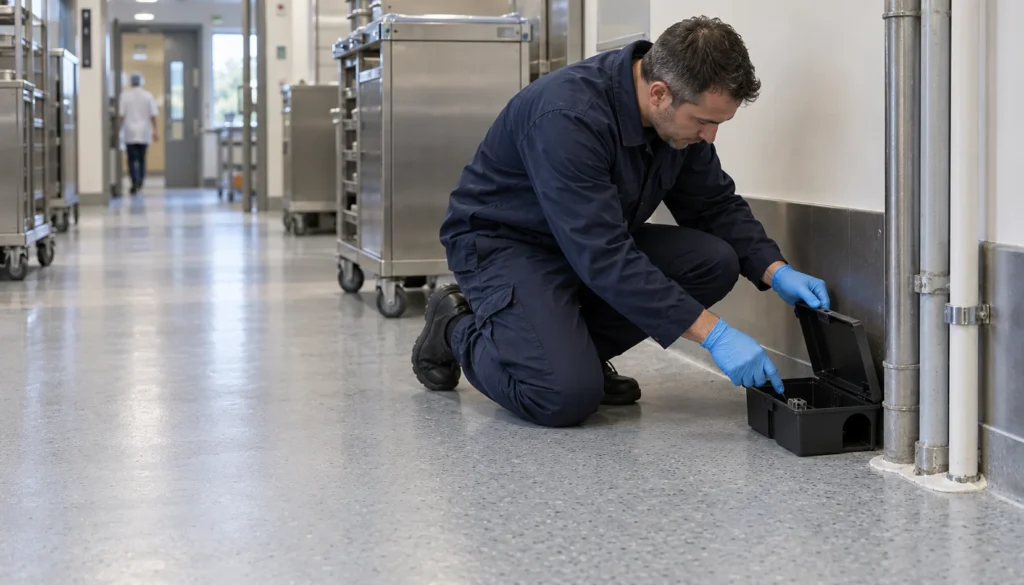
Healthcare Pest Control for Hospitals & Care Homes
Operating a clinical environment requires strict standards of hygiene, safety, and operational vigilance. Effective healthcare pest control forms a vital defence line against microbial contamination, safeguarding vulnerable patients from biosecurity hazards. Unlike standard commercial premises, healthcare settings face distinct constraints regarding biocide application, patient sensitivity, and multi-occupancy traffic. A structured programme must integrate preventative maintenance, active surveillance, and rapid non-toxic containment. This approach ensures clinical spaces remain compliant throughout the year without compromising fragile individuals.
Every ward, catering kitchen, and basement plant room presents distinct environmental variables that pests exploit for shelter, moisture, and warmth. Estates teams must balance infection control demands with strict chemical restrictions. How can managers reconcile clinical safety with the legal limits governing biocide use around vulnerable patients and care home residents?
Key Takeaways
- Clinical environments demand preventative integrated pest management to protect vulnerable patients from vector-borne pathogens whilst strictly restricting hazardous chemical biocide exposure across sensitive recovery wards.
- Pharaoh ants represent severe clinical risks because colonies split when sprayed, requiring targeted insect growth regulator baiting programmes rather than traditional residual chemical insecticide sprays.
- Rodent ingress through riser ducts, service penetrations, and false ceilings threatens sensitive medical cabling, electronic diagnostics, and sterile ward storage areas.
- Estates teams must maintain comprehensive compliance documentation, including detailed device floor plans, site-specific risk assessments, and interpreted trend reports, for rigorous regulatory scrutiny.
- Exclusion techniques, prompt structural proofing repairs, and rigorous hygiene practices provide permanent control without introducing biocide hazards into vulnerable patient recovery and treatment zones.
Clinical Vulnerability and Pest Vectors in Care Facilities
Hospitals and residential care homes operate complex estates. Medical treatment, catering, laundering, and waste management run continuously under one roof. These diverse activities create varied micro-climates that attract different pest species. Each species poses acute infection risks to immune-compromised individuals. A zoned approach aligns intervention strategies with patient vulnerability.
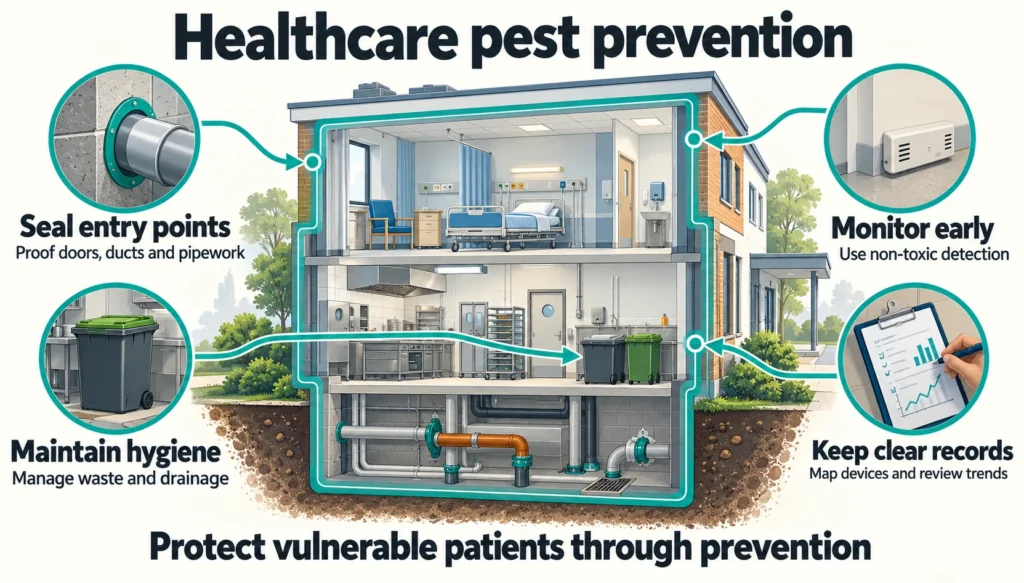
Preventative barriers must take precedence over reactive treatments. Clinical zones cannot tolerate airborne chemical mists or loose particulate poisons. Effective pest governance relies on physical exclusion, ambient monitoring, and non-chemical measures. These actions interrupt pest lifecycles before populations establish within patient wards, operating theatres, or central food production areas.
| Facility Zone | Primary Pest Threats | Standard Control Strategy |
|---|---|---|
| Ward and Clinical Areas | Pharaoh ants, bed bugs, mice | Exclusion, non-toxic monitoring, targeted gel baiting |
| Catering and Food Stores | Cockroaches, house flies, rodents | Glue-board fly units, structural proofing, strict rotation |
| Basements and Plant Rooms | Rats, mice, oriental cockroaches | Drain non-return valves, mechanical traps, barrier sealing |
| Laundry and Waste Compounds | Feral pigeons, blowflies, rats | Bin lid discipline, perimeter fencing, regular sanitisation |
Environmental Restrictions and Product Selection
Chemical Constraints Around Vulnerable Patients
Biocide use within healthcare facilities faces stringent limitations under the Control of Substances Hazardous to Health Regulations 2002. Technicians must minimise airborne particulates and volatile organic compounds around patients. Deploying low toxicity pest control in healthcare settings requires targeted non-spray formulations. Sealed gel baits neutralise pests without contaminating ambient clinical air.
Standard synthetic pyrethroid sprays can aggravate asthma and trigger allergic reactions. They may also contaminate delicate medical apparatus. Estates teams require contractors to evaluate every proposed biocide against patient proximity before application. Formulations must remain securely contained within tamper-resistant bait stations. In addition, technicians use micro-encapsulated crack-and-crevice placements. This precaution ensures active ingredients never contact bedding, curtains, or clinical worktops.
Non-Toxic Exclusion and Structural Proofing
Physical proofing provides the safest and most permanent form of pest management across care environments. Technicians inspect external building envelopes to identify structural gaps beneath doorways, around pipework, and across ventilation louvres. Sealing these entry points with wire mesh, metal plate, and specialist sealants halts pests mechanically without chemical intervention.
Preventing pest access removes the need for biocides entirely. Facilities teams should focus proofing resources on high-risk thresholds. Crucial areas include loading docks, external bin rooms, and ground-level fire escapes. Maintaining brush strips on exterior doors creates a resilient barrier. Similarly, capping disused internal service penetrations halts pest pressure from surrounding land.
Critical Pests in Care and Ward Environments
Pharaoh Ant Colonisation and Budding Hazards
Pharaoh ants thrive in heated clinical buildings, nesting deep within ductwork, heating conduits, and internal wall voids. Applying synthetic pyrethroid sprays to pharaoh ants causes a catastrophic survival response known as budding. The multi-queen colony fragments into numerous satellite nests. This defensive reaction multiplies the infestation rate across multiple wards within days.
Pharaoh ants represent a dangerous hazard in medical wards. Their tiny size allows them to penetrate sterile packs, intravenous lines, and wound dressings. Control requires a slow-acting bait matrix containing an insect growth regulator. Worker ants carry the active ingredient back into the hidden nests. This treatment eradicates the queens over several weeks without dispersing the colony.
Rodent Ingress Through Service Infrastructure
Rats and mice use complex utility routes, false ceilings, and underfloor pipe chases to navigate hospital buildings unseen. A house mouse enters through a gap no wider than a pencil. Their inquisitive foraging behaviour leads to extensive contamination of disposable supplies, sterile packaging, and ward pantry stock.
Rodent incisors grow continuously throughout life. This forces the animals to gnaw structural elements, plastic pipes, and electrical cables. Damaged insulation within electrical risers can ignite fires or disable critical diagnostic systems. Estates managers must integrate non-toxic tracking and snap traps inside secure stations. Rapid gap sealing then intercepts rodents within plant zones before they breach sterile boundaries.
Did You Know?
The Food Safety and Hygiene (England) Regulations 2013 set the penalties for hygiene offences in hospital and care home kitchens. Conviction on indictment carries an unlimited fine and up to two years’ imprisonment.
Clinical Hygiene and Infection Prevention Protocols
Pathogen Transmission via Insect Vectors
Flying and crawling insects carry harmful bacteria picked up from waste compounds, drains, and soiled linen stores. House flies, blowflies, and German cockroaches transfer pathogens onto clinical contact surfaces. They also contaminate medical carts and food preparation boards. Transmission occurs readily through mechanical contact, defecation, and digestive regurgitation.
Infection prevention teams must treat insect sightings as critical biosecurity breaches rather than cosmetic issues. Contaminated insects can transmit pathogens directly to post-operative or immunocompromised individuals. Maintaining seamless environmental seals and rigorous cleanliness schedules eliminates moisture and organic films. Without these resources, insect populations cannot survive.
Waste Handling and Kitchen Drainage Hygiene
Healthcare facilities generate substantial food, clinical, and packaging waste that serves as an immediate attractant for scavengers. External bin compactors, clinical waste holding skips, and kitchen grease traps provide continuous nourishment if left unmonitored. Waste containers must remain locked, undamaged, and sited well away from building ventilation air intakes.
Drainage networks demand equal operational attention. Organic sludge accumulating inside floor gullies, commercial dishwashing wastes, and effluent traps creates prime breeding grounds for pests. Regular biological degreasing and enzyme treatment break down organic residues. This practice eliminates the harbourage films that attract hospital and care home pests into central catering complexes.
Free Pest Control Audit Review
We will review your risk assessment, site plan, visit reports, trend analysis, open recommendations, product records and demo our AI Pest management System.
Non-Chemical Interventions and Physical Monitoring
Sticky Trapping and Non-Toxic Early Detection
Continuous monitoring relies on non-toxic sticky traps positioned systematically across ward perimeters, equipment cupboards, and plant rooms. These mapped detection devices capture crawling insects at the earliest stages of ingress. They alert estates teams to activity before physical sightings occur in patient bays. Technicians log catches during scheduled inspections.
Modern commercial programmes deploy non-toxic early-warning blocks inside rodent monitoring boxes instead of permanent toxic bait. This methodology complies with the Campaign for Responsible Rodenticide Use Code of Best Practice. Replacing permanent poisons with non-toxic monitors eliminates secondary poisoning risks to wildlife. Technicians then apply rodenticides only during verified active infestations.
Siting Standards for Electronic Fly Killers
Electric fly killers provide continuous airborne insect monitoring, but their internal positioning requires careful planning within clinical environments. Units must never sit directly above open food preparation benches, sterile packing tables, or surgical instrument trays. Flying insect units using electric grids can shatter insect fragments, scattering biological particles across surrounding surfaces.
Catering and laundry areas should utilise glue-board fly control systems fitted with shatter-resistant lamps. Glue boards retain captured flies whole, eliminating particle dispersal whilst facilitating accurate catch analysis. Technicians inspect the glue boards to identify species and quantify catch rates. This data shows whether incoming flies originate from external doors or internal structural drains.
AI Pest Management
AI pest management is pest control delivered with continuous digital monitoring and analytics rather than paper records, with real time data access across a single or multiple sites.
Proofing Priorities in Complex Medical Estates
Sealing Pipework Runs and Service Penetrations
Hospitals contain miles of retrofitted cabling, oxygen supply lines, and plumbing runs passing through fire barriers and drywall partitions. Contractors frequently leave annular gaps around newly installed pipes, creating movement highways for mice and crawling insects. Contractors must seal every service penetration flush with appropriate fire-rated, pest-resistant materials.
Technicians inspect pipe risers from the basement to the plant rooms above wards. Escutcheon plates, stainless steel wire mesh, and intumescent sealants prevent pests from using mechanical voids as transit routes. Thorough proofing restores the integrity of internal compartments. This work halts lateral pest travel between service tunnels and sterile patient accommodation.
Door Discipline and Sub-Floor Voids
External doors represent the single most common vulnerability across complex healthcare estates. High-traffic delivery entrances, ambulance bays, and staff smoking exits frequently sit propped open. This grants unhindered access to opportunistic rodents and foraging insects. Fitting heavy-duty automatic door closers and robust bristle strips ensures external thresholds remain fully impenetrable when unmonitored.
Older hospital pavilions often incorporate suspended timber ground floors over damp, unventilated underfloor voids. These sub-floor spaces contain network conduits and heating mains, offering warm, quiet harbourage for rodents. Estates managers must seal external air bricks with fine insect mesh. They should also maintain perimeter clearance and ensure inspection hatches remain tightly battened.
Regulatory Scrutiny and Inspector Expectations
Evidence Demanded During Care Quality Commission Audits
The Care Quality Commission inspects health and social care premises under fundamental standards of safety and cleanliness. Inspectors assess whether premises are clean, secure, and well maintained to protect people from healthcare-acquired infections. A documented pest programme provides essential proof of proactive environmental risk governance during regular CQC quality reviews.
An inspector checks more than visual cleanliness. They review the formal pest management register. This file must hold up-to-date contractor credentials, technicians’ RSPH qualifications, site-specific risk assessments, and emergency call-out records. Outstanding maintenance actions must show assigned operational owners and firm completion dates.
Due Diligence Records and Food Hygiene Scrutiny
Hospital kitchens and care home dining services fall under the Food Safety Act 1990. They must also comply with the Food Safety and Hygiene (England) Regulations 2013. Environmental Health Officers inspect catering premises to verify proactive pest exclusion. Recorded pest documentation forms the backbone of a facility’s statutory due diligence defence.
Catering facilities must record and retain daily sightings logs, fly killer servicing records, and mapped baiting plans. If an EHO discovers active pest activity alongside systemic documentation failures, serious enforcement actions can follow. These measures include Hygiene Improvement Notices or immediate closure via Hygiene Emergency Prohibition Notices. Consistent record-keeping proves an active preventative system operates across the catering department.
Contractor Competence and Programme Governance
Professional Qualifications and Technician Vetting
Estates departments must verify that pest management contractors possess recognised credentials and demonstrable competence. Attending technicians should hold RSPH Level 2 Awards in Pest Management. They must also maintain active BASIS PROMPT continuing professional development registration. Certification against the BS EN 16636 European standard confirms service quality, process control, and technical rigour.
Attending contractors must operate with security clearance and strict infection control adherence. Technicians need specialised training in hospital workflows. Essential competencies include isolation protocols, personal protective equipment usage, and out-of-hours servicing techniques. This preparation minimises operational disturbance to clinical teams and recovering patients.
Staff Sightings Logs and Collaborative Reporting
A successful pest management strategy depends on early reporting from on-site healthcare staff who occupy wards daily. Housekeeping and nursing personnel require a simple, blame-free mechanism to record unusual sightings, structural defects, or sanitation issues. Immediate logging enables facilities teams and visiting technicians to target investigations before minor incursions establish.
The sightings register should detail the precise time, date, location, and nature of any observed pest activity. Visiting technicians review this log first upon entering the site. They cross-reference entries against device catches and building infrastructure changes. This collaborative communication loop ensures dynamic risks receive fast corrective action, maintaining safe, compliant care environments.
Final Thoughts
Effective healthcare pest control requires a disciplined, multi-layered approach tailored to the acute sensitivities of clinical premises. Facilities teams can exclude destructive pests whilst protecting vulnerable patients from chemical hazards. They achieve this by combining structural maintenance, non-toxic monitoring, and disciplined waste management. The priority must always remain robust prevention rather than reactive eradication.
Maintaining accessible and interpreted documentation is just as vital as physical site proofing. Regulators expect clear evidence of continuous environmental oversight. Healthcare providers that implement structured, low-toxicity pest management frameworks preserve high clinical standards. This rigorous approach protects operating reputations and ensures safe environments for patient care.
Request a Free Site Survey
Frequently Asked Questions
A:
Clinical and residential care zones heavily restrict biocide sprays. This restriction protects patients with compromised immune systems, respiratory conditions, or chemical sensitivities. Chemical mists can circulate through ventilation ductwork and contaminate sensitive medical apparatus. Instead, professional pest managers employ low-toxicity strategies such as physical exclusion proofing, non-toxic monitoring stations, and enclosed bait gels. These targeted applications eliminate pest populations precisely within structural harbourages. They resolve infestations without releasing hazardous airborne compounds into vulnerable patient recovery environments.
A:
Pharaoh ants possess multiple queens within a single colony and display a survival mechanism called budding. Conventional synthetic pyrethroid sprays fracture the colony. This causes satellite queens and workers to disperse into neighbouring wall voids and wards, worsening the infestation. Control requires slow-acting insect growth regulators blended into protein or carbohydrate bait matrices. Foraging worker ants collect this attractive bait and carry it deep into internal harbourages. Feeding the queens this active ingredient successfully eradicates the entire colony without scattering.
A:
Care Quality Commission inspectors require proof of a comprehensive, proactive pest management system that supports infection control and patient safety. Estates managers must present an up-to-date site folder. It should contain a pest risk assessment, dated bait floor plans, and completed inspection logs. The documentation must prove the competence of attending personnel through RSPH qualifications. It must also show that any identified pest activity received rapid remedial investigation. Attaching close-out evidence to all recommendations demonstrates rigorous operational governance.
A:
Traditional electronic fly killers employ high-voltage electrocution grids. These grids cause exploding insect bodies to scatter contaminated fragments, hairs, and bacteria across several metres. In hospital catering environments, this fragmentation creates a severe risk of direct microbial contamination onto preparation surfaces and patient trays. Units equipped with adhesive glue boards capture flying insects silently and intact. This design contains all pathogens, prevents physical food contamination, and enables technicians to identify species accurately. Technicians can then calculate catch trends to address root breeding sources.
A:
Healthcare estates must operate an accessible, blame-free sightings log where nursing, catering, and domestic staff can immediately document pest observations. Each entry must record the exact date, time, specific room or ward location, and a description of the pest seen. When the visiting pest technician arrives, they inspect this log before walking the facility. This allows them to investigate reported hotspots directly. Recording subsequent technician actions and proofing completions ensures full transparency. This closes the corrective action loop for audit and regulatory inspections.
By choosing Shield Pest Management, you’re partnering with a company that combines local expertise with industry-leading practices. Our commitment to quality, compliance, and customer satisfaction makes us an ideal choice for both residential and commercial pest control needs.
