
Hospitality Pest Control for Hotels and Pubs
Guest confidence rests on standards that hold across dining rooms, bars and bedrooms. Hospitality pest control underpins all of them. It protects your food hygiene rating and shields the brand from public scrutiny. One sighting in a restaurant or guest room can undo years of goodwill. Structural proofing, routine technician visits and disciplined hygiene remove that risk before guests ever encounter it.
High footfall, constant food preparation and daily deliveries make prevention harder than it looks on paper. Meeting statutory duties whilst keeping the customer environment immaculate takes clear procedures and professional oversight. Are your kitchen routines, cellar controls and bedroom inspection protocols strong enough to survive an unannounced Environmental Health Officer visit?
Key Takeaways
- A single guest sighting can cause lasting reputational damage online, which makes planned prevention far cheaper than managing the fallout afterwards.
- Kitchens and cellars need robust proofing, regular drain maintenance and strict waste control to remove the harbourage that draws pests in.
- Environmental Health Officers expect documented monitoring, current site plans and closed-out corrective actions as evidence of active due diligence.
- Bed bugs arrive on luggage rather than through poor housekeeping, so rapid multi-room inspection prevents spread and avoids costly room downtime.
- Servicing outside core trading hours keeps compliance work invisible to guests and avoids drawing attention to monitoring devices in public areas.
Core Pest Risks Across Hospitality Operations
Hotels and pubs face different biological threats in different parts of the building. Kitchens, cellars, bedrooms and public areas each carry their own pressures. Clear control zones stop a minor ingress problem becoming a full infestation. The table below sets out the species we encounter most often in hospitality, where they harbour and what they cost the business.
Each department creates its own conditions. Cellars stay cool and damp, which suits oriental cockroaches and drain flies. Cooking lines stay warm, which suits mice and German cockroaches. Bedrooms carry no food at all, yet remain the highest reputational risk of the lot. Generic treatment schedules miss this entirely, so controls must be matched to the zone.
| Pest Type | Primary Harbourage Area | Operational Risk |
|---|---|---|
| Rats and mice | Kitchen voids, basements, bin stores | Food contamination, cable damage, enforced closure |
| German cockroaches | Warm equipment voids, motors, crevices | Allergen spread, pathogen transfer, failed audits |
| House and fruit flies | Drip trays, refuse areas, open food lines | Bacterial transfer to food, customer complaints |
| Bed bugs | Mattress seams, headboards, bed frames | Guest complaints, negative reviews, room downtime |
| Stored product insects | Dry goods stores, opened flour sacks | Ingredient spoilage, stock write-off, hygiene breaches |
Commercial Consequences of Pest Sightings
Reputational Damage and Online Review Exposure
A single pest sighting can undo years of goodwill in a hospitality venue. Guests photograph what they see. Those images reach review platforms and social feeds within minutes. In practice, the cancellations that follow cost far more than a full year of preventative servicing would ever cost the business.
Public perception in food service and accommodation rests on visible cleanliness. When vermin appear in a dining room or bedroom, customers question what happens behind the kitchen door. That inference is reasonable and hard to argue against. Rebuilding trust afterwards takes months of marketing spend and careful public relations. Prevention protects commercial standing before any of that becomes necessary.
Food Hygiene Rating Downgrades and Enforcement
Local authority inspectors assess pest control directly when they set your published Food Hygiene Rating. Officers examine storage areas, proofing integrity and your documentation. Evidence of live rodent or insect activity can drop the score immediately. That published figure then tells every prospective customer what the inspector found.
A downgrade bites hardest in competitive urban markets where diners compare ratings before booking. Enforcement can escalate quickly. Under the Food Safety and Hygiene (England) Regulations 2013, officers may serve a Hygiene Improvement Notice. Where pests pose an imminent risk to health, a Hygiene Emergency Prohibition Notice closes the premises on the spot. Unplanned closure stops trade and attracts local press attention.
High-Risk Zones in Hospitality Buildings
Commercial Kitchens and Food Preparation Lines
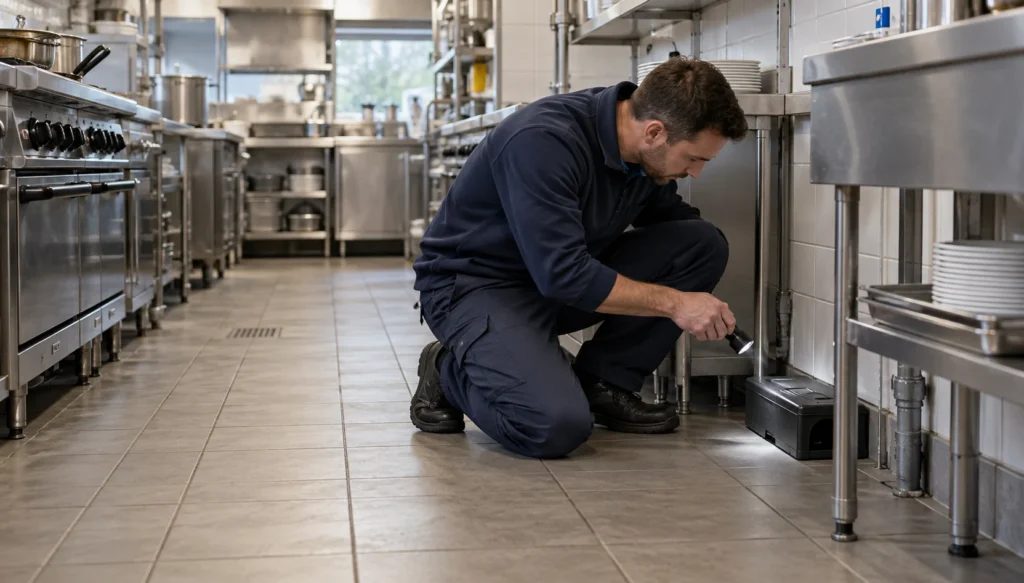
Commercial kitchens give pests warmth, moisture and organic residue in one place. Heavy catering equipment makes much of it unreachable. Cooker ranges, refrigeration motor housings and prep stations shelter German cockroaches and mice. Cleaning regimes and physical inspections must reach those recesses, because surface cleaning alone never disturbs an establishing population.
Food debris collects in the voids beneath cooking suites. Nightly cleaning rarely reaches that far. Grease films and organic matter then sustain insects indefinitely. From experience across the sector, scheduled deep cleans combined with non-toxic sticky traps detect crawling insect movement early. Sealing structural cracks and splashbacks removes the cavity routes pests use to nest inside walls.
Cellars, Bar Drip Trays and Waste Stores
Pub cellars and external refuse stores attract pests heavily and need rigorous sanitation. Beer line spillage, damp barrel storage and fermenting drip tray residue draw drain flies, fruit flies and oriental cockroaches. External bin compounds feed rodents continuously unless all waste sits inside sealed, lidded commercial containers with intact lids.
Waste discipline governs external rodent and fly pressure more than any other factor. Position bins away from delivery doors. Service compactors frequently rather than when they overflow. Inside the bar, unwashed drip trays and standing wash water sustain fruit fly populations week after week. Clearing beverage lines and sanitising floor drains each night breaks the breeding cycle.
Did You Know?
Breaching food safety and hygiene regulations is triable either way in England and Wales. On indictment the court can impose an unlimited fine and up to two years’ imprisonment.
Practical Hotel and Pub Pest Management
Preventative Controls in Customer Areas
Effective hotel and pub pest management depends on exclusion rather than reactive chemical treatment. An Integrated Pest Management framework gives operators a structured way to monitor risk points and intervene only when the evidence justifies it. That approach suppresses hazards whilst keeping chemical use away from food preparation and guest dining areas.
Integrated Pest Management balances hygiene, mechanical exclusion and routine surveillance. Defined action thresholds matter here. They tell the technician when a rising count warrants investigation, well before a visible infestation develops. Most hospitality venues have now removed permanent external toxic baiting in line with Campaign for Responsible Rodenticide Use standards. Non-toxic monitoring blocks provide the early warning instead.
Physical Proofing and Envelope Exclusion
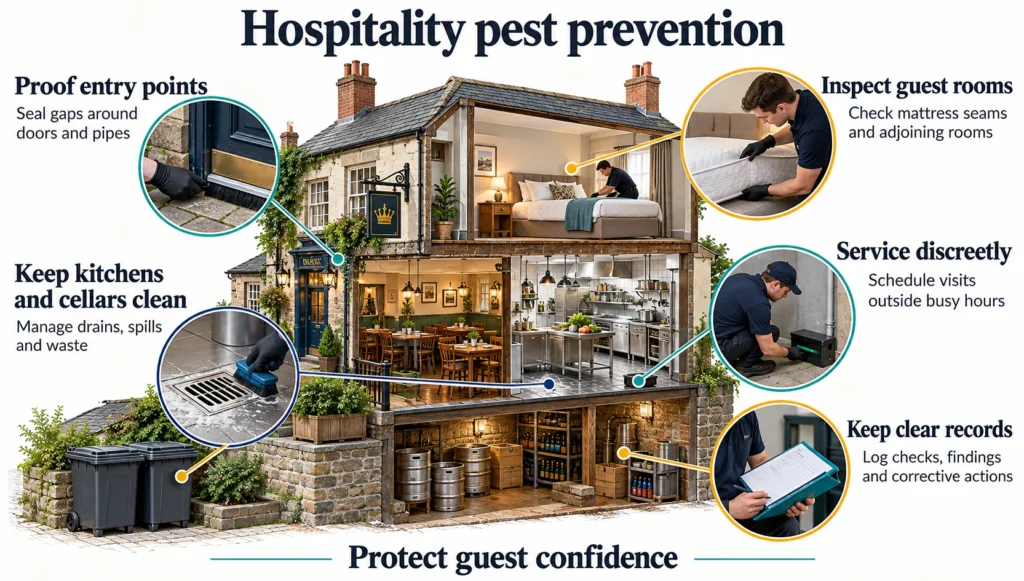
Physical exclusion remains the most durable defence against rodents and insects entering from outside. A mouse passes through a gap no wider than a pencil. Door sweeps and cable entry seals therefore earn their cost quickly. Heavy-duty brush strips on delivery doors and sealed pipework penetrations block the common service yard routes.
Envelope integrity usually fails first at loading bays, cellar drop doors and kitchen extract vents. Staff then undermine the investment by propping doors open during summer shifts and busy delivery windows. Management must enforce door discipline alongside the maintenance programme. Wire mesh in damaged floor gullies and non-return drain valves close the underground route brown rats favour.
Free Pest Control Audit Review
We will review your risk assessment, site plan, visit reports, trend analysis, open recommendations, product records and demo our AI Pest management System.
Bed Bug Protocols for Hotel Accommodation
Room Inspection Sequences and Early Indicators
Housekeeping teams need structured training to spot bed bugs during changeovers. Inspections must cover mattress seams, headboard fixings and bed frame crevices. Staff look for dark faecal spotting, cast skins and live insects. Early detection isolates a small introduction before the insects move through wall conduits into adjoining bedrooms.
Bed bugs reach hotels on guest luggage, clothing and bags. They are not a housekeeping failure, and treating them as one guarantees late reporting. A blame-free reporting culture encourages room attendants to flag faint signs without fear of reprimand. Passive monitors fitted discreetly beneath bed legs detect low-level activity and confirm that a room remains clear between stays.
Treatment Programmes and Adjacent Room Containment
Treating one affected bedroom in isolation almost always produces a recurrence. Professional protocols require immediate inspection of the rooms beside, above and below the reported site. That containment boundary stops dispersing insects establishing secondary harbourage elsewhere in the accommodation block, which is where most prolonged infestations begin.
Operators generally choose between thermal remediation and a targeted residual insecticide programme. Heat treatment raises room temperature to lethal levels and kills every life stage, eggs included, in a single day. Insecticide programmes need staged visits to catch nymphs as eggs hatch. Contaminated linen must be bagged inside the room, which prevents insects dropping in corridors.
AI Pest Management
AI pest management is pest control delivered with continuous digital monitoring and analytics rather than paper records, with real time data access across a single or multiple sites.
Flying Insect Control in Catering Areas
Breeding Source Elimination at Drains and Waste
Flying insect control starts by removing internal breeding reservoirs, not by adding more catch units. House flies and blowflies exploit exposed meat scraps, open waste bins and uncleaned floor drains. They reproduce quickly in all three. Removing damp organic matter denies them the sites they need to breed at all.
Flies carry Campylobacter and Salmonella between contaminated surfaces and prepared food. One fly landing on an open buffet or plating line is an unacceptable contamination event in any catering operation. Drain flies breed in the biofilm lining drainage channels. Deep cleaning those channels with a biological foam digests that film and delivers control that actually lasts.
Electric Fly Killer Siting and Maintenance
Electric fly killers earn their place when sited correctly, both as a control and as a monitoring tool. Units must never sit directly above open food preparation surfaces. They should not be visible from external doorways either. Siting away from competing light sources gives maximum attraction without drawing outdoor insects inside.
Most modern kitchens now specify glue board units rather than electrocution grids, because grids scatter insect fragments across preparation zones. Ultraviolet lamps lose output gradually and need scheduled annual replacement. Waiting for a tube to fail completely leaves you with an ornament. Catch tray analysis also tells you whether captured species came from internal drains or external waste.
Discreet Servicing for Front-of-House Spaces
Scheduling and Unobtrusive Attendance
Professional hospitality pest control relies on discreet pest control for hospitality venues, so guests and diners never register that it happened. Technicians attend before opening, early in the morning, or in the quiet window between breakfast and dinner service. Unbranded clothing and plain vehicles keep preventative work invisible to the paying public.
Discretion protects the guest experience and the venue reputation at the same time. Technicians coordinate with the duty manager and work through public bars, restaurant seating and bedroom corridors without crossing customer routes. Out-of-hours attendance also produces better inspections. Nobody is working the pass, so the technician can check the areas that matter properly.
Monitoring Device Placement in Public Areas
Monitoring devices in guest-facing areas must stay out of public sightlines and remain easy for the technician to reach. Traps sit behind bar kicks, beneath fixed banquette seating or inside service ducts. Numbering every device against a current layout plan keeps servicing systematic and avoids drawing attention during routine visits.
Tamper-resistant stations protect the public in shared areas and stop children or pets reaching the non-toxic lure inside. Technicians place devices along habitual rodent runs, such as perimeter skirting and pipe chases, rather than in open floor space. Digital barcoding speeds up each check, which keeps dwell time in guest areas to a minimum.
Statutory Requirements and Audit Documentation
Food Safety Legislation and Statutory Duties
UK food businesses must keep premises free of pests under the Food Safety and Hygiene (England) Regulations 2013. The legislation requires adequate pest control procedures, clean premises and sound structural maintenance. Failure invites a Hygiene Improvement Notice, substantial fines, or an emergency prohibition order that closes the business outright.
Section 3 of the Prevention of Damage by Pests Act 1949 adds a further duty. Occupiers must notify the local authority when rats or mice resort to the premises in substantial numbers. Operating without a robust pest management regime leaves owners exposed on both counts. A professional contract evidences compliance and stands up to routine environmental health audit.
Records for a Due Diligence Defence
The due diligence defence under the Food Safety Act 1990 depends entirely on your records. Operators must hold an accessible on-site compliance file. It needs technician reports, product safety data, risk assessments and floor plans. Those documents prove the business took all reasonable precautions to prevent contamination.
An audit-ready file logs every inspection, every recorded finding and every proofing recommendation. Trend analysis matters just as much. It shows the inspector that management reads activity patterns and acts on structural faults rather than filing reports unread. An active staff sightings log completes the picture and evidences a food safety culture that functions day to day.
Final Thoughts
Consistent hospitality pest control demands commitment across every department, not just the kitchen. Pubs and hotels absorb constant pressure from deliveries, guest turnover and ageing building fabric. Moving from reactive treatment to disciplined Integrated Pest Management protects the hygiene rating and the customer relationship together. Exclusion, staff awareness and hygiene discipline keep risk away from guest-facing areas.
Public transparency around hygiene standards continues to increase, and unannounced inspection remains a fact of the trade. Structured documentation and discreet servicing are therefore operational necessities rather than refinements. Venues that build prevention, monitoring and fast corrective action into daily routine protect their reputation and their revenue year after year.
Request a Free Site Survey
Frequently Asked Questions
A:
An Environmental Health Officer will ask for your full pest management file. It must hold the current service contract, a site-specific risk assessment and an up-to-date plan showing every numbered monitoring device. You also need COSHH safety data sheets for any products used, written technician reports and evidence that corrective actions were closed out. Officers look for an active staff sightings log and trend analysis too, because both show the venue reviews biological risk rather than simply filing paperwork.
A:
Frequency should follow documented risk, not habit. Commercial kitchens, busy bars and high-turnover hotels usually warrant monthly visits because food preparation and deliveries never stop. Lower-risk areas may need only quarterly attendance. Complex multi-kitchen sites sometimes justify fortnightly checks. If activity is found, or the building fabric changes, attendance must increase until control is re-established. Record the reasoning in your site risk assessment so any change in frequency is formally justified.
A:
Yes, and in hospitality it routinely is. Contractors schedule preventative visits during low-occupancy windows to preserve discretion. Technicians attend before breakfast service, between lunch and dinner seatings, or during planned maintenance hours. Vehicles can be unbranded and entry is made through back-of-house doors. In dining rooms and bedroom corridors, monitoring stations sit beneath banquettes or behind panels. Guests notice nothing, yet every critical risk zone still receives a thorough physical inspection.
A:
No. Bed bugs are not an indicator of poor hygiene. They arrive by passive transport on guest luggage, clothing and personal belongings. Five-star hotels experience introductions for the same reason, because international travel volume drives the risk. What separates a well-run property is detection speed and containment. A blame-free reporting culture encourages room attendants to report faecal marks or cast skins early, which allows isolation and treatment before the problem reaches adjacent rooms.
A:
Contain the area first. Stop food preparation in the affected zone, dispose of any exposed ingredients and sanitise all surrounding work surfaces. Record the sighting in your pest file, then call your pest management technician for a targeted investigation. Check the building envelope, internal pipe penetrations and drainage routes to find the entry point, and seal any gaps found. Keeping a clear written record of each step also supports your due diligence position afterwards.



By choosing Shield Pest Management, you’re partnering with a company that combines local expertise with industry-leading practices. Our commitment to quality, compliance, and customer satisfaction makes us an ideal choice for both residential and commercial pest control needs.
