
Squirrel Removal
A squirrel in a roof is not a noise problem. It is gnawed cables, soaked insulation and a fire risk, and it will keep returning to a roof it knows until the way in is closed.
What Happens
A technician confirms it is squirrels rather than rats or birds, finds the entry point, and works out whether there is a drey and young inside. Control is trapping, because there is no poison approved for grey squirrels in the UK. Traps are sited on the runs the animals are actually using, in the roof space and at the entry point, and live-capture traps are checked at least daily under the Animal Welfare Act.
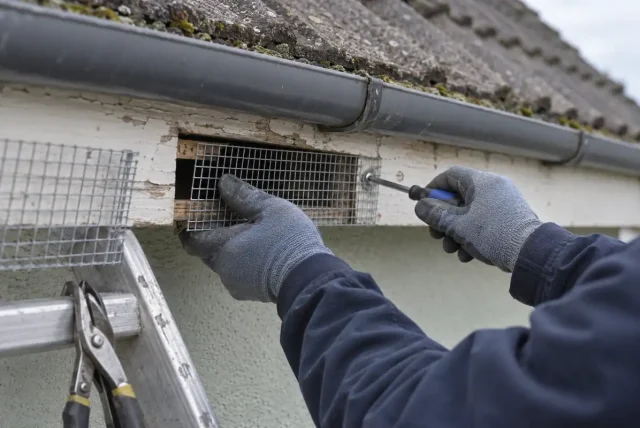
Spring traps are the approved patterns only, set in a tunnel so nothing else can reach them. Once the roof is clear the entry point is proofed in metal mesh or fitted with the right detail for that roof line, because a squirrel that has lived in a roof will chew its way back into it through anything softer. The visit is written up with what was caught, where, and what proofing was done.
Where They Get In
Squirrels climb and jump rather than crawl, so the survey starts at roof level and works down. A gap the size of a fist is plenty.
The commonest route by a distance. Squirrels jump several feet, so a branch or a service cable near the roof is a bridge onto the building.
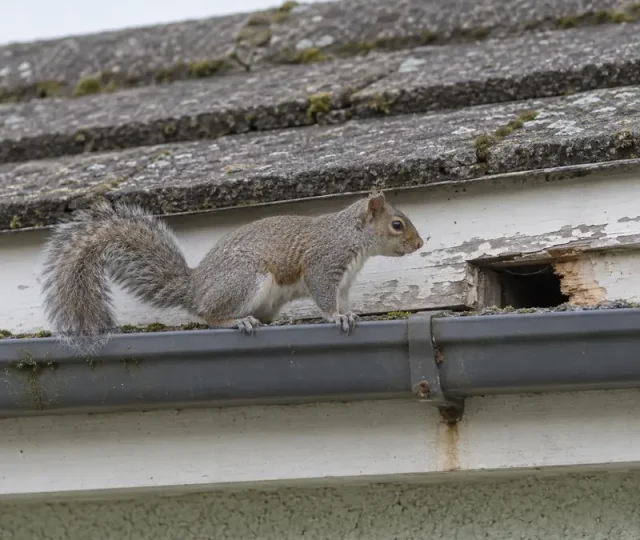
Rotten or lifted timber at the eaves, and the open gap where a bargeboard meets the tiles at a gable end.
A displaced tile or a gap at the ridge gives direct access to the roof space, and squirrels will enlarge an opening that is nearly big enough.
Uncapped chimneys, open flues and unmeshed vents, all of which admit birds and bats as well and need proofing that accounts for that.
Box gutters, cladding ends and the junction between a flat roof and a wall, which are common on commercial units and rarely inspected.
Detached buildings with open eaves or a gap under the roof sheet, often used as a route to the main roof rather than as the nest itself.
How We Work
Squirrel, rat, bird or bat sound similar through a ceiling and are four different jobs. Bats are protected and stop the work entirely until a licensed ecologist is involved.
Trapping an adult while young are left behind in the roof creates a welfare problem and a smell problem. The timing of the work depends on what is up there.
Approved traps, sited on the runs, in tunnels where required, and live traps checked at least once every day as the law requires.
Metal mesh and the right detail at the entry point, plus the branch or cable that gave access. Trapping without proofing is a job you do again next year.
The Law
The grey squirrel is a non-native invasive species, and under the Wildlife and Countryside Act 1981 it is an offence to release one into the wild or to allow one to escape. That is the part most people do not know: a squirrel caught alive in a loft cannot legally be driven to a wood and released, and any contractor who offers to do that is committing an offence on your behalf. A live-caught grey squirrel must be dispatched humanely, which is what Shield does, under the Animal Welfare Act and to BPCA best practice.
Red squirrels are the opposite case entirely, fully protected, and while they are rare across most of Yorkshire the identification matters before anything is set. Bats in a roof space stop the job outright until a licensed ecologist has been involved. None of this makes the work difficult, but it does mean it has to be done by somebody who knows which animal they are looking at.
Commercial
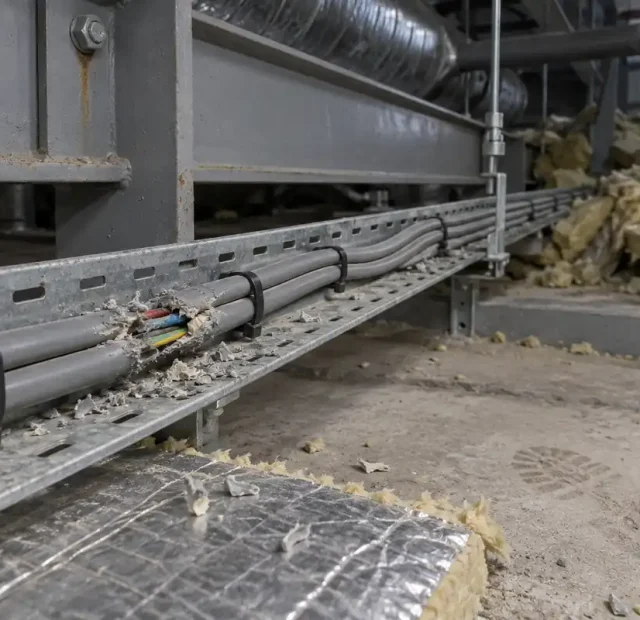
Squirrels gnaw constantly because their incisors never stop growing, and in a commercial roof space the things worth gnawing are cables, data runs, insulation and water pipes. That puts the risk somewhere most pest problems do not sit: fire, an outage across a floor, a soaked ceiling over a server room.
Schools, care homes and older estate buildings are the sites we see most, because they combine mature trees close to the building with roof lines that have been patched rather than replaced. Shield surveys the whole roof line rather than the one noise complaint, traps to clear the population, proofs the access, and raises the tree work and fabric items that will otherwise put the next one back in the same place. On a contracted site it is logged and tracked to close-out like any other recommendation.
Identification
Squirrels are active in daylight, particularly early morning and late afternoon, and the noise is heavy: rolling, thumping, scrabbling, sometimes something being dragged. Rats are quieter, faster and mostly nocturnal, and mice are lighter again and almost constant.
Squirrel damage is coarse, meaning stripped cable, chewed timber and insulation gathered into a drey, where rodents leave droppings, smears along runs and finer gnawing. Squirrels also come and go through one obvious hole near the roof line, while rats usually arrive from below through drainage and the fabric. If you are not sure, that is fine: the survey settles it before anything is set, and it needs to, because the trap, the law and the proofing are all different.
Domestic
Most domestic calls start the same way: scratching and thumping overhead in the morning, usually in autumn or late winter when squirrels move into roofs. By the time it is loud enough to call somebody there is normally insulation pulled into a drey and at least some cable damage. The work is trapping, then proofing the entry point in mesh, then dealing with the branch that made the roof reachable.
What we cannot do is take one away and release it. What nobody should do is block the hole while an animal is inside, which traps it in the roof and turns a pest problem into a welfare problem and a smell you will be living with for weeks.
AI Pest Management
Squirrel work is legally sensitive and welfare sensitive, which makes the record part of the job rather than an afterthought. Insectram holds the trap positions on the site plan, the date and outcome of every check, the proofing raised with a photograph and an owner, and the tree or fabric work that needs to follow.
On a contracted site an auditor or a facilities manager can see the whole sequence without asking anyone for it.

Areas We Cover
Based in Selby, Shield covers commercial and domestic property across Yorkshire, the Humber and the North of England. Independent since 2002, BPCA registered, CRRU compliant, £10m public liability, 24-hour emergency response.
A: No, and nor can anyone else. The grey squirrel is a non-native invasive species, and releasing one into the wild or allowing one to escape is an offence under the Wildlife and Countryside Act 1981. A live-caught grey squirrel has to be dispatched humanely, which is what we do, under the Animal Welfare Act and to BPCA best practice. Anybody offering to relocate one for you is offering to break the law on your behalf.
A: The timing is the best clue. Squirrels are active in daylight, especially early morning and late afternoon, and the noise is heavy and rolling. Rats are mostly nocturnal, lighter and faster. Squirrel damage is coarse, meaning stripped cable, chewed timber and insulation dragged into a drey, while rodents leave droppings and smears along their runs. The survey settles it properly, and it matters, because the trap, the law and the proofing are all different.
A: Trapping is usually days rather than weeks, depending on how many animals are using the roof and whether there is a drey with young, which changes the timing. The part that decides whether it is permanent is the proofing afterwards: mesh at the entry point and, where it applies, cutting back the branch or dealing with the cable that made the roof reachable. Trapping without proofing buys you a season.
Cookies on this site
We use strictly necessary cookies to make this site work. With your permission we would also like to use analytics cookies to see how the site is used so we can improve it. You can change your choice at any time. See our cookie policy.