
Facilities Management
Facilities managers rarely have a pest problem. They have a reporting problem, a responsibility problem and a consistency problem across buildings they did not design. Shield runs portfolios as one programme with one point of contact, and gives you the evidence at whichever level you are being asked for it.
At a Glance
Pest control under a facilities management contract is a single programme covering buildings with different uses, different tenants and different risk levels, delivered to a consistent standard and reported at portfolio, site and point level.
It has to cope with shared services and voids, catering inside otherwise low-risk buildings, waste compounds, external grounds and roofs, and a responsibility line that runs between freeholder, managing agent and occupier. The output an FM needs is not a service sheet. It is a defensible record for each building and a view across all of them.
Across the Portfolio
Very few FM portfolios are one building type. The same programme has to work in an office with a staff canteen and in a distribution unit two miles away, without being written twice.
Shared risers, ceiling voids and service corridors mean activity in one demise is rarely contained to it. Monitoring is planned around the building, not the lease plan.
A staff restaurant or coffee offer changes the risk profile of an entire office. It needs food-grade controls and records inside a building that otherwise does not.
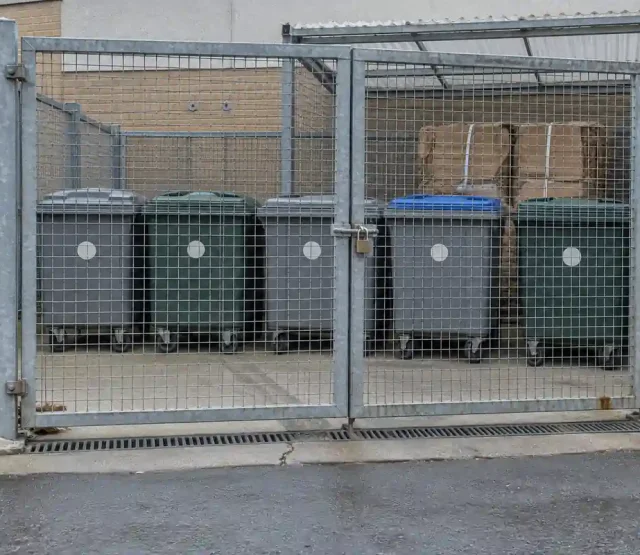
The highest-pressure point on most commercial estates, and the one furthest from anyone’s job description. Compound design, collection frequency and housekeeping do more than baiting ever will.
Long unoccupied periods, wide public access, food provision and a very low tolerance for visible control equipment.
Public footfall, external seating, litter and gull pressure, with the reputational cost falling on the managing agent rather than the tenant.
The parts nobody walks. Bird fouling on plant and access routes is a health and safety issue as much as a pest one.
The Programme
Every building gets its own risk assessment and monitoring density, written to one standard, so a warehouse and a head office can still be compared.
A named account contact and a consistent technician team, rather than a different branch and a different process for each address on the portfolio.
Point, building, area or whole portfolio. An FM is usually answering to a client about one site and to a board about all of them, in the same week.
Sightings logged by anyone on site, routed to the right building and visible to you and to us straight away, without a phone call or a chased email.
A 24-hour emergency call-out across the portfolio, with the same technicians who service it, so nobody arrives without already knowing the building.
Risk assessment, plan, service history, COSHH and RAMS against each address, so a tenant, an auditor or an incoming client gets exactly what relates to them.
Building Types
Audit-compliant programmes for BRCGS, SALSA and retailer specifications, where a pest non-conformance can suspend supplier approval.
Large footprints, constant vehicle movement and stored product risk across racking, yards and loading bays that stay open all day.
Process heat, machinery voids and shift patterns that leave little window for service work or for the proofing repairs that follow.
Kitchens, waste and public areas, with fly management and reputational risk front and centre.
Vulnerable occupants, discreet control equipment and access that has to work around teaching and clinical timetables.
Public footfall, shared service areas, public access areas, food stores, bin stores and bird pressure on roofs and canopies.
Responsibility
The Prevention of Damage by Pests Act 1949 places the notification duty on the occupier: section 3 requires the occupier of land to notify the local authority in writing, forthwith, if it comes to their knowledge that rats or mice are living on or resorting to the land in substantial numbers, with agricultural land excepted. Enforcement is wider. Under section 4, where a local authority considers steps should be taken, it may serve notice requiring reasonable steps on the owner or the occupier. So a managing agent cannot assume a tenant issue stays with the tenant.
In practice the split is settled by the lease and the service charge: common parts, external areas, roofs, drainage and shared voids almost always sit with the landlord or managing agent, while the demised area sits with the occupier, and activity moves freely between the two. Shield’s position is to survey the whole building, report by demise, and make the boundary explicit in the documentation rather than leave it to be argued after an infestation.
Our Method
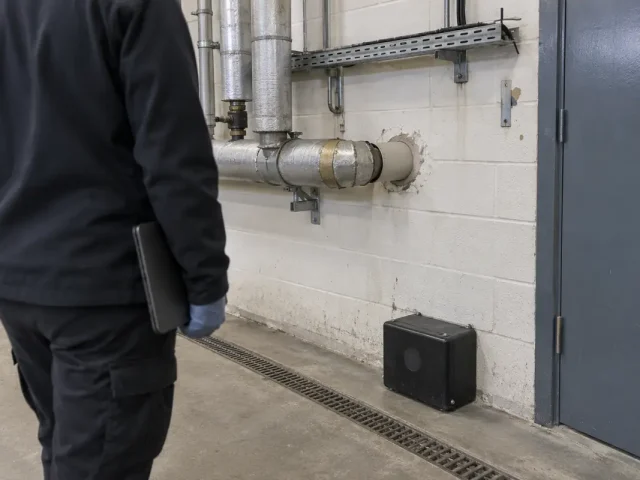
A field biologist surveys each building in the portfolio, writes a risk assessment per address and sets monitoring density and visit frequency by building rather than by contract value. Points are installed, numbered and mapped, and every building is set up in Insectram with its own documentation and its own access for the site team.
Reporting is configured so you can cut activity by point, building, area or portfolio. At ninety days you have a comparable picture across every address, a closed-out action list and a clear view of which buildings carry the real pressure.
AI Pest Management
Multi-site is where the portal stops being a convenience. Insectram holds every building’s plan, numbered points, service history, recommendations and documents, and lets you read them as a portfolio or as a single address. Trend data cuts by point, department, area, site or the whole estate, so you can see which buildings are driving activity rather than which ones complained loudest. Tenants and site teams can be given access to their own building only.
Recommendations carry an owner and a date, which is what turns a proofing issue into a closed action rather than a recurring line in a report.

Pests We Manage
Risers, voids, drainage and bin compounds
Roofs, plant, canopies and public frontages
Roof voids, grounds and external seating
Kitchens, waste areas and staff restaurants
Floor joints, kitchens and welfare areas
Warm plant rooms, kitchens and laundry
Residential demises and student accommodation
Lofts, roof spaces and grounds
Client Feedback
“Shield’s audit compliance support for our BRCGS certification has been invaluable. Their knowledge of the standards has made our audits much more streamlined.”
Food Manufacturing
“Shield’s pest awareness training for our food production team was fantastic. The course was informative, engaging, and tailored to our specific needs.”
Food Production
“We’ve been using Shield’s Insectram reporting system and it has changed how we manage pest control. Real-time updates and trend analysis keep us proactive.”
Multi-site Facilities
Areas We Cover
Based in Selby, Shield services managed estates, multi-tenant offices, schools, leisure sites and mixed portfolios across Yorkshire, the Humber and the North of England. Independent since 2002, BPCA registered, £10m public liability, 24-hour emergency response across every building on the contract.
A Shield field biologist will walk a representative sample of your buildings, tell you where the real pressure is across the estate, and set out what one consistent programme would look like against what you have now. No obligation.
A: Both, in different ways. Under the Prevention of Damage by Pests Act 1949 the notification duty sits with the occupier: section 3 requires them to tell the local authority in writing, forthwith, if rats or mice are living on or resorting to the land in substantial numbers. But section 4 lets a local authority serve notice requiring reasonable steps on the owner or the occupier, so a managing agent is not insulated. Beyond that it is a lease question. Common parts, roofs, drainage, external areas and shared voids normally sit with the landlord or managing agent, and the demise with the occupier. Because activity moves between the two, the workable answer is to survey the whole building and report by demise.
A: Yes, and it should. What has to be consistent is the standard: a written risk assessment per building, the same reporting structure, the same escalation route and one point of contact. What has to differ is the programme itself. A distribution unit, a multi-tenant office with a staff restaurant and a primary school need different monitoring densities and visit frequencies, and an FM contract that gives them the same one is either overspending on the low-risk buildings or exposed on the high-risk ones.
A: Access in Insectram is set per building, so a tenant or a site team sees their own address and nothing else, while you see the portfolio. Sightings can be logged by anyone on site and are routed to the right building automatically, which removes the phone call to the helpdesk and puts a timestamp on when the issue was actually first reported.
Cookies on this site
We use strictly necessary cookies to make this site work. With your permission we would also like to use analytics cookies to see how the site is used so we can improve it. You can change your choice at any time. See our cookie policy.