
UK Food Premises Pest Control Requirements
Every commercial kitchen, bakery and cold store in the UK works under statutory hygiene law. Food premises pest control requirements sit at the centre of that duty. A single rodent sighting can halt production. It can also cost a Food Hygiene Rating overnight. Enforcement officers expect prevention rather than reaction.
Environmental Health Officers now look for hard evidence. They read service reports, sightings logs and corrective action records. They test your proofing with their own eyes. Would your site plan, your pest file and your building fabric stand up to an unannounced inspection tomorrow?
Key Takeaways
- Food law requires adequate pest procedures, so proofing, monitoring and written records all count as evidence of compliance.
- Officers check ingress gaps, drainage, waste areas, fly killer condition and the cleanliness behind fixed kitchen equipment.
- Pest control works as a HACCP prerequisite programme rather than a critical control point within the plan.
- Permanent outdoor toxic baiting is no longer acceptable, so non-toxic monitoring and physical proofing carry the load.
- A dated site plan, corrective action log and interpreted trend analysis form the backbone of due diligence.
Compliance Pillars Every UK Food Business Must Maintain
Food law sets out what must be achieved, not how to achieve it. In practice, compliance rests on five pillars. Each one carries its own evidence trail. Officers rarely assess them in isolation. Weak proofing undermines strong paperwork, and strong paperwork cannot excuse an open loading bay door.
The table below maps each pillar to its purpose and its legal driver. Use it as a self-assessment before your next visit. From experience across the sector, most enforcement action traces back to one of these five areas. Waste handling and building fabric are frequent triggers for improvement notices.
| Compliance Pillar | Primary Objective | Regulatory Driver |
|---|---|---|
| Building proofing | Deny physical entry to rodents, birds and insects | Regulation 852/2004, Annex II |
| Monitoring programme | Detect activity early using mapped, numbered devices | Integrated pest management practice |
| Due diligence records | Evidence continuous, proactive control | Food Safety Act 1990, Section 21 |
| Waste and hygiene control | Remove food sources and internal harbourage | Food Safety and Hygiene (England) Regulations 2013 |
| Staff reporting | Capture sightings between technician visits | HACCP prerequisite programme standards |
UK Food Law and the Duties It Places on Operators
Statutes That Govern Pest Control in Food Premises
Two instruments carry most of the weight. The Food Safety Act 1990 sets the offences and the defences. The Food Safety and Hygiene (England) Regulations 2013 enforce the retained hygiene rules. Together they require premises to stay clean, sound and free from pests. Adequate control procedures are mandatory, not advisory.
Scotland, Wales and Northern Ireland apply equivalent regulations under their own statutory instruments. The underlying hygiene requirements remain the same. Annex II of Regulation 852/2004 requires adequate procedures to control pests across layout, equipment and storage. Section 3 of the Prevention of Damage by Pests Act 1949 adds a further duty. Occupiers must notify the local authority when rats or mice are present in substantial numbers. The Act does not define that phrase, so judgement falls to the operator.
Enforcement Powers, Notices and Penalties
Local authorities hold graduated enforcement powers. An authorised officer can issue a Hygiene Improvement Notice requiring named works within a stated period. Where activity presents an imminent risk to health, a Hygiene Emergency Prohibition Notice closes the premises immediately. The court must then confirm that closure. Officers also use informal written warnings.
Prosecution is the end of the ladder, not the start. Repeat failures can lead to a Hygiene Prohibition Order against the business or the individual running it. Section 21 of the Food Safety Act 1990 offers a due diligence defence. It protects operators who took all reasonable precautions and exercised all due diligence. That defence lives or dies on your records. In practice, we find that contemporaneous paperwork decides the outcome long before anyone reaches court.
What an EHO Checks for Pest Control in Food Premises
External Ingress Points and Building Fabric
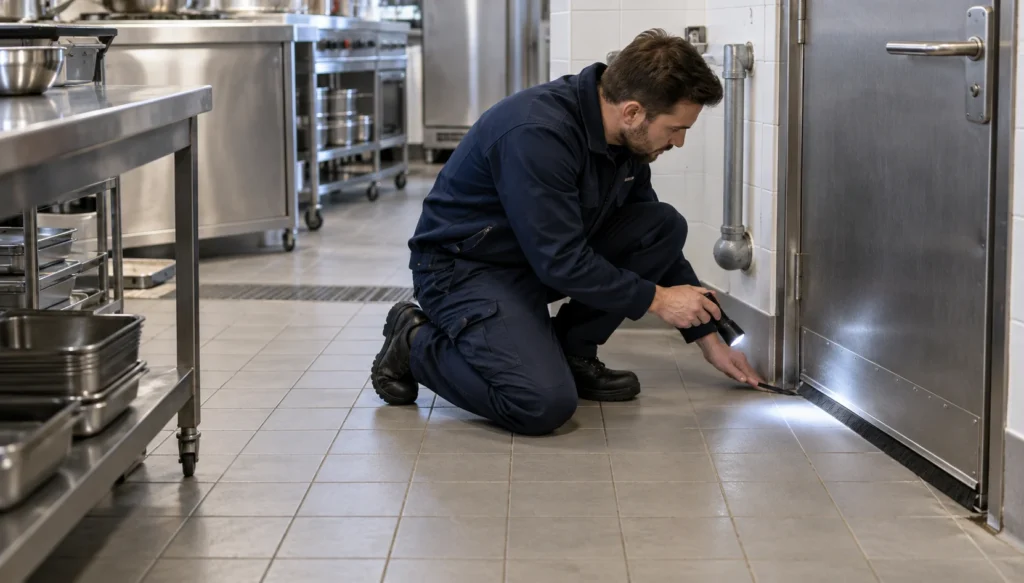
The inspection starts outside. Officers walk the perimeter looking at door seals, loading bays, air bricks and service penetrations. Mice exploit gaps of around six millimetres. Rats need little more than twenty. Damaged brush strips, perished dock seals and unsealed pipework are recorded as immediate failures, because exclusion is the baseline control.
Drainage receives close attention. Officers lift gully covers and check for damaged connections, missing rodding eyes and open sub-floor voids. Brown rats travel the sewer network and surface through faults in private drainage. Roof lines matter too. Gaps at cladding junctions, open eaves and missing bird mesh on vents all invite entry. Record the defects you cannot fix at once, then show the planned works and dates.
Internal Signs of Activity and Harbourage
Inside, officers look behind and beneath fixed equipment. They check motor housings, chiller plinths, false ceilings and dead space behind wall cladding. Fresh droppings, smear marks, gnawed packaging and insect fragments all carry weight. Warmth and food debris in equipment voids create ideal breeding conditions for cockroaches and stored product insects.
Electronic fly killers attract scrutiny of their own. Officers check lamp condition, catch tray contents and the position of the unit relative to open food. Lamps must be shatter-resistant. Units sited directly above a preparation bench are a defect, not a safeguard. A full catch tray signals a lapsed cleaning schedule. Officers also inspect floor gullies for grease build-up, which sustains drain flies through the year.
Did You Know?
Hygiene offences under the Food Safety and Hygiene (England) Regulations 2013 carry an unlimited fine. On conviction on indictment, a court may also impose up to two years imprisonment.
Pest Control Inside Your HACCP System
Prerequisite Programme, Not a Critical Control Point
Pest control is a prerequisite programme. It creates the conditions in which a HACCP plan can work, rather than acting as a critical control point. No cooking step or metal detector removes a rodent hair from a sealed pack. Control the environment first, then the hazard analysis holds.
The hazards are biological, physical and chemical. Rodents, birds and flies carry Salmonella, Campylobacter and Listeria onto open food and contact surfaces. Physical contamination arrives as droppings, hairs, feathers, insect bodies and gnawed packaging fragments. Chemical risk enters through the control programme itself. Product data sheets and COSHH assessments therefore belong in the pest file. Auditors to BRCGS and SALSA standards treat the prerequisite programme as a scored section.
Action Thresholds for Each Zone
Thresholds set the response. A single fly in a high-care room demands investigation that same day. A moth in an external store does not. Agree the limits for each zone in writing with your contractor. Record who signs them off. Without thresholds, every sighting becomes either a crisis or an afterthought.
A breach should trigger a defined sequence. Investigate the root cause, apply a corrective action, record it and verify the result at the next visit. Perimeter devices behave differently. They measure ambient pressure from surrounding land and should not trigger automatic treatment. This distinction keeps biocide use proportionate. It also satisfies auditors who want evidence of judgement rather than reflex.
Free Pest Control Audit Review
We will review your risk assessment, site plan, visit reports, trend analysis, open recommendations, product records and demo our AI Pest management System.
Proofing Work That Keeps Pests Outside the Building
Doors, Loading Bays and Service Penetrations
Exclusion is the only permanent control. Fit metal-backed bristle strips to external personnel doors and keep thresholds flat. Dock levellers need intact rubber seals and tight perimeter brushes. Seal every service penetration carrying conduit, refrigeration pipework or gas. Expanding foam alone fails, because rodents gnaw straight through soft polyurethane.
Use the right materials. Wire wool bedded in mortar, steel plate and purpose-made mesh all hold. Soft sealants do not. Above ground, check cladding junctions, open eaves and uncapped downpipes, which give gulls and pigeons ready nesting sites. Fly screens on opening windows must be fine mesh and removable for cleaning. Air curtains help at delivery doors, but they never replace a door that closes.
Internal Hygiene and External Waste Storage
Exclusion fails when the building feeds pests. Strip and clean machinery voids, motor housings and conveyor transfer points on a written schedule. Deep clean floor gullies and effluent channels, where organic film sustains drain flies. Store dry goods off the floor and away from walls, so inspection runs stay clear.
External waste is the single biggest attractant on most sites. Keep bins intact, lidded and standing on a clean hard surface. Site them away from delivery doors and intake points. Increase collection frequency before you increase bin numbers. Overflowing skips and loose sacks draw rats and gulls within a night. From experience across the sector, tidy bin yards correlate strongly with clean internal monitoring results.
AI Pest Management
AI pest management is pest control delivered with continuous digital monitoring and analytics rather than paper records, with real time data access across a single or multiple sites.
Pest Control Records That Prove Due Diligence
What the Site Pest File Must Hold
The pest file is your evidence bundle. It should hold the current service agreement, the contractor insurance and technician qualifications. Add call-out arrangements and agreed response times. Include a product inventory with safety data sheets and COSHH assessments for every item used. An environmental risk assessment should justify each method chosen.
Keep the file where staff can find it. An officer who waits twenty minutes for a folder has already formed a view. Check that technician certification is current and matches the work carried out. RSPH Level 2 is the usual minimum for a field technician. Confirm the contractor holds membership of a recognised trade body. BPCA and NPTA membership both carry weight with auditors and officers.
Site Plans, Trend Analysis and Corrective Actions
A dated site plan anchors the whole programme. It must show every device by number and exact position. When production reconfigures and a device moves, the technician updates and signs the plan that day. Unrecorded or missing devices are the discrepancy auditors find first. They also suggest nobody checks the paperwork.
Reports must say something. A report that records only a tick and a signature adds nothing to a due diligence file. Technicians should record findings, structural defects and recommendations at every attendance. The business then tracks each recommendation in a corrective action log with completion dates and sign-off. Periodic trend analysis closes the loop. Insist on written interpretation of the catch data, not a bar chart with no commentary.
Rodenticide Stewardship and Digital Monitoring
Responsible Rodenticide Use Under CRRU Rules
Rodenticide use sits under the CRRU UK stewardship regime. The aim is to limit secondary poisoning of barn owls, kestrels, red kites and foxes. Permanent baiting around a perimeter is no longer accepted practice. Technicians must justify toxic use, record it and withdraw bait once activity stops.
The practical sequence runs in one direction. Deploy non-toxic monitoring blocks in tamper-resistant stations. Confirm activity. Only then introduce a targeted toxic formulation, with a defined end date. Since the 2024 label changes took full effect, second generation anticoagulants may only be used in and around buildings. Open area and waste dump uses have gone. Purchasers must also show proof of competence or stewardship-approved training at point of sale.
Connected Sensors and Online Reporting
Paper files are giving way to digital reporting. Technicians log observations, photographs and timestamps on site, and the report reaches the client portal before they leave. Multi-site operators can see outstanding actions across the estate in one view. Audit preparation becomes retrieval rather than reconstruction.
Connected sensors change response times. A triggered trap reports within minutes, not at the next scheduled visit. Timestamps let managers link activity to shift patterns, deliveries or cleaning gaps. The limits are real, though. A sensor cannot see a perished door seal or grease under a conveyor. Physical inspection by a competent technician remains the part that finds root causes.
Staff Training and Pest Sightings Reporting
Frontline Vigilance Between Technician Visits
Your staff are in the building every day. A technician visits monthly, or weekly at best. That gap is where infestations establish. Trained staff spot the early signs first: droppings behind a bin store, a gnawed bag, scratching above a ceiling tile. Awareness training turns those observations into recorded action.
Officers test this directly. They ask a kitchen porter what they would do if they saw a mouse. A blank answer undermines an otherwise strong file. Cover the basics at induction and refresh them annually. Staff should know the reporting route, the named responsible person and why propping a fire door open matters. Training records belong in the pest file alongside the service reports.
The Site Sightings Log in Practice
Every site needs a sightings log that staff can reach. Record the date, time, location and what was seen. Name the person who reviews it and the trigger for calling the contractor. A log kept in a locked office achieves nothing. Keep it where the work happens.
An empty log raises suspicion, not confidence. Officers know that minor sightings occur in every food environment. Years of blank pages usually mean poor training or a culture where reporting feels risky. Close the loop visibly. When someone reports a sighting, record the action taken and tell them what happened. Reporting stops the moment staff believe nothing comes of it.
Final Thoughts
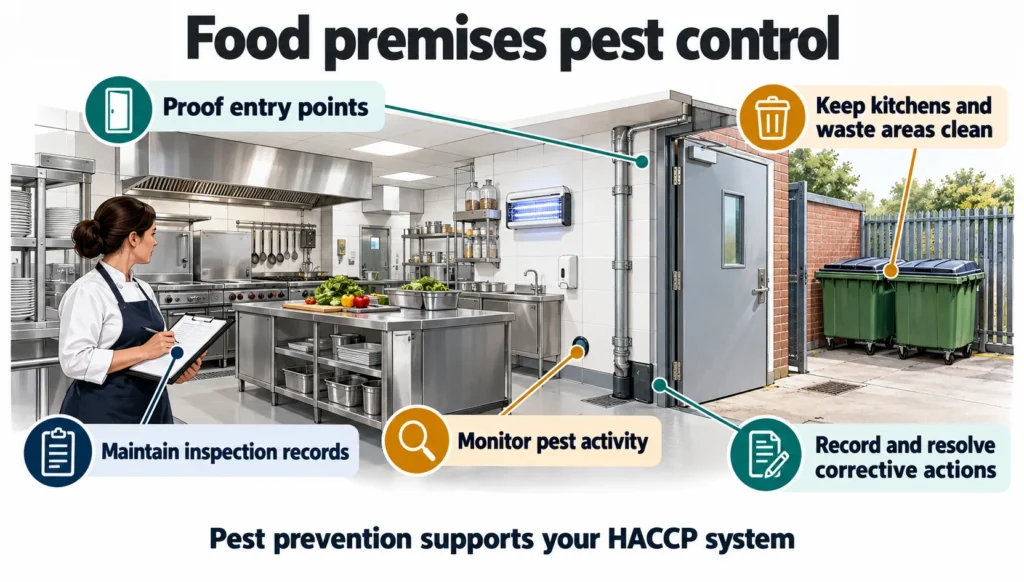
Food premises pest control requirements come down to three things. Keep pests out. Watch for them constantly. Record what you do. Proofing carries the physical load, monitoring gives early warning, and records convert both into a defence you can rely on.
Chemical options keep narrowing. Stewardship rules will continue to push the sector towards exclusion, hygiene and evidence-led intervention. Sites that invest in building fabric now will spend less on reactive treatment later. Rodent pressure rises sharply with the first cold weather, and buildings are judged on how they were prepared months earlier.
Request a Free Site Survey
Frequently Asked Questions
A:
No statute names a contract. The law requires adequate procedures to control pests, and it leaves the method to you. In practice, proving adequacy without professional support is difficult. An Environmental Health Officer expects competent technicians, numbered devices, safety data sheets and dated reports. Producing that evidence in-house means training staff to professional standard and holding the same records. Most operators find a contracted service the cheaper route to a defensible file.
A:
The response scales with risk. Minor activity in an external store may bring written recommendations. It may also bring a Hygiene Improvement Notice with a deadline for named works. Activity near open food is treated differently. Where there is an imminent risk to health, the officer can serve a Hygiene Emergency Prohibition Notice. The premises close straight away. A court then decides whether to confirm it. Your Food Hygiene Rating will also drop at the next scoring.
A:
Permanent external baiting breaches current stewardship practice. Continuous toxic bait poisons predators such as barn owls and red kites through the food chain. It also selects for resistance in rodent populations, which makes future control harder. The accepted method now starts with non-toxic monitoring in tamper-resistant stations. Toxic product goes down only after activity is confirmed, with a written justification and a defined end date. Bait is then removed and the result recorded.
A:
Frequency follows a documented risk assessment, not habit. High-risk manufacturing, bakeries and meat processing usually warrant monthly visits, and sometimes fortnightly. Restaurants, cafes and low-risk dry stores can often justify quarterly service if hygiene and proofing are sound. The assessment should name the factors behind the decision: product type, building age, local pressure and site history. Any confirmed activity triggers extra visits until the site is formally signed off as clear.
A:
Keep the current service agreement, contractor insurance and technician qualifications. Hold a signed, dated site plan showing every numbered device. Include safety data sheets, COSHH assessments and an environmental risk assessment for each product used. Add the full run of service reports, the staff sightings log and a corrective action tracker with completion dates. Finish with periodic trend analysis that carries written interpretation. An officer should be able to work through the file unaided.


By choosing Shield Pest Management, you’re partnering with a company that combines local expertise with industry-leading practices. Our commitment to quality, compliance, and customer satisfaction makes us an ideal choice for both residential and commercial pest control needs.
