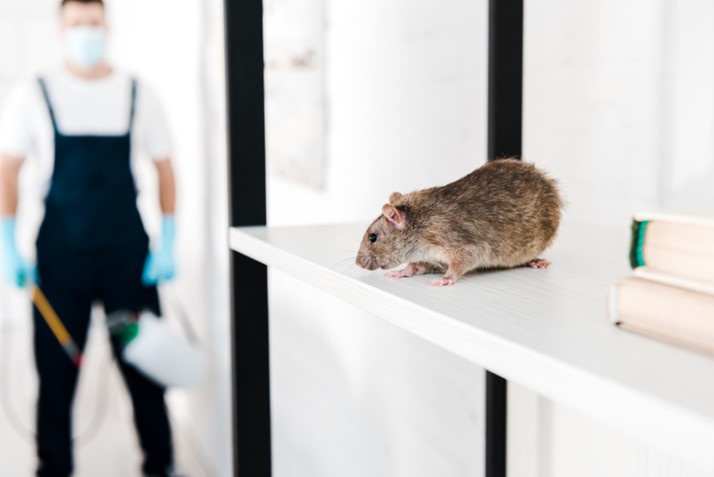
Commercial Rodent Control & Rat Control Services

UK Commercial Rodent Control & Rat Control Services.
Commercial rodent control is one of the most critical investments any business can make. Professional rat control services protect your premises, products, and reputation. Smart mouse prevention tips stop infestations before they take hold. Rodents cause structural damage and contaminate stock. They also trigger regulatory failures that can shut operations overnight.
Do you have the right rat control services in place? Are they meeting BRCGS, Red Tractor, or Food Safety Act requirements? Are your staff applying the correct mouse prevention tips to stop infestations before they start?
Key Takeaways
- BPCA-qualified technicians deliver compliant, audited pest control
- Rat control services must meet Food Safety Act 1990 standards
- Mouse prevention tips reduce infestation risk before it escalates
- Rodent damage can trigger immediate premises closure by enforcement
- Proactive pest contracts protect audits with BRC, Tesco and more
Get Effective Commercial Rodent Control for Your Business
Recognise the Serious Threat Rodents Pose to Commercial Premises
Rodents are the single most common pest issue reported in UK commercial settings. Rats and mice contaminate food. They damage electrical cables. They spread disease through droppings, urine, and fur. A single infestation can trigger regulatory closure. It can force product recalls. It can leave lasting reputational harm.
The British Pest Control Association confirms that rodents gnaw through aluminium and wood. This creates fire risks when they attack electrical cabling. In food manufacturing, one contaminated batch can trigger product recalls. It can cause supply chain disruption. It can lead to loss of retail contracts. The Food Safety Act 1990 places a clear legal duty on businesses. Adequate pest control procedures must remain in place. Failure carries fines of up to £20,000 or six months in prison.
Identify Active Rodent Infestations Early
Early detection of rodent activity prevents minor pest pressure from escalating. Key indicators include fresh droppings near food stores. Look for gnaw marks on packaging or cabling. Check for smear marks along walls from rat fur. Listen for scratching sounds in ceilings or wall cavities during quiet periods at the site.
Staff awareness is critical. Pest awareness training courses help site teams spot signs early. The Tesco specification requires a trained employee accountable for pest management. Scheduled BPCA-qualified technician visits provide professional inspection. They use monitoring data and trending analysis. This catches problems the untrained eye misses entirely.
| Warning Sign | Likely Pest | Urgency Level |
|---|---|---|
| Dark, capsule-shaped droppings near food | Mouse | High |
| Larger droppings, smear marks on walls | Rat | Critical |
| Gnaw marks on cables or packaging | Rat or Mouse | High |
| Nesting material in stored goods | Mouse | High |
| Scratching sounds in ceiling voids | Rat or Mouse | Medium–High |
| Live or dead rodent sightings | Rat or Mouse | Critical |
commercial rodent control
rat control services
commercial rodent control
rat control services
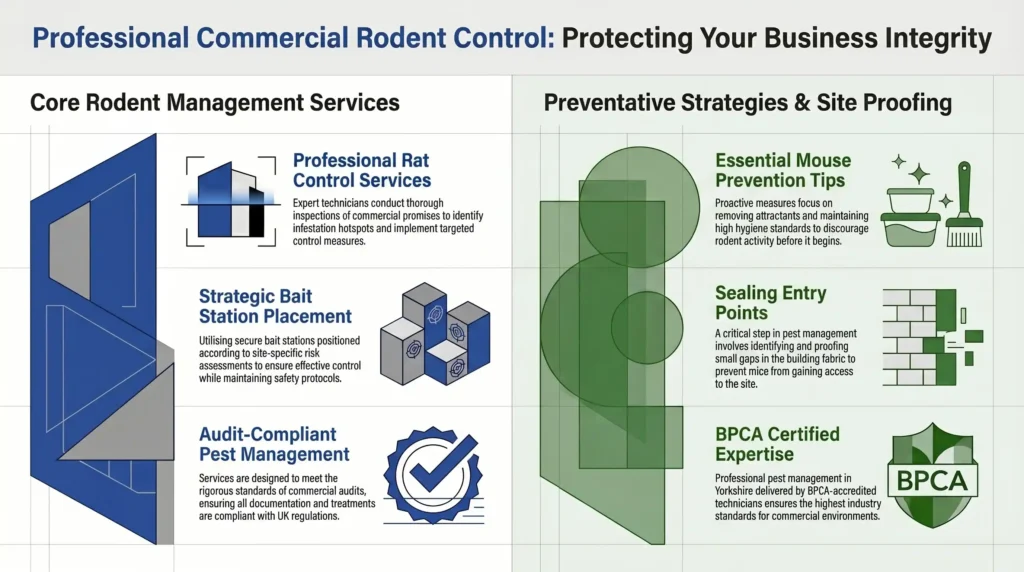
Choose Professional Rat Control Services
Verify BPCA Membership for Rat Control Services
Selecting rat control services from a BPCA-certified company guarantees the highest verified standards. The British Pest Control Association admits members who prove technical competence. They must hold valid insurance. They must follow published Codes of Best Practice. This protects your business legally and operationally if a pest incident is ever challenged.
BPCA membership ties into TrustMark registration. TrustMark is the only UK Government-endorsed quality scheme for trade services. Businesses using a BPCA member can demonstrate due diligence to auditors and enforcers. They can show compliance to retail partners. BPCA members also carry minimum £5 million public liability insurance. This covers your site against unforeseen incidents during treatment. That level of protection remains non-negotiable for commercial operators in food or retail.
Get the Right Pest Contract for Your Industry Sector
Not every business faces identical rodent risks. A generic pest contract rarely delivers adequate protection. Effective commercial rodent control is sector-specific. Food manufacturers face different audit expectations to logistics warehouses. Schools, hospitals, and retail sites each carry distinct compliance obligations. A qualified provider must understand these before designing any programme.
A BPCA-qualified technician will conduct a free site survey. The survey assesses pest entry points, harbouring conditions, and risk factors. That information shapes a bespoke pest management plan. The plan covers scheduled inspection visits, baiting strategies, proofing recommendations, and documented reporting. The plan must align with whichever audit standards govern your site. That includes BRCGS, ISO 22000, SALSA, Red Tractor, or major retailer codes. Marks and Spencer, Tesco, and Morrisons all expect this level of rigour.
Commercial Pest Control
We provide comprehensive pest management solutions tailored to protect your business and reputation.
Site Visit and Consultation
We will visit your premises, assess your situation, provide advice, make recommendations and provide a quote.
Apply Proven Mouse Prevention Tips Across Your Site
Proof Your Building Against Mouse Entry
Mice can enter a building through gaps as small as 6mm. That is roughly the diameter of a standard pencil. Effective proofing forms the first line of defence in any commercial rodent control programme. Priority entry points include gaps around pipework. Check damaged air bricks. Inspect poorly fitted door frames. Review loading bay seals worn by forklift use.
A qualified pest technician will assess proofing deficiencies during every visit. They document remedial actions in a site report. Practical mouse prevention tips include fitting brush strip seals to all external doors. Replace damaged air bricks with fine stainless-steel mesh covers. Seal pipe penetrations with rodent-resistant materials. These actions are not cosmetic. BRCGS auditors and major retailer inspectors actively assess proofing standards. Poor proofing remains one of the most common non-conformances in UK food safety audits.
Improve Housekeeping to Reduce Rodent Attraction
Good housekeeping directly reduces the chance of mouse activity in your premises. Rodents need food, water, and shelter to survive. Removing all three disrupts their ability to establish on site. Secure food storage in sealed, hard-sided containers. Remove standing water from drainage areas. Clear clutter from storage zones where mice can nest undisturbed.
One of the most practical mouse prevention tips for commercial kitchens is strict cleaning beneath fixed equipment. Clean behind refrigeration units regularly. Grease build-up, food debris, and condensation create ideal harbouring conditions. Waste management discipline matters too. External bins must have fitted lids. Waste collection must run frequently. Compactor areas need regular cleaning. The BPCA’s guidance is clear. A clean, well-maintained, and proofed building remains the most effective deterrent against rodent establishment.
Audit Compliance
Our specialised services ensure your pest control measures meet rigorous industry compliance standards & certifications.
Pest Management Technology
Shield Pest Management utilises Insectram Ai, the UK’s premier real time integrated pest management system.
Comply With Audit Standards Through Commercial Rodent Control
Satisfy BRCGS Pest Control Requirements
BRCGS Issue 9 requires actively managed, documented, and reviewed pest control. It forms part of a site’s food safety management system. Businesses must show evidence of scheduled visits and technician findings. Corrective actions and trend analysis also need full documentation. Commercial rodent control programmes must generate paper or digital reports for audit inspection.
Shield Pest Management’s ShieldNet online reporting system delivers exactly this audit trail. Each technician records visit data in real time via mobile device. Reports become immediately accessible to site managers, 24 hours a day, seven days a week. The system stores site plans, bait station maps, trend data, COSHH information, and risk assessments. BRCGS and major retailers require all of this as evidence of an effective integrated pest management programme. Poor documentation alone can result in a major non-conformance during an otherwise clean audit.
Deliver Specialist Rodent Services for ISO 22000 and SALSA Sites
ISO 22000 and SALSA certification both require documented pest management. It must form part of a wider food safety management system. SALSA serves small and micro food producers with one to fifty employees. The standard demands evidence of pest prevention, monitoring, and corrective action. Rat control services must come from a competent, insured provider.
ISO 22000 takes a hazard-based approach. Rodent activity must feature in the HACCP plan as a food safety hazard. Specialist rat control services provide the technical evidence required. Expert field biologist reports satisfy this audit requirement. A long-term contract with a BPCA-certified provider demonstrates the “continual improvement” principle. Both ISO 22000 and SALSA auditors look for this during renewal inspections at certified UK food production sites.
Conduct Regular Inspections With Qualified Pest Technicians
Schedule Visits to Protect Your Premises Year-Round
Regular site inspections by BPCA-qualified pest technicians form the backbone of effective commercial rodent control. Inspection frequency should match risk level. High-risk food sites typically require fortnightly visits. Lower-risk premises may suit a monthly schedule. Each visit must produce a written report. The report identifies activity, proofing issues, and recommendations.
During inspections, technicians assess bait consumption and check trap integrity. They review proofing conditions and update site plans. These records carry legal significance. The Health and Safety at Work Act 1974 requires employers to provide a safe working environment. Demonstrable pest control procedures form part of that obligation. A pest management contract with scheduled visits, signed reports, and corrective action records delivers genuine due diligence evidence. That evidence protects businesses during enforcement investigations or retailer audits.
Apply Integrated Pest Management Principles on Every Visit
Integrated Pest Management, or IPM, is the professional standard for commercial rodent control. It applies across all regulated industries. IPM prioritises prevention, monitoring, and targeted treatment over reactive chemical use. This approach reduces pesticide exposure to the environment. It also protects non-target species. It maintains effective rodent control across the site throughout the year.
The Campaign for Responsible Rodenticide Use, or CRRU, operates under the Think Wildlife banner. It sets the framework for responsible rodenticide stewardship in the UK. CRRU compliance permits rodenticides only when monitoring confirms active infestations. Bait must sit in tamper-resistant stations. Applications need regular review. This protects barn owls, kestrels, red kites, and other wildlife from secondary poisoning. Government rodenticide regulators have raised significant concern in recent years. CRRU-compliant providers demonstrate genuine environmental responsibility alongside operational effectiveness.
commercial rodent control
rat control services
commercial rodent control
rat control services
Pest Awareness Training
We provide pest awareness training as an essential component of quality assurance and regulatory compliance.
Domestic Pest Control
Our expert technicians eliminate household pests quickly and safely, ensuring your home remains pest-free.
Get Commercial Pest Reporting That Satisfies Retail Auditors
Implement Real-Time Reporting to Transform Pest Management
Traditional paper-based pest reports fall short for BRCGS or Red Tractor businesses. They miss the mark for major retailer audit standards. Digital reporting systems capture visit data in real time. Site managers gain immediate visibility of open actions and inspection findings. They can also track corrective work status. This capability now sits at the baseline expectation for food-sector operators.
ShieldNet, the online reporting platform from Shield Pest Management, delivers exactly this capability. Technicians complete treatment reports on mobile devices at the point of visit. Data becomes instantly available to site management. The system displays site plans with bait station locations. It tracks pest activity trends over time. It shows pending actions and risk assessment documents. All of this sits in one accessible dashboard. Tesco, Morrisons, and Marks and Spencer have worked with Shield. The reporting infrastructure underpins compliance across all those supply chain relationships.
Review Pest Trend Data to Prevent Recurring Infestations
Trend analysis remains the most underused tool in commercial pest management. Reviewing rodent activity data across multiple visits reveals patterns. A single inspection report cannot show these patterns. Rising bait consumption at specific stations is one signal. Repeated mouse droppings in one zone is another. Seasonal spikes in activity also point to root causes.
A professional pest management contract includes biologist-level trend reports. These interpret monitoring data and recommend strategic adjustments to the programme. The reports also serve as evidence during retailer audits. They demonstrate that the business actively manages and reduces risk over time. Red Tractor and BRCGS auditors view trend analysis as a marker of mature food safety culture.
Did You Know?
Under the Food Safety Act 1990, businesses face strict penalties for inadequate pest control. The Food Hygiene (England) Regulations 2013 reinforce these obligations. Fines can reach £20,000. Prison terms can extend to six months. Premises can close immediately. A BPCA-certified contractor with comprehensive reporting demonstrates legal due diligence to enforcement authorities and retail auditors.
Verify Staff Pest Awareness Training Meets Retailer Standards
Train Staff to Protect Audit Compliance
Retailer specifications increasingly require a trained site employee accountable for pest management. The Tesco specification explicitly states this obligation. Pest awareness training ensures your team understands pest biology and legislation. It covers proofing principles, hygiene standards, and pest report interpretation. All of this sits in the context of the site’s audit obligations.
A structured pest awareness course covers identification, legislation, biology, housekeeping, and proofing. The Food Safety Act 1990 sits at the heart of the curriculum. Participants receive a certificate on completion. That certificate satisfies the documented training requirement during audits. Tesco, BRCGS, and SALSA inspectors all check for it. Trained staff also reduce response times when warning signs appear. In high-risk food environments, that speed prevents minor alerts from becoming full infestations.
Build a Pest-Aware Culture Across Your Workforce
Building genuine pest awareness across an entire workforce takes more than a single training session. It demands consistent communication. It requires clear reporting lines. Management must commit to acting on findings quickly. Staff need to know what to look for. They need to know who to tell. They must know what documentation to complete.
Practical steps include displaying laminated pest identification guides in staff areas. Add pest awareness to induction programmes for new starters. Run refresher briefings when seasonal risk increases. Autumn is critical, as rat activity rises sharply when temperatures drop. Log any pest sighting immediately. Communicate it to your contracted pest technician. Visit schedules can then shift accordingly. Reactive treatments deploy promptly. This internal discipline separates sites that consistently pass audits from those facing repeated non-conformances.
Summary: Commercial Rodent Control Essentials
Effective commercial rodent control is not a reactive measure. It is a structured, documented, and legally supported programme. It protects your business from financial loss, regulatory failure, and reputational damage. Your site may operate under BRCGS, Red Tractor, ISO 22000, SALSA, or a major retailer code. The standard remains the same throughout. You need qualified technicians, real-time reporting, proofing compliance, and trained staff who create a genuinely pest-aware workforce.
The businesses that consistently pass audits and avoid enforcement action treat pest management as a core operational function. They never see it as an afterthought. Partnering with a BPCA-certified, CRRU-compliant provider gives you technical expertise. It also delivers audit documentation and rapid response capability. Your site stays protected every day of the year. Call 01757 212727 to speak with one of Shield Pest Management’s qualified experts. Complete the contact form to arrange a free site survey.
Make an Enquiry
commercial rodent control
rat control services
commercial rodent control
rat control services
Frequently Asked Questions
A:
A commercial rodent control contract typically includes scheduled site inspections by BPCA-qualified technicians. It covers bait station installation and monitoring. It includes proofing assessments, written visit reports, and trend analysis. Corrective action management forms part of the package. Digital reporting systems provide real-time access to all documentation. This supports compliance with BRCGS, ISO 22000, Red Tractor, and major retailer audit requirements. Contracts suit the risk profile and regulatory obligations of each business sector.
A:
Rat control services should visit based on your site's risk level. High-risk food manufacturing and processing sites typically require fortnightly inspections. Lower-risk environments such as offices or retail may suit a monthly visit. Frequency should rise during periods of elevated activity. Seasonal pressure in autumn often demands extra visits. Structural changes to the building also justify increased frequency. Your pest management contract should include a risk assessment defining the appropriate schedule for your specific site.
A:
The most effective mouse prevention tips for food businesses combine structural proofing, housekeeping, and staff training. Seal all gaps around pipework and door frames with rodent-resistant materials. Fit brush strip seals to external doors. Store all food in sealed, hard-sided containers. Clear clutter from storage areas. Clean beneath fixed equipment regularly. Ensure waste bins have fitted lids. Staff should know how to identify early warning signs. They must report them immediately to the site pest technician.
A:
Yes. BRCGS Issue 9 requires documented evidence of pest monitoring and scheduled inspections. Corrective actions and trend analysis also need clear evidence. A professional pest management contract with a BPCA-certified provider delivers all of this. It includes real-time digital reports, site plans, bait station maps, COSHH records, and biologist reports. These documents form a critical part of the audit evidence file. Businesses without a structured, documented pest programme routinely receive major non-conformances during BRCGS assessments.
A:
CRRU-compliant rat control services follow the Campaign for Responsible Rodenticide Use Code of Best Practice. This governs how technicians apply rodenticides to minimise wildlife exposure. Barn owls, kestrels, and red kites top the priority species list. Compliant providers only use rodenticides when monitoring confirms active infestations. They place bait exclusively in tamper-resistant stations. They review applications at every visit. This protects the environment whilst maintaining effective rodent control. Food retailers and auditors across the UK increasingly expect this approach.
commercial rodent control
rat control services
commercial rodent control
rat control services


BRC audit compliance and food industry pests
food industry pests
BRC audit compliance and food industry pests
food industry pests
commercial rodent control
mouse prevention tips
commercial rodent control
mouse prevention tips
By choosing Shield Pest Management, you’re partnering with a company that combines local expertise with industry-leading practices. Our commitment to quality, compliance, and customer satisfaction makes us an ideal choice for both residential and commercial pest control needs.
Share This Article