
Bees Wasps and Hornets.
Bees wasps and hornets are common insects encountered in gardens, parks, and even urban areas throughout the UK. While all three belong to the order Hymenoptera, they exhibit distinct appearances, behaviours, and ecological roles that significantly impact how we should respond when encountering them. Identifying these stinging insects correctly is crucial not only for appropriate management but also for understanding their importance to our ecosystem, with bees serving as vital pollinators and wasps acting as natural pest controllers.
What exactly sets these three stinging insects apart, and how can we determine which poses a genuine threat when found near our homes? Moreover, what steps should we take if we discover a nest of bees wasps or hornets on our property?
Key Takeaways
- Physical identification of bees, wasps or hornets relies on distinct body features and nest structures.
- Behavioural differences include varying levels of aggression and dietary preferences.
- Sting dangers range from mild to severe, with proximity to nests increasing risk factors.
- Professional intervention is essential for safe nest management rather than DIY removal.
- Seasonal patterns affect when and where these insects are most active.
- Preventative strategies can help reduce unwanted encounters while respecting ecological roles.
Physical Identification
Distinctive Features
Bees typically have round, fuzzy bodies with golden-brown and black stripes, helping them collect pollen as they move from flower to flower. In contrast, wasps display smooth, shiny bodies with bright yellow and black stripes and a pronounced “wasp waist”—a narrow connection between the thorax and abdomen. Furthermore, hornets, being the largest of the three, measure between 18-35mm and feature either brown and yellow markings (European hornets) or predominantly black bodies with a single yellow-orange band (Asian hornets).
Nest Appearances
Honey bees construct wax combs containing hexagonal cells, typically housed in cavities such as hollow trees or wall spaces, while bumblebees create smaller, waxy, irregular nests in abandoned rodent burrows or grass tussocks. Conversely, wasps build distinctive papery nests from chewed wood fibres mixed with saliva, commonly found in sheltered locations like lofts, sheds, or underground. Additionally, hornets create similar papery structures, though European hornet nests appear in tree hollows or barns, whereas Asian hornets often establish nests high in trees, sometimes 10-20 metres above ground.
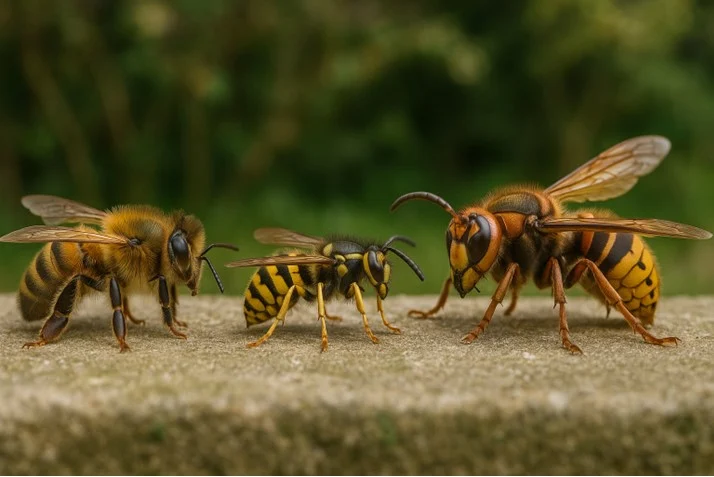
bees wasps and hornets
control bees wasps and hornets
bees wasps and hornets
control bees wasps and hornets
Behavioural Differences
Temperament and Aggression
Bees generally exhibit docile behaviour unless they feel threatened or their nest is disturbed, with honey bees able to sting only once due to their barbed stinger. Wasps, however, demonstrate increasingly aggressive tendencies, especially in late summer when food sources diminish, and they can deliver multiple stings with their smooth stinger. Similarly, European hornets, while less aggressive than wasps, will defend their nests if disturbed, while Asian hornets display highly aggressive behaviour, particularly toward honey bee colonies, posing a significant ecological threat.
Diet and Foraging
Bees primarily consume nectar and pollen, serving as essential pollinators for plants and crops throughout the UK. In contrast, wasps maintain an omnivorous diet, feeding on nectar, other insects, and human food scraps, which explains their common presence at picnics and outdoor meals. Additionally, European hornets mainly prey on insects and tree sap, showing less interest in human food than wasps, whereas Asian hornets specifically target honey bees and other insects, making them particularly problematic for beekeepers and the wider ecosystem.
Domestic Pest Control
Our expert technicians eliminate household pests quickly and safely, ensuring your home remains pest-free.
Commercial Pest Control
We provide comprehensive pest management solutions tailored to protect your business and reputation.
Risk Assessment
Sting Danger
Bee stings, while painful, typically cause localised swelling and discomfort, with honey bee stingers remaining embedded in the skin, requiring removal to prevent further venom release. Wasp and hornet stings, however, deliver sharper, more intense pain, as these insects can sting repeatedly, with hornets injecting larger venom doses, resulting in more severe reactions. Subsequently, all three insects pose risks of allergic reactions, with anaphylaxis affecting approximately 1-7% of the population, potentially leading to life-threatening situations requiring immediate medical attention.
Nest Proximity Risks
Nests located near homes, schools, or workplaces naturally increase the likelihood of stings, particularly for wasps and hornets that defend their territory more aggressively. Disturbances such as loud noises, vibrations, or direct contact can trigger defensive swarming behaviour in all three species. Hence, professional assessment becomes essential when nests are discovered in high-traffic areas, as improper handling could result in multiple stings and serious health consequences, especially for vulnerable individuals like children, the elderly, or those with known allergies.
Audit Compliance
Our specialised services ensure your pest control measures meet rigorous industry compliance standards & certifications.
Pest Awareness Training
We provide pest awareness training as an essential component of quality assurance and regulatory compliance.
Nest Management
Professional Intervention
Upon discovering a nest, it’s advisable to avoid DIY removal attempts, as these often lead to increased aggression and potential stings. For bee nests, contacting the British Beekeepers Association (BBKA) can facilitate safe relocation, particularly for honey bees, which are beneficial and protected. Likewise, wasp and European hornet nests require professional pest control services using appropriate protective gear and treatment methods, while Asian hornet sightings should be reported immediately to the Non-Native Species Secretariat due to their invasive status and threat to native ecosystems.
Safe Approach
When a nest is identified, maintaining a safe distance is paramount—at least 3-5 metres for bees and 5-10 metres for wasps or hornets. Subsequently, securing the area to prevent access by children, pets, and unaware adults reduces the risk of accidental disturbance. Therefore, while awaiting professional assistance, it’s essential to avoid blocking nest entrances or using loud equipment nearby, as these actions may provoke defensive responses from the colony.
Seasonal Considerations
Activity Patterns
Honey bees remain active year-round in suitable conditions but show peak activity from March to October, while bumblebees operate from spring to late summer before new queens hibernate for winter. Wasps become most active between April and October, with colonies growing throughout summer and reaching peak aggression in August-September as resources diminish. Similarly, hornets follow comparable patterns, with European hornets active from April to October and Asian hornets potentially extending their activity into November during milder seasons.
Prevention Timing
Spring offers the optimal time for preventative measures, as queens emerge from hibernation to establish new colonies, making early intervention more effective before nests grow larger. During this period, sealing cracks, gaps, and entry points in buildings can deter nesting, while securing rubbish bins reduces wasp attraction. Therefore, regular monitoring of potential nesting sites in spring can facilitate early detection and professional management before colonies expand to problematic sizes during summer months.
Protection Strategies
Avoiding Provocation
To minimise risks when bees wasps and hornets are present, remain calm and avoid sudden movements or swatting, as these actions can trigger defensive responses. Covering food and drinks outdoors significantly reduces attraction for wasps in particular, while wearing light-coloured clothing rather than bright or floral patterns makes you less visible to these insects. Additionally, avoiding strong perfumes or scented products helps prevent unwanted attention from all three species, as they can mistake these scents for floral sources.
Property Management
Proactive property maintenance plays a crucial role in preventing unwanted nests of bees wasps and hornets. Regularly inspect and seal potential entry points such as gaps in roof eaves, cracks in walls, and openings around pipes or cables. Furthermore, removing fallen fruit promptly reduces food sources for wasps, while keeping compost bins securely covered prevents foraging opportunities. Consequently, these preventative measures significantly decrease the likelihood of nesting issues while still allowing these beneficial insects to thrive at a safe distance from human activity.
Conclusion
Accurately identifying bees wasps and hornets enables appropriate response strategies while respecting their ecological importance. Bees serve as essential pollinators requiring protection, wasps control other insect populations despite their aggression, and hornets—particularly the invasive Asian variety—warrant careful monitoring and professional management. Therefore, when encountering these insects or their nests, proper identification followed by appropriate professional intervention ensures both human safety and ecological responsibility.
For homeowners discovering nests on their property, the best approach combines caution, distance, and professional assistance rather than DIY removal attempts. Shield Pest Management and other BPCA-registered professionals offer specialised services for managing wasps and hornets safely, while local beekeepers can relocate beneficial bee colonies. Thus, with proper knowledge and professional support, we can coexist with these important yet potentially dangerous insects while minimising risks to our families and properties.
Customer Reviews
bees wasps and hornets
control bees wasps and hornets
bees wasps and hornets
indentify bees wasps and hornets
Frequently Asked Questions
How can I safely remove a beehive from my garden without harming the bees?
Safely removing bees wasps and hornets requires different approaches based on the species. For honeybees specifically, you should never attempt removal yourself, as these important pollinators are protected and require special handling. Instead, contact your local beekeeping association who can arrange for a beekeeper to assess and potentially relocate the colony. Consequently, this not only protects you from potential stings but also preserves these valuable insects.
Professional beekeepers have the proper equipment and experience to safely transfer the bees to a new hive. Additionally, they can determine if you’re dealing with a temporary swarm (which will often move on naturally within 48 hours) or an established colony requiring more comprehensive removal. Therefore, while waiting for professional assistance, maintain a safe distance of at least 3-5 metres from the bees wasps and hornets and keep children and pets away from the area.
What are the warning signs that a wasp or hornet nest is nearby?
The most obvious indication of bees wasps and hornets nesting nearby is increased insect traffic—numerous insects flying in a consistent direction, often following the same flight path to and from a specific location. Additionally, you might notice these insects entering and exiting a hole in the ground, wall cavity, roof space or tree, particularly during warm weather when colonies are most active. Furthermore, finding chewed wood particles around your property might indicate wasps gathering materials for nest construction.
For wasps and hornets specifically, you may hear a distinctive buzzing sound if the nest is within walls or roof spaces. Moreover, finding multiple wasps or hornets indoors, especially in the same room repeatedly, often suggests a nest is close to or inside your home. Subsequently, if you observe these warning signs, it’s advisable to maintain a safe distance and contact professional pest control experts who can properly identify and manage bees wasps and hornets without putting you at risk of multiple stings or nest damage.
Can I be legally liable if someone is stung by bees wasps and hornets on my property?
The legal implications regarding bees wasps and hornets on your property fall under your general duty of care as a property owner or occupier. Under UK law, specifically the Occupiers’ Liability Acts, you have a responsibility to ensure your premises are reasonably safe for visitors. Consequently, if you’re aware of a nest and fail to take appropriate action, particularly in areas accessible to others, you could potentially face liability if someone is stung and suffers harm.
This responsibility is especially significant for businesses or landlords who must take reasonable steps to address known hazards. Furthermore, while bees are protected under wildlife conservation laws, this doesn’t exempt property owners from their duty of care regarding public safety. Therefore, the appropriate action is to engage professional services for proper management of bees wasps and hornets rather than ignoring the situation or attempting dangerous DIY removal. Subsequently, documenting that you’ve taken reasonable steps to address the hazard by engaging professionals can help demonstrate you’ve fulfilled your legal obligations.
How do I distinguish between an allergic reaction and a normal response to a sting?
Normal reactions to stings from bees wasps and hornets typically include localised pain, redness, swelling, and itching at the sting site, possibly extending a few centimetres from where the stinger entered. Additionally, these symptoms usually resolve within a few hours to days and can be managed with simple measures like cold compresses, antihistamines, and pain relievers. Furthermore, mild swelling, even if it appears significant on areas like the face, is often not cause for serious concern if limited to the sting area.
In contrast, allergic reactions include symptoms beyond the sting site. Specifically, watch for hives or rash across the body, significant swelling far from the sting location, dizziness, nausea, stomach cramps, or difficulty breathing. Moreover, anaphylaxis—the most severe reaction—presents with throat tightness, wheezing, chest constriction, or a sudden drop in blood pressure causing weakness or collapse. Subsequently, these symptoms require immediate emergency medical attention, as anaphylaxis from bees wasps and hornets can be life-threatening if not treated promptly with adrenaline. Therefore, anyone experiencing these symptoms should call 999 immediately.
What should I do if I spot an Asian hornet in my garden?
If you believe you’ve encountered Asian hornets rather than native bees wasps and hornets, your actions play a crucial role in controlling this invasive species. First, safely take clear photographs from multiple angles if possible, as this will help experts confirm identification. Subsequently, report your sighting immediately to the Non-Native Species Secretariat through their online reporting form or the “Asian Hornet Watch” app available for smartphones. Furthermore, note the exact location and time of your sighting for accurate tracking.
Asian hornets pose a serious threat to honeybees and native insects, thus prompt reporting is essential for UK eradication efforts. Additionally, do not attempt to disturb or destroy a suspected Asian hornet nest, as these insects are more aggressive than European hornets and can deliver multiple painful stings. Moreover, keep a safe distance of at least 10 metres from any suspected nest. Therefore, once you’ve reported the sighting, professional pest management teams trained in dealing with bees wasps and hornets will take appropriate action to investigate and remove the threat if confirmed.
bees wasps and hornets
know bees wasps and hornets
bees wasps and hornets
find bees wasps and hornets
The Benefits of Working with a BPCA Member
Ensuring Professional Standards
When seeking pest control services, partnering with a British Pest Control Association (BPCA) member offers numerous advantages. BPCA members are held to high professional standards, therefore ensuring that you receive expert service from qualified technicians. These professionals undergo rigorous training and, additionally, stay updated on the latest pest control techniques, regulations, and safety protocols.
Compliance and Accountability
BPCA members are committed to operating within legal and regulatory frameworks. This commitment provides peace of mind for both commercial and residential clients, consequently knowing that the pest control methods used are compliant with current legislation. Furthermore, BPCA membership offers a layer of accountability, as the association maintains a code of conduct that members must adhere to.
Access to Expertise
By choosing a BPCA member, you gain access to a wealth of industry knowledge. These professionals are equipped to handle a wide range of pest issues, from common household nuisances to complex commercial infestations. Moreover, their expertise extends to understanding pest behaviours, identifying root causes of infestations, and implementing effective, tailored solutions.
Environmentally Responsible Practices
BPCA members are at the forefront of adopting environmentally friendly pest control practices. They are trained in Integrated Pest Management (IPM) techniques, which prioritise prevention and non-chemical control methods. This approach not only addresses immediate pest problems but also, importantly, considers long-term environmental impact, thus making it suitable for eco-conscious households and businesses alike.
Reliable Insurance Coverage
Working with a BPCA member provides an additional layer of protection through proper insurance coverage. BPCA members are required to maintain adequate insurance, thereby protecting you from potential liabilities associated with pest control activities. This coverage is particularly crucial for commercial clients, meanwhile, pest control operations may involve more significant risks.
Summary
Whether you’re a homeowner dealing with a persistent pest problem or a business manager responsible for maintaining pest-free premises, choosing a BPCA member ensures you receive professional, reliable, and responsible pest control services. The association’s commitment to excellence provides a standard of service that benefits both domestic and commercial clients, consequently offering peace of mind and effective pest management solutions.
bees wasps and hornets
control bees wasps and hornets
bees wasps and hornets
control bees wasps and hornets
pest control Yorkshire
BPCA pest control Yorkshire
pest control Yorkshire
BPCA pest control Yorkshire
pest control Yorkshire
Why Work with Shield Pest Management
Expertise and Experience
Shield Pest Management brings over two decades of industry experience to every project. Established in 2002, our family-run business has built a reputation for excellence in pest control services across Yorkshire and beyond. Furthermore, our team’s extensive knowledge spans various industries, from food manufacturing and packaging to healthcare and educational institutions, thus ensuring we can handle pest issues in any setting.
Comprehensive Service Offering
We provide a wide range of pest management solutions tailored to both domestic and commercial needs. Our services include general pest control, bird control, fly control, and specialised audit compliance for various industry standards. Therefore, whether you’re dealing with a one-off infestation or require ongoing pest prevention, Shield has the expertise to address your specific requirements.
Qualifications and Accreditations
As members of the British Pest Control Association (BPCA) and the National Pest Technicians Association (NPTA), Shield Pest Management adheres to the highest industry standards. Additionally, our technicians are BPCA qualified, ensuring that you receive service from skilled professionals who stay updated with the latest pest control techniques and regulations.
Audit Compliance Specialisation
We specialise in audit compliance for numerous industry standards, including BRCGS, SALSA, Red Tractor, AIB, ISO22000, and FSCC22000. This expertise is particularly valuable for businesses in the food and beverage sector, where, consequently, pest control is crucial for maintaining regulatory compliance and product safety.
Innovative Technology
Shield Pest Management stays at the forefront of pest control technology. Our online reporting system, Insectram, offers real-time, detailed reporting and trending of pest management activities. Moreover, this innovative approach enhances transparency and helps our clients stay informed about their pest control efforts.
Environmental Responsibility
We are committed to environmentally responsible pest management practices. As members of the Think Wildlife and Campaign for Responsible Rodenticide Use (CRRU) programmes, we strive to minimise the environmental impact of our pest control methods while maintaining effectiveness.
Customer-Centric Approach
At Shield, we prioritise customer satisfaction. Our approach is built on clear communication, prompt service, and tailored solutions. Therefore, we work closely with our clients to understand their specific needs and develop pest management strategies that align with their goals and requirements.
Geographical Coverage
Based in Yorkshire, our services extend across the North of England, from Grimsby to Manchester and from Middlesbrough to Birmingham. Subsequently, this broad coverage allows us to serve a wide range of clients across various regions.
Make an Enquiry
By choosing Shield Pest Management, you’re partnering with a company that combines local expertise with industry-leading practices. Our commitment to quality, compliance, and customer satisfaction makes us an ideal choice for both residential and commercial pest control needs.
Share This Article
