
Pest Control Audit Checklist
Whether the audit is BRCGS, SALSA, a retailer or your own internal review, the pest control section follows a familiar route. This page sets out what an auditor checks, the evidence they ask for and how to prepare for it.
At a Glance
A pest control audit tests two things: whether the site is free of pest activity that could reach product, and whether the documents prove the programme is working. The auditor walks the site checking devices, proofing, hygiene and stored goods, then reviews the file: contract, risk assessment, site plan, visit reports, trend analysis, sightings log, corrective actions, product data and training records. Findings are raised wherever the site and the paperwork do not agree.
On Site
The walk comes first on most audits. The auditor is looking for activity, for the conditions that invite it, and for devices that do not match the plan.
Devices present, numbered, secured and in the positions shown on the plan, clean and working, with none missing or moved without a record.
Units sited away from open product, tubes changed on schedule, catch trays analysed, and shatterproof tubes where glass is controlled.
Doors, dock seals, fly screens, drains and service entries kept pest-tight, with past recommendations checked against the site.
Spillages, debris under equipment, waste areas and external vegetation, all of which give pests food and harbourage and undermine control.
Raw materials and finished goods inspected for damage and activity, stock rotation working, and pallets stored clear of walls for inspection.
Droppings, gnaw marks, smears, insect activity or bird fouling, and whether anything found has been reported and dealt with.
In the File
Then the file. The question is not whether the documents exist but whether they are current, complete and consistent with what the auditor has just seen.
A current contract covering the pests, areas and visit frequency the site needs, with emergency and out-of-hours contacts.
A site-specific assessment, reviewed recently, that explains the monitoring and frequency the auditor saw on the walk.
A signed, dated plan that matches the devices on the wall, amended whenever a point is added, moved or removed.
A report for every scheduled visit at even intervals, with findings, products used, actions taken and signatures.
Catch data trended over time with a written interpretation, not twelve months of readings with no conclusion.
Recommendations closed out with dates, current data sheets, COSHH assessments, insurance and training records.
How to Prepare
Walk the site as the auditor will, with the plan in hand, checking every device is present and numbered and every open recommendation against what is actually on site.
Check the plan matches the wall, every visit has a report, data sheets cover every product in use and nothing in the file is older than the standard allows it to be.
Work through outstanding recommendations and record each completion with a date and evidence, so the auditor sees closed actions rather than a long open list.
Make sure the people an auditor may speak to know how to report a pest sighting, where the file is kept and who is responsible for pest control across the site.
Common Findings
Most pest control findings are not about pests. They are about a programme that has drifted away from the site it describes.
Devices on the wall that are missing from the plan, or the other way round.
Gaps in the visit schedule with no reason recorded and no catch-up visit.
The same proofing recommendation raised visit after visit and never closed.
Catch data collected at every visit but never analysed or interpreted.
Products on site with no safety data sheet or COSHH assessment on file.
Staff aware of activity that never made it onto the sightings record.

Our Method
Ahead of your audit a Shield field biologist walks the site and reviews the file exactly as an auditor would, using the language of your standard. Every gap is listed with an owner and a date, and Shield closes the ones that are ours: proofing, device changes, report corrections and updated plans.
On the day, your file is current, your plan matches your wall and your open actions are closed, and a field biologist can attend to answer technical questions directly.
AI Pest Management
Insectram holds the site plan, device list, visit reports, trend analysis, open and closed recommendations and product data in one place, updated as each visit is completed. Auditors can be given direct access for the audit period, reading the evidence at source instead of printed extracts.
Management see real-time data for a single site and consolidated across every site they run, so an open action or a rising count is caught early rather than found at audit. Every technical decision stays with your BPCA-qualified technician.

Unannounced Audits
Certification schemes include unannounced audits, and retailers and customers can arrive with little notice. A programme that only comes together in the week before a planned audit will not survive one. The only reliable preparation is a file that is complete after every visit.
Shield’s reports are completed and uploaded before the technician leaves site, so the file is as current on an unplanned day as it is on the planned one.
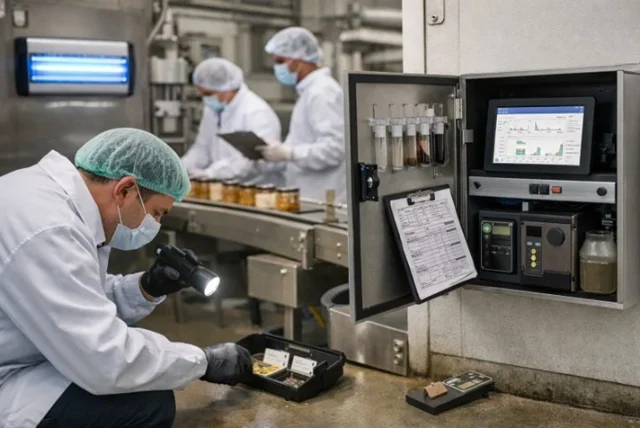
Field Biologist Support
A documented inspection ahead of your audit, written in the language of your standard, identifying each gap with an owner and a date while there is still time to close it before the day.
A field biologist can attend on the day to walk the site with the auditor and answer technical questions on the programme, the risk ratings and the trend data directly.
Where a pest control finding is raised, you get a corrective action plan with owners, dates and evidence requirements, closed out and documented through the portal.
Related Pages
Every audit works from the same evidence, shaped by the standard you are certified to. These pages cover the standards and documents the pest control section is built on.
How a certified food site builds the complete pest control file its auditor expects to see, document by document.
What clause 4.14 asks for and how Shield builds a programme to meet it, from survey to trend analysis.
Proportionate, achievable pest control for smaller UK food and drink producers, without BRCGS overhead.
Points-scored auditing with heavy emphasis on root cause analysis and the interpretation of trends.
How a site-specific pest risk assessment sets monitoring, visit frequency and response times for each area.
How supplier codes of practice add to certification, and how one programme is built to meet the strictest.
Client Feedback
“Shield’s audit compliance support for our BRCGS certification has been invaluable. Their knowledge of the standards has made our audits much more streamlined.”
Food Manufacturing
“We’ve been using Shield’s Insectram reporting system and it has changed how we manage pest control. Real-time updates and trend analysis keep us proactive.”
Multi-site Facilities
“Shield’s commercial pest control service is impressive. Their technicians are professional and thorough, ensuring our warehouse remains pest-free.”
Warehousing
Areas We Cover
Based in Selby, Shield prepares food manufacturing, storage, distribution and commercial sites for pest control audits across Yorkshire, the Humber and the North of England. Independent since 2002, BPCA registered, £10m public liability, 24-hour emergency response.
A: The site and the paperwork. On site, the auditor checks for activity, devices, proofing, hygiene and stored goods. In the file, they check the contract, risk assessment, site plan, visit reports, trend analysis, sightings log, corrective actions, product data and training records, and whether all of it matches what they saw.
A: Walk the site with the plan and check every device, reconcile the file so the plan, reports and data sheets are current, close out open recommendations with dated evidence, and brief the staff an auditor may speak to. A pre-audit inspection by a field biologist does the same exercise with a specialist’s eye.
A: The scope and date of the audit, the areas inspected, any pest activity or conditions found, the condition of devices and proofing, a review of the documentation, and each finding with its severity, the corrective action required, an owner and a deadline. Conformity should be recorded as well as non-conformity.
A: Yes. Evidence of pest activity that could reach product, or a programme that cannot be shown to work, can be raised as a major or even critical non-conformity depending on the standard. Most pest findings, though, are documentation gaps that could have been closed before the audit.