
Bird Control & Pigeon Proofing
Pigeons on a roof, gulls on a flat roof, nests in gutters and fouling down a public frontage. Shield surveys the building, works out what is actually holding the birds there, and proofs it: legally, and in a way that is still working in five years.
What Happens
Bird control is proofing, not killing. A technician surveys the building, identifies the species, works out where the birds are roosting, nesting and feeding, and then specifies the physical proofing that denies them the ledge, the void or the roof. Netting closes an open area, post-and-wire makes a ledge unusable, spikes cover a narrow sill, mesh and boxing close a void, and skirting stops pigeons nesting under solar panels. Shield plans and installs the proofing itself, bringing in a scaffolding or access contractor only where the height or the structure demands it. Fouling is removed and the area disinfected before anything is installed, because the guano is the health and safety problem, not the bird.
Where a licence is genuinely required and available, it is applied for and recorded. Everything is written up, and on a contracted site the proofing recommendation sits in the portal with a date and an owner against it.
Proofing Methods
Which one is right is decided by the structure, the species and the access, not by preference. Most sites need two or three of them working together.
The most complete option. A tensioned net closes a courtyard, canopy, plant deck or roof space entirely, and if it is installed properly it is invisible from the ground and lasts for years.
Fine wire on sprung posts, set at a height that makes a ledge, parapet or sign unusable to a pigeon or a gull without changing how the building looks.
For narrow sills, ledges, pipework and signage. Cheap, quick and effective on the right detail, and useless where a nest is already established behind them.
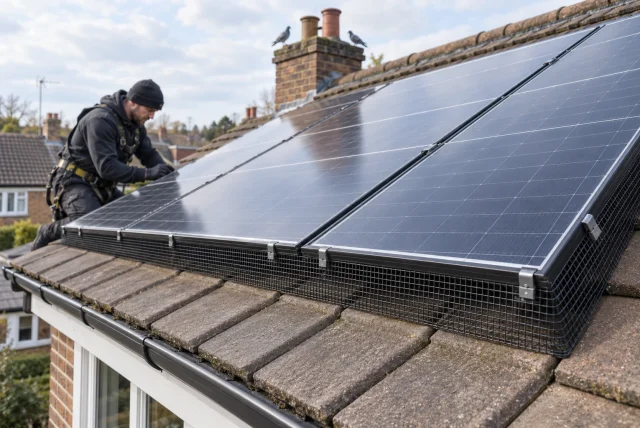
Mesh skirting clipped around the array. Pigeons nesting under panels are one of the fastest-growing bird problems in Yorkshire, and the fouling costs output as well as the warranty.
Roof spaces, eaves, service openings and plant housings shut off in the fabric, which is the only proofing that also keeps rodents and insects out.
Open waste, spillage, feeding by staff or the public, and standing water. Proofing a building that still offers food moves the problem rather than solving it.
The Law
Every wild bird in the UK is protected, along with its nest while that nest is in use or being built, and its eggs. That is the Wildlife and Countryside Act 1981, and it is why the honest answer to can you remove the nest is usually no, not yet. Feral pigeons and a small number of other species can be controlled, but only where a general licence applies, only where non-lethal methods have genuinely been tried first, and only for a permitted reason such as public health.
Gulls are more restricted again and normally need an individual licence applied for case by case. Shield will tell you which of these you are dealing with before quoting anything. Nests in a gutter, a chimney or a solar array are cleared once the birds have finished with them, and the opening is proofed the same day so there is nothing to clear next season.
Fouling Removal
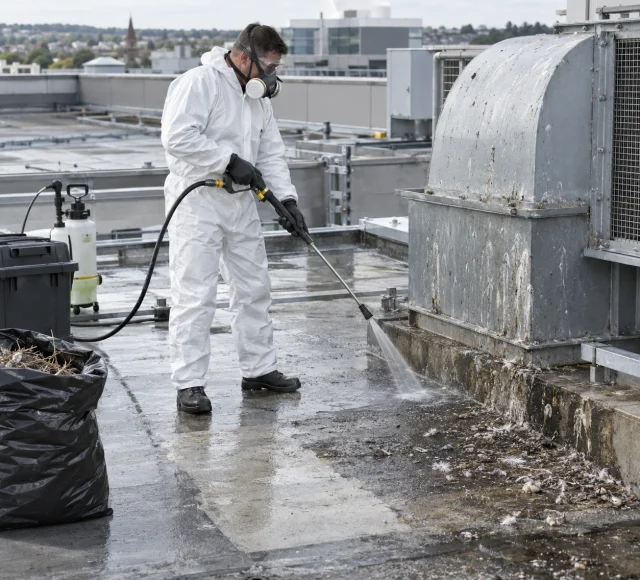
Any level of bird activity produces fouling. Wet droppings on steps, a walkway or a loading bay are a genuine slip hazard and a genuine liability. Accumulated guano in a roof space or on plant carries ornithosis and salmonella and supports a secondary insect population of its own, and it is acidic enough to damage the fabric it sits on. Shield’s bio-clean service removes the fouling, the nest debris and the associated insects, disinfects the area and leaves it ready for proofing, which is the right order, because proofing over contaminated fabric seals the problem in. On food sites the clean is recorded with the products used, because an auditor will ask.

Commercial Bird Control
Food manufacturing, warehousing, retail parks, offices, schools and farms all get the same three problems: birds inside the building through open doors and intake bays, fouling on the parts of the site the public can see, and nesting in the roof structure. Under BRCGS, SALSA and Red Tractor the expectation is proofing and documented control rather than a reaction each spring, and a bird flying over an open production line is a non-conformance waiting to be written. Shield surveys the whole envelope, not the ledge somebody pointed at, specifies the proofing in priority order with the fabric work the building actually needs, and where the site is contracted the whole thing is tracked to close-out.
How We Work
Roof, parapets, plant, canopies, intake bays, gutters and solar. Proofing one ledge on a building that offers thirty moves the birds twenty feet.
Feral pigeon, woodpigeon, gull, starling, house sparrow and swallow are not the same job legally or practically, and the difference decides what is possible.
The right method for that detail, fixed properly, on materials that survive a Yorkshire winter. Bad proofing fails in a year and takes the fabric with it.
Species, locations, method, materials and any licence position, with photographs. On contracted sites it is in the Insectram portal with a date and an owner against every recommendation.
Domestic
The two calls we get most from householders are pigeons nesting under solar panels and birds nesting in a gutter or a chimney. Both follow the same rule as a commercial job: while the nest is active it stays, and the work happens once the birds have finished, at which point the debris is cleared and the opening is proofed so it does not recur.
Solar arrays are proofed with mesh skirting clipped to the panel frame rather than fixed through the roof, which keeps the installer’s warranty intact. What we will not do is take an active nest out because it is inconvenient, and any contractor who offers to is telling you something about how they work.
AI Pest Management
Bird work is where pest control reports usually go to die: the same proofing raised every spring, photographed, and never actioned. In Insectram each recommendation carries a location on the site plan, a photograph, an owner and a date, and it stays open until it is evidenced as done. The trend analysis shows the auditor a closing pattern rather than a repeating one, which is the difference between a finding and a pass.

Areas We Cover
Based in Selby, Shield covers commercial and domestic property across Yorkshire, the Humber and the North of England. Independent since 2002, BPCA registered, CRRU compliant, £10m public liability, 24-hour emergency response.
Tell us what the building is, where the birds are sitting and whether there is fouling to deal with. A photograph from the ground helps more than a description. We will tell you what is legally possible before we tell you what it costs.
A: Not while it is in use. Every wild bird's nest is protected in law while it is being built or used, so an active nest stays where it is whatever the inconvenience. Once the birds have finished, the nest and the fouling are removed and the opening is proofed the same visit, which is the only part of this that stops it happening again next spring. Feral pigeons sit under a general licence and can sometimes be controlled where non-lethal methods have genuinely been tried first, and we will tell you honestly which situation you are in.
A: Netting and post-and-wire installed properly on sound fabric are a ten-year answer, not a season. Spikes on the right detail last as long as the fixing does. What fails early is proofing fitted to the wrong detail, fitted over existing fouling, or fitted to fabric that needed repair first, which is why the survey matters more than the product.
A: Gulls are more heavily protected than pigeons and normally need an individual licence applied for case by case, so the answer is not a simple yes. What can almost always be done without a licence is proofing: denying the roof, the parapet and the plant the nesting space in the first place, ahead of the season rather than during it. We will tell you what applies to your building before quoting.