
Commercial Pest Control by Wakefield Pest Controllers
Shield Pest Management works with distribution and logistics sites, food storage, retail, regeneration projects and civic estates across Wakefield. Independent and established in 2002, with every visit documented to the standard your auditor expects. BPCA approved Wakefield pest controllers come with a guarantee of experience, expertise, training and insurance cover.
Over 20 years of commercial experience
Fully insured operations, nationwide
Out-of-hours response across the North
BRCGS, SALSA, Red Tractor, ISO 22000
BPCA · NPTA · TrustMark · RSPH Level 2 · CHAS · CRRU / Think Wildlife
Covering Wakefield
Shield runs its Wakefield work from Selby, half an hour along the M62 to junction 30 and the distribution parks around it. Wakefield sits on the same technician patch as Leeds, Castleford, Pontefract and Normanton, so an operator with sites across West Yorkshire is covered by one team and one set of records.
We are a regional contractor rather than a national with a Wakefield call centre, and we would rather say that than imply otherwise. What a Wakefield site needs is the same technician every visit, one who knows the perimeter, the door line and the goods-in route, and who can be on site when a customer audit is called at short notice.
Premises We Cover
A motorway junction, four distribution and business parks, a regenerating city centre and a major hospital. Different premises, different pest pressures, and one set of records.
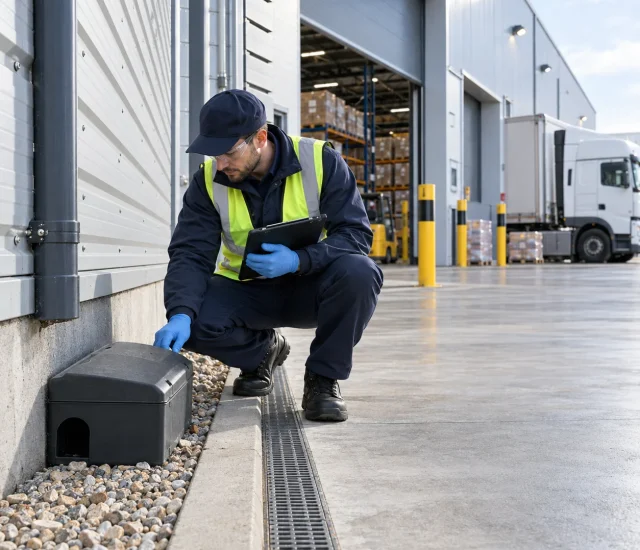
Distribution sheds at Wakefield Hub, Wakefield 41 and M62 junction 30, where goods-in, loading doors and the perimeter carry most of the pressure.
Calder Park and Silkwood Park, where offices, light industrial units and trade counters share landscaping, service yards and a common waste route.
Chilled, frozen and ambient stock moving in volume across the region, where goods-in checks belong in the programme rather than left to the visit.
Trinity Walk, Westgate Retail and Leisure Park and the city-centre food trade, serviced outside trading hours and recorded for the EHO file you keep.
Rutland Mills, Tileyard North and the older central buildings along the Calder, where voids and service routes were never designed to be sealed.
Pinderfields Hospital and the civic and education estate, where discretion, lowest-toxicity options and an auditable record come before anything.
Local Pest Pressure
Wakefield is a junction, and so are its sites. Where the M1 meets the M62, a large share of the premises belong to operators with sites elsewhere in the region. The Wakefield shed is one node in a network, and a pest programme that holds a different standard at each site produces an audit trail that falls apart the moment a customer compares them.
Goods-in is the front door. Stock that has stood in yards across the country arrives every hour of the day, so goods-in is a control point rather than a formality, and the checks there are written into the programme.
A finding is only finished when it is closed. The most common audit failure is not a pest sighting. It is a recommendation made months ago that nobody actioned, sitting in a report nobody reread. Every Shield recommendation is logged as an action with an owner and a date, and stays open until it has been verified as done.
The older city has its own pressures. Rutland Mills, Tileyard North and the buildings along the Calder carry service voids, shared drainage and steady river-side rodent pressure that proofing deals with far better than treatment ever does.
Sector Specialisms
Programmes are written around the standard a site is audited against, not around a generic service schedule.

Documented, risk-assessed programmes for the food storage, packing and distribution sites around the M1 and M62, written around BRCGS, SALSA and retailer schemes.

The sector that defines this city. Sheds at Wakefield Hub, Wakefield 41 and junction 30, where goods-in, the loading doors and the perimeter carry the pressure.

Programmes built around continuous production, wash-down regimes and strict zoning, with the work planned around your shift patterns rather than against them.

Discreet, scheduled servicing for the city-centre, Trinity Walk and Westgate restaurants, bars and cafes, carried out before trading rather than in front of guests.

Pinderfields Hospital, the colleges and the schools estate, needing lowest-toxicity options, documented records and technicians who work around the building users.

Low-visibility servicing outside trading hours for Trinity Walk, Westgate and the Calder Park and Silkwood Park offices, with bird proofing and rodent prevention.
Pest Management
A full site survey and pest risk assessment covering storage, goods-in, loading doors, the yard and the perimeter, with entry points written down rather than remembered.
Proofing, exclusion and environmental recommendations that remove the conditions pests need, each one logged as an action with an owner and a date to be closed by.
Devices, electronic fly killers and trend data show what is happening between visits, which is the first thing an auditor and an environmental health officer ask to see.
Proportionate, CRRU-compliant intervention only where the risk assessment justifies it, recorded with the reason it was used. That record is what an auditor asks for.
Audit Compliance
Food storage and distribution sites answer to BRCGS, SALSA and the retailers they supply, and customers audit the whole network. Shield builds around the standard you face.
The leading scheme for UK small food and drink producers, built around your scale.
Britain’s largest food and farm assurance scheme, for farms, packing and processing.
Rigorous global food safety auditing, with trend analysis and root cause documentation.
The international food safety management standard, with pest control inside your FSMS.
GFSI-recognised and retail-approved, with documentation to satisfies global supply chains.
AI Pest Management
Pest activity, device readings, trend data, recommendations and outstanding corrective actions, in one portal, available to your team and to an auditor on the same day. Open actions stay visible until they are closed, across every site in the network rather than one folder each.

Pests We Treat
Each of these goes through to how Shield Pest Management handles it. If what you have is not listed, the answer is still a survey rather than a guess.
Rats and mice at goods-in, in voids and along the perimeter of the distribution parks. Baiting is the last step, not the first, and CRRU rules apply on every site.
Beetles, weevils, psocids and moths in dry goods, ingredients and packaging held in distribution. Pheromone monitoring finds them before a customer ever does.
Drains and wet areas after wash-down are the usual source. Unit placement, lamp changes and catch-tray counts all form part of the audit record for your site.
Pigeons and gulls on shed roofs, canopies, gantries and open loading doors. Netting, spikes and wire fitted by Shield, with the fouling cleared and sanitised first.
Commercial kitchens, plant rooms, cellars and warm voids. Gel baiting and monitoring rather than sprays, because a spray scatters a population across a building.
Nests in roof voids, cladding and yard structures, treated with trading hours and pedestrian routes in mind rather than at the first convenient opportunity.
Bait that reaches the colony rather than sprays that only scatter the trail. In food premises the nest is usually outside, under the paving or the loading bay.
The fabric work that prevents the next pest problem, from a loading door seal to a mill void. Shield carries this work out itself rather than only specifying it.
Areas We Cover
Wakefield sits half an hour from the Selby base, on the same technician patch as Leeds, Castleford, Pontefract and Normanton, so an operator with sites across the region is covered by one team and one set of records.
Client Feedback
“Shield’s commercial pest control service is impressive. Their technicians are professional and thorough, ensuring our warehouse remains pest-free.”
Warehousing
“Shield’s audit compliance support for our BRCGS certification has been invaluable. Their knowledge of the standards has made our audits much more streamlined.”
Food Manufacturing
“We’ve been using Shield’s Insectram reporting system and it has changed how we manage pest control. Real-time updates and trend analysis keep us proactive.”
Multi-site Facilities
Tell us the site, the standard you are audited against and what has been seen. A BPCA approved Wakefield pest controller will survey the premises, identify the pressures and set out the programme and the evidence it produces.
A: Yes. Shield covers Wakefield from its Selby base, half an hour along the M62, on the same technician patch as Leeds, Castleford, Pontefract and Normanton. An operator with sites across West Yorkshire is handled by one team under one set of records. Every one of our Wakefield pest controllers is BPCA qualified and fully insured.
A: Yes. A Wakefield distribution site is often one of several in the region. Shield runs one programme, one risk assessment method and one reporting view across all of them, so a customer or an auditor comparing sites sees the same standard at every one.
A: Every recommendation from a Shield visit is logged in Insectram as an action with an owner and a date. It stays open, and visible to your team and to an auditor, until it is verified as done. Most repeat audit findings are old recommendations that nobody closed.
A: Both. Most commercial sites are on a contract because a standard requires continuous monitoring and documented evidence, but Shield will attend a single job and often does. It frequently leads to a wider conversation about the site, which is the point.
A: A Shield field biologist walks the site with you, covering storage, goods-in, loading doors, the yard and the perimeter. You get a pest risk assessment identifying entry points, harbourage and existing activity, a proposed programme and a clear account of the evidence it will produce. There is no charge and no obligation.