
Mole Control
Molehills appear faster than anything you can buy to stop them. Trapping is the only method that reliably works, and doing it properly is about reading the tunnels rather than setting more traps.
What Happens
A technician reads the ground before setting anything. Molehills are spoil, not entrances, so the work is finding the main runs beneath them, which are the deep permanent tunnels the animal patrols rather than the shallow feeding runs it abandons. Traps are approved patterns, set in the run itself with the soil sealed behind them so no light or draught reaches the tunnel, because a mole will pack a disturbed run with earth rather than pass through it. Traps are checked on the schedule the law and good practice require.
There is no poison involved: strychnine was withdrawn in 2006 and nothing replaced it for general use. That is why every product sold in a garden centre to get rid of moles is either a deterrent that does not work or a trap set by somebody without the experience to place it.
Where Moles Matter
On a lawn it is an eyesore. On working ground it is damage, contamination or a safety issue, and the case for dealing with it is different in each.
The commonest call. Molehills, collapsed runs underfoot and a lawn that cannot be mown flat, usually caused by a single animal working a surprisingly large territory.
Collapsed runs are a leg injury risk for horses and livestock, and the spoil brings stones to the surface where machinery works.
Cricket squares, bowling greens, football pitches and golf. A single run across a playing surface is both a hazard and a fixture cancelled.
The serious one. Soil in the cut is a listeriosis risk in silage, so molehills on forage ground are a livestock health problem rather than a tidiness problem.
Grounds staff on sites where the surface is expected to be immaculate and where the public is walking across it every day.
Large areas, mature boundaries and constant pressure from surrounding land, which makes this a managed programme rather than a single visit.
How We Work
Molehills tell you where the spoil came out, not where the mole travels. The traps go in the deep permanent runs, which is what separates a result from a fortnight of empty traps.
Handled cleanly, bedded into the run and the entry sealed. A mole that detects light, draught or disturbance will simply block that stretch of tunnel and go round.
Approved patterns only, set to the law, and checked on schedule. Mole trapping is a welfare-sensitive job done badly by a lot of people.
Where a garden backs onto fields, pasture or a golf course, reinvasion is a matter of when. We will say so and price accordingly rather than promise a permanent fix we cannot deliver.
Before You Buy Anything
Almost everything on the shelf is a deterrent, and moles are not deterred. Sonic and vibrating spikes have no reliable effect: a mole tunnels past them, and where they appear to work it is usually because the animal had already finished with that stretch of ground. The same goes for mothballs, bleach, broken glass, chilli powder, smoke pellets bought over the counter and every variation of pouring something unpleasant down a hill.
Two things are actually true and worth knowing. A mole is solitary and territorial, so a lawn covered in hills is very often one animal, not an infestation. And moles do not eat plant roots, so what you are seeing is tunnelling damage and spoil rather than feeding on the garden. Trapping, done by somebody who can read the runs, is the method that works, and it is why this job is priced by skill rather than by product.
Commercial and Agricultural
Soil in the pit is the reason farms take moles seriously. Molehills on forage ground put earth into the cut, and soil in silage is associated with listeria, which makes a tidiness problem into a livestock health and feed quality problem that an assurance inspection will ask about. On grazing and paddocks the issue is collapsed runs and the stones the spoil brings up. On sports surfaces it is a playing hazard and a cancelled fixture.
Shield works these as programmes rather than call-outs, timed to the ground and the season, because on land bordered by fields or rough the question is not whether moles return but how quickly they are dealt with when they do. Every visit is recorded, which matters on assured farms where the inspection asks what the pest control arrangement actually is.

Identification
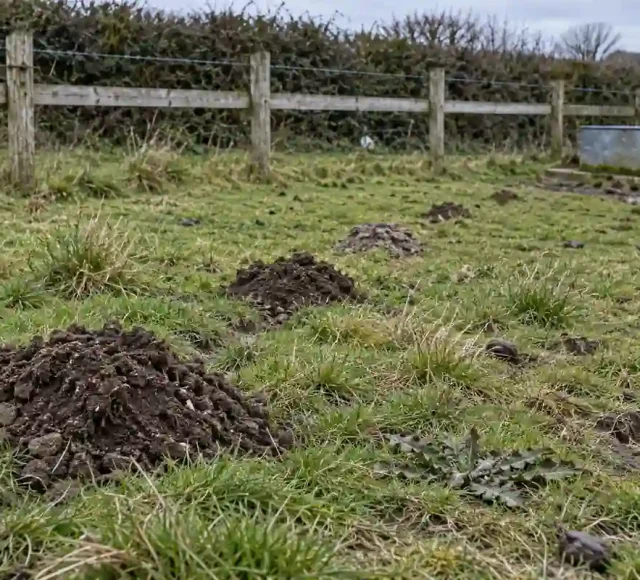
A mole is solitary and holds a territory that can run to several hundred square metres, so a garden covered in fresh hills is normally one animal rather than a colony. That is worth knowing before anybody quotes you per mole. Molehills are loose conical spoil heaps with no visible entrance, which distinguishes them from rat holes, rabbit scrapes and the open burrows of other animals. Surface ridges pushed up across a lawn are shallow feeding runs, often used once and abandoned, while the runs that matter are deeper and reused daily.
Activity peaks from autumn through to spring, and again when young disperse in early summer, which is when a garden that has been quiet for months suddenly produces hills overnight.
Domestic
Most garden jobs are a visit to set, a return to check and clear, and honest advice about what comes next. The lawn itself recovers quickly: the hills are spread or lifted, the runs are firmed, and the grass grows through. What nobody should promise you is that no mole will ever tunnel into your garden again. If you back onto fields, a golf course, a railway embankment or rough ground, the territory next door will be re-occupied at some point.
The sensible arrangement is dealing with it promptly rather than pretending otherwise. What we will not do is sell you a gadget, and we will tell you before attending if we think your situation is going to need more than one visit.

AI Pest Management
On farms, estates and sports grounds, mole work is one part of a wider programme, and the value of recording it is that the pattern becomes visible: which fields, which boundaries, which times of year, and how long after treatment the ground is re-occupied.
In Insectram every visit is mapped and dated, so the work can be timed to the ground rather than to the phone call, and an assurance inspection gets a record rather than a recollection.

Areas We Cover
Based in Selby, Shield covers commercial and domestic property across Yorkshire, the Humber and the North of England. Independent since 2002, BPCA registered, CRRU compliant, £10m public liability, 24-hour emergency response.
A: Almost certainly fewer than you think, and quite possibly one. Moles are solitary and territorial, and a single animal working a territory of several hundred square metres can throw up a lawn full of hills in a few days. That matters before anyone quotes you per mole caught. Where ground is genuinely occupied by more than one, it is usually large ground, or a garden next to fields where separate territories meet.
A: No. Sonic and vibrating spikes have no reliable effect, and neither do mothballs, bleach, chilli powder, broken glass or anything else poured down a hill. Where they seem to work, the mole had usually finished with that stretch of ground anyway. Trapping is the method that works, and there is no poison available for general mole control since strychnine was withdrawn in 2006.
A: If your ground borders fields, rough, a golf course or an embankment, then at some point yes, because the territory will be recolonised from next door. That is not a treatment failure, it is geography. On a garden surrounded by other gardens it is far less likely. We will tell you honestly which situation you are in when we look at the ground, and for working land the sensible arrangement is a programme rather than a one-off.