
Wasp Nest Removal
A wasp nest next to a fire exit, a loading bay or a customer entrance stops work. Shield treats it the same day where we can, with BPCA-qualified technicians, the right access equipment and a written report at the end.
What Happens
A technician identifies the insect and locates the nest entrance, then applies an insecticidal dust or spray to the entrance itself rather than to the visible wasps. Foragers carry it into the nest on their bodies, so the treatment reaches the brood and the queen without the nest having to be opened or reached. Most colonies are dead within a few hours and all activity has normally stopped inside twenty-four. Activity often increases for the first hour as returning wasps meet the treated entrance, which is expected and is not a sign the treatment has failed.
The nest is never sealed or blocked: wasps denied their entrance will chew a new one, frequently into the room below. Where the nest itself has to come out, in food premises and anywhere dead brood would become a contamination or secondary pest problem, it is removed physically once the colony is dead.
How We Work
Wasp, hornet, bee or hoverfly changes everything that follows. Honey bees are not destroyed, bumblebees and solitary bees are left where they are wherever possible, and an Asian hornet is reported rather than treated.
The nest may be three metres into a roof void or behind a soffit. The flight line to the entrance is what matters, and it is the entrance that gets treated.
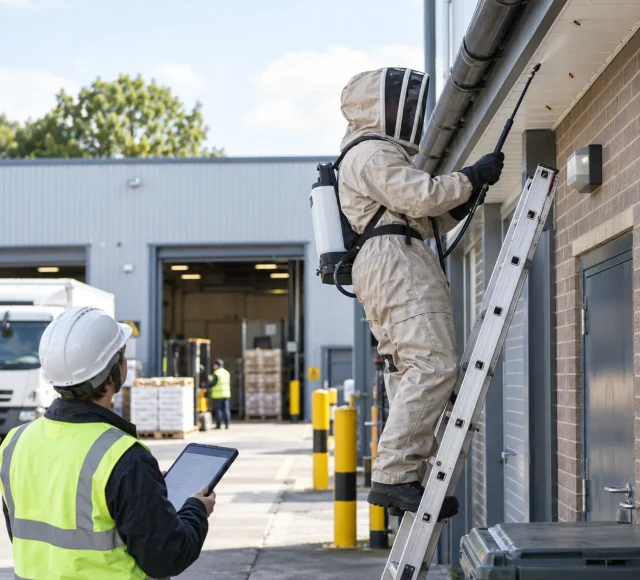
Roof voids, fascias, high gutter lines and flat roofs. Extension lance applicators, ladders and tower access where required, with the area below kept clear while the treatment takes hold.
Every job ends with a report identifying the species, the nest location, the product applied and its safety data, and any proofing needed. On contracted sites it is in the Insectram portal before the technician leaves.
Where We Find Them
Nine out of ten call-outs are one of these. Where the nest sits decides the access equipment, the timing and whether the nest has to be taken out afterwards.
The most common commercial and domestic site by a wide margin. Entry is usually a gap in the fascia, a lifted tile or an unsealed eaves course.
Small, high entrances, often directly above a door or a window where the foot traffic is worst. Treated from the entrance, at height.
Old rodent burrows, embankments, verges and decking. Awkward on grounds and sports surfaces, and easily struck by a mower.
Sheds, stores, plant rooms and waste compounds, where a nest is often not noticed until the colony is already large.
Exposed aerial nests, more common with median wasps. Usually found by a grounds team mid-cut, which is how most stings on site happen.
Cavity cladding, boxing, service risers and external plant housings on commercial units, where the access dictates the method.
Commercial Wasp Control
Food manufacturing, hospitality, warehousing, schools, care settings and farms all have the same two problems with a wasp nest. In late summer wasps move off protein and onto sugar, which is what brings them into production areas, bin stores, canteens, loading bays and outside seating. Under BRCGS, SALSA, Red Tractor and the other audited standards the sighting is not the failure. Not being able to show what you did about it is.
Shield treats the nest, removes it where removal is warranted, records the species, location, product and date, and adds the proofing recommendation to the site file. On a contracted site the whole record sits in Insectram, with a monitoring point added where the nest location is one that will be used again.

Identification
Common wasps and German wasps account for most UK nests, with median wasps responsible for the exposed nests found in hedges and shrubs.
European hornets look alarming and are noticeably larger, but are far less aggressive than a wasp colony and are treated only where the nest is genuinely in the way.
Honey bees are not treated at all: a swarm is a job for a local beekeeper and we will point you at one. Bumblebee and solitary bee nests are small, short-lived and left alone unless the location makes that impossible.
Any suspected Asian hornet is reported to the Non-Native Species Secretariat rather than treated, because sightings are tracked nationally. If you are not sure what you have, send a photograph before booking anything.
The Wasp Year
A queen starts the nest alone in spring, and through early summer the colony is small and largely unnoticed. It grows all season, and by August and September a mature nest holds several thousand workers. That is also the point at which the colony stops rearing brood, the workers lose their protein supply, and they turn to sugar and become far more aggressive, which is exactly when the calls start.
The colony dies off with the first hard frosts and the nest is not reused the following year, so an old nest left in a roof void is not a reason to treat. A new one in the same place is, and it usually means the entry point was never proofed. The useful window is early: a nest found in June is smaller, calmer and quicker to deal with than the same nest in September.
Domestic
Shield is a commercial pest control company by weight of work, and the same technicians handle domestic wasp nests across the same area. It is the service most householders call us about.
The job is identical: identify, treat the entrance, confirm the colony is dead, and tell you what needs sealing so it does not happen again in the same spot. What we will not do is send you up a ladder.
Treating a nest at height, in a loft, or anywhere the colony can turn on you is the part of this job that puts people in hospital, and shop-bought aerosols aimed at a nest entrance tend to provoke rather than kill.

AI Pest Management
On a contracted site the wasp treatment is logged like any other visit: species, location on the site plan, product and safety data sheet, and the proofing recommendation with an owner and a date against it.
When the same eaves detail produces a nest three summers running, the trend analysis shows it rather than somebody remembering it. Auditors log in and read it instead of asking you for it.

Areas We Cover
Based in Selby, Shield covers commercial and domestic property across Yorkshire, the Humber and the North of England. Independent since 2002, BPCA registered, CRRU compliant, £10m public liability, 24-hour emergency response.
A: Same day in most cases across Yorkshire and the North of England, and Shield runs 24-hour emergency call-out for nests that are stopping work: a nest at a fire exit, a loading bay, a kitchen or a public entrance. Contracted commercial sites take priority and are attended by the technicians who already know the building. The treatment itself usually takes a few minutes, and the colony normally dies within a few hours.
A: Treatment is what kills the colony, and on most domestic and external jobs the nest is then left in place. It will not be reused the following year and nothing is gained by opening up a roof void to retrieve it. In food premises, and anywhere dead brood would be a contamination risk or would attract secondary pests such as larder beetles, the nest is physically removed once the colony is dead and the removal is recorded.
A: We tell you, and we do not treat them. Honey bee swarms are collected by local beekeepers and we will point you towards one. Bumblebee and solitary bee nests are small, die out naturally within weeks and are left alone unless their location makes that genuinely unworkable. Sending a photograph before you book saves everybody a visit.