
BRC Pest Control Standards Explained for Food Sites
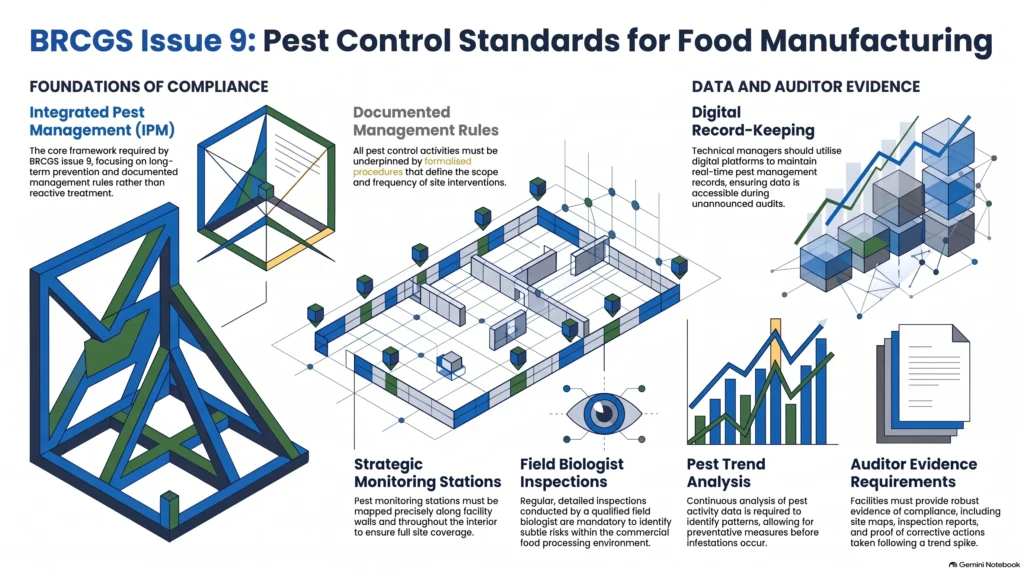
Operating a food production facility under Global Food Safety Initiative benchmarks requires rigorous operational discipline and unyielding proof of hygiene. Modern brc pest control standards demand far more than occasional contractor visits or scattered toxic bait stations. Technical managers must maintain an active, preventive system that protects raw materials, production lines, and finished goods from biological contamination. Meeting these stringent expectations requires clear documentation, robust site defence, and complete traceability across every monitoring point on site.
Audit non-conformances rarely stem from live pest activity alone. They typically arise from systemic administrative gaps, incomplete corrective action logs, and unanalysed trend records across the file. When third-party auditors arrive to inspect your technical data, will your pest control documentation demonstrate total compliance, or will unaddressed recommendations reveal costly oversights?
Related: BRCGS Pest Control for Food Manufacturing and Packing Sites
Key Takeaways
- Clause 4.14 of the standard mandates a preventative, fully documented integrated pest management system designed around site-specific environmental risk assessments.
- Technicians must possess demonstrable competence through recognised qualifications, continuing professional development, and adherence to the Campaign for Responsible Rodenticide Use Code.
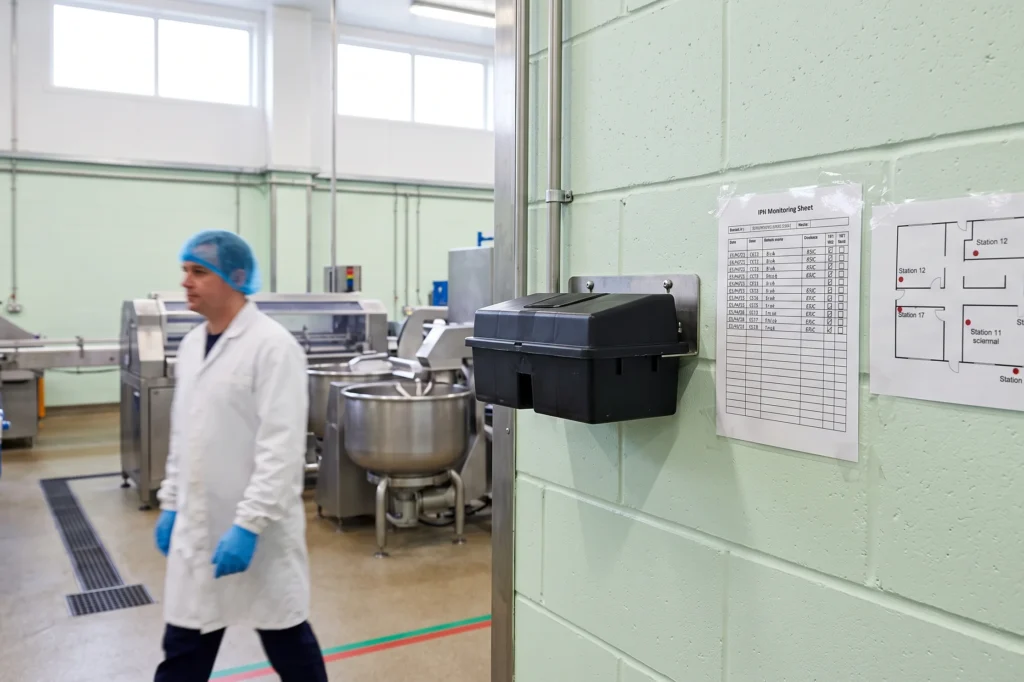
- A detailed site plan must record every numbered monitoring device and match the physical installation across the interior and exterior perimeter exactly.
- Trend analysis requires written interpretation explaining population movements, operational site changes, corrective actions, and subsequent verification rather than presenting raw numerical charts.
- Independent technical inspections by a qualified field biologist provide critical third-party verification that challenges existing preventive measures and highlights hidden risks.
Core Components of Clause 4.14 Compliance
The Global Standard for Food Safety addresses pest exclusion, monitoring, and corrective governance across manufacturing facilities. Achieving compliance requires businesses to establish a defensible prerequisite programme. This framework must actively prevent ingress rather than merely reacting to ongoing biological contamination events on site.
Auditors evaluate the structural integrity of the processing facility alongside recorded technical data. Every routine service visit must yield clear operational evidence. The summary table below outlines the primary compliance pillars, audit evidence expectations, and mandatory governance rules reviewed during third-party certification inspections across modern food sites.
| Standard Element | Mandatory Requirement | Primary Audit Evidence |
|---|---|---|
| Programme Scope | Documented Integrated Pest Management plan | Site manual and risk assessment |
| Device Mapping | Dated and signed layout plan with numbered points | Physical site plan matching live locations |
| Contractor Competence | Verified technical qualifications and continuous training | BPCA certification and BASIS PROMPT records |
| Data Analysis | Documented trend reviews with written commentary | Interpreted graphs and written action notes |
| Expert Oversight | Risk-based in-depth survey by a pest control expert | Field biologist comprehensive inspection reports |
Documented Integrated Pest Management Frameworks
Site-Specific Risk Assessments
A compliant pest programme begins with an exhaustive evaluation of operational hazards across the facility. Technicians examine product vulnerability, moisture sources, structural voids, and neighbouring environmental pressures to establish baseline risks. This documented assessment dictates visit frequency and device placement rather than relying on arbitrary operational habits.
Under brcgs issue 9 pest control rules, auditors inspect these assessments to confirm that controls match actual site risks. High-risk zones, such as open ingredient processing rooms, demand higher monitoring densities and stricter intervention thresholds than external ambient storage units. Technical teams must review and update these assessments whenever processes, structures, or machinery layouts change.
Exclusion and Preventative Controls
Physical proofing serves as the primary barrier against pest ingress across food processing environments. Facilities must eliminate gaps around doors, seal service penetrations, screen open vents, and fit drainage networks with non-return valves. Excluding pests mechanically removes the reliance on chemical interventions, fulfilling core environmental and safety requirements.
When external doors or roller shutters fit poorly, rodents exploit the smallest gaps. House mice require an aperture no wider than a pencil to enter production spaces. A successful Integrated Pest Management programme prioritises maintenance tasks, requiring managers to log, track, and seal physical defects before insects or rodents establish internal harbourage.
Device Mapping and Monitoring Infrastructure
Numbered Device Placement
Every monitoring station across a certified site must feature a durable, legible number that corresponds to central records. Devices include non-toxic rodent monitoring blocks, mechanical traps, electronic fly killers, and pheromone insect traps. Positioning follows precise spatial strategies designed to intercept pests at perimeter boundaries and internal transit routes.
Auditors conduct physical site walks to inspect individual devices, verifying that boxes remain secure, clean, and operational. If an auditor discovers an unlabelled station or finds that a device has moved from its assigned position, they may raise a non-conformance. Toxic rodent baits cannot be used where open product is present, except to treat an active infestation.
Site Plan Maintenance
The facility layout plan forms a vital piece of operational evidence within the compliance file. This document must display every numbered monitoring point, define external boundaries, and outline specific internal hygiene zones. Site management must review, sign, and date the plan annually or immediately following any structural modifications.
Maintaining an accurate map ensures full visibility during regular service routines and third-party audits. Discrepancies between printed drawings and physical locations demonstrate poor administrative governance. Facilities utilising digital platforms retain real-time synchronisation, ensuring device additions, relocations, or removals reflect instantly across central databases without administrative delay.
Did You Know?
BRCGS Food Safety Issue 9 requires pest trend analysis at a minimum annually and in the event of any infestation. The in-depth pest survey must also take place at least once a year, whatever the site risk rating.
Contractor Competence and Professional Qualifications
Technician Certifications
Technical managers cannot delegate compliance risks to unqualified personnel. Service providers must prove technician competence through industry-recognised qualifications, such as the RSPH Level 2 Award in Pest Management. These qualifications ensure operatives understand pest biology, food safety legislation, safe chemical handling, and safe systems of work within sensitive environments.
Professional pest controllers must also maintain active continuing professional development through recognised schemes like BASIS PROMPT. Regular training ensures technicians remain current on evolving legislative updates, emerging treatment methodologies, and rodenticide stewardship protocols. Food manufacturers must retain copies of these qualifications and training registers inside their primary on-site audit file.
Trade Body Membership and Accreditation
Selecting an audited trade body member provides vital assurance of technical competence and quality management. Servicing membership of the British Pest Control Association requires companies to undergo independent operational audits and carry adequate insurance cover. The European standard BS EN 16636 provides additional verification regarding customer service, technical delivery, and record keeping.
Certified service providers maintain strict procedural control over product selection, environmental risk management, and health and safety compliance. For high-care manufacturing, contractors should carry comprehensive public liability cover alongside relevant pre-qualification credentials like CHAS. Partnering with accredited contractors ensures that service delivery satisfies both global food standards and statutory enforcement officers.
Free Pest Control Audit Review
We will review your risk assessment, site plan, visit reports, trend analysis, open recommendations, product records and demo our AI Pest management System.
Trend Analysis and Actionable Data Interpretation
Data Capture Across Zones
Capturing accurate catch records across every visit establishes the baseline metrics needed to evaluate programme success. Technicians log catches by species, count, and precise device location during routine inspections. Recording findings across specific operational zones allows technical managers to separate external baseline activity from critical internal line contamination.
Capturing raw numerical figures satisfies only the initial phase of the data collection requirement. Routine entries in the central pest sightings log by factory floor personnel supplement contractor observations. Food manufacturers must record internal observations promptly, ensuring that unexpected insect activity or minor rodent incursions receive swift professional investigation and documented resolution.
Written Analysis and Commentary
Charts and catch totals without analytical commentary rarely satisfy an auditor. Compliance requires competent interpretation explaining what data shifts indicate about site conditions. Reports must explain whether recorded catches demonstrate seasonal population fluctuations, stock ingress issues, structural proofing failures, or localised deep-cleaning breakdowns.
Interpreted reports must state whether existing corrective actions resolved previously identified activity hotspots. If monitoring data reveals a spike in stored product moths within raw material warehousing, the commentary must identify probable stock sources. The analysis must detail the specific investigations undertaken, root causes established, and preventive controls introduced to secure the zone.
AI Pest Management
AI pest management is pest control delivered with continuous digital monitoring and analytics rather than paper records, with real time data access across a single or multiple sites.
Field Biologist Inspections and Oversight
Technical Survey Objectives
Specialist technical inspections provide critical oversight that extends beyond routine service visits. A qualified field biologist conducts an exhaustive, forensic examination of the entire premises, scrutinising high-level voids, roof lines, motor housings, and hidden service runs. This deep inspection identifies latent risks that routine operational sweeps might overlook.
BRCGS requires these expert surveys at a frequency set by documented risk assessment. In practice, most food sites schedule them quarterly, bi-annually, or annually. The survey challenges existing preventive controls, evaluates external harbourage risks, and assesses operational hygiene standards. The resulting report provides management with an objective assessment of overall pest management effectiveness.
Report Recommendations and Close-Outs
Field biologist reports generate actionable recommendations prioritised by severity and contamination potential. Site managers must integrate these technical findings directly into central corrective action software or physical logs. Every assigned task requires an allocated owner, an agreed completion deadline, and robust documented evidence demonstrating close-out.
Carrying unresolved recommendations across successive audit cycles represents a severe compliance failure. Auditors examine historical reports to verify that engineering, maintenance, and hygiene teams completed the necessary structural repairs or deep cleans. Closing out actions with photographic evidence provides undeniable proof of diligent food safety management.
Rodenticide Stewardship and Regulatory Duties
Environmental Restrictions and Stewardship
Statutory restrictions have fundamentally reshaped rodenticide usage across the food manufacturing and distribution sectors. Professional pest controllers must adhere to the Campaign for Responsible Rodenticide Use Code of Best Practice to protect non-target predatory wildlife. Open-ended permanent toxic baiting around building exteriors is no longer acceptable commercial practice.
Technicians employ non-toxic monitoring baits within external bait stations to detect rodent presence without dispersing harmful toxins. If active infestations appear, professionals deploy rodenticides as targeted, short-term treatments justified by clear physical evidence. All toxic products must be removed once the infestation ceases, returning monitoring boxes to non-toxic detection formulations.
Food Safety Legislation and Due Diligence
Meeting external certification standards ensures simultaneous compliance with fundamental statutory obligations under UK legislation. The Food Safety Act 1990 and the Food Safety and Hygiene (England) Regulations 2013 place statutory duties on operators to maintain hygienic, pest-free premises. Deficient pest management leaves businesses vulnerable to severe enforcement action, including hygiene emergency prohibition notices.
Maintaining complete, verifiable pest control records provides the foundation for a statutory due diligence defence. Demonstrating that the company employed competent contractors, enacted proofing advice, and investigated sightings proves all reasonable precautions were taken. Thorough documentation protects the business from regulatory prosecution, costly product recalls, and severe brand damage.
Audit Day Evidence and Documentation Reviews
Primary Audit Folder Contents
When an auditor requests the pest control file, immediate presentation of an organised, comprehensive system creates vital confidence. The documentation must contain current insurance schedules, technician competencies, service contracts, emergency call-out agreements, and the signed site plan. Every safety data sheet and COSHH assessment for on-site chemicals must remain immediately accessible.
Missing paperwork, unsigned service reports, or outdated chemical registries delay audits and raise immediate doubts regarding operational control. Food businesses must organise documentation systematically, ensuring that routine service records, sightings entries, and material safety data link seamlessly. A thoroughly prepared compliance folder demonstrates total governance before the auditor commences physical inspections.
Live Corrective Action Verification
Auditors cross-reference physical site observations directly against entries recorded within service visit sheets and corrective action logs. If an auditor spots damaged door brush strips, they will check whether the technician previously identified the fault. They will then demand proof that management resolved the defect within the specified timeframe.
Maintaining a closed-loop action tracker eliminates discrepancies between physical conditions and administrative records. Dedicated digital management portals allow technical teams to attach completion photographs and maintenance work-order sign-offs to specific recommendations. Presenting time-stamped proof of completed repairs satisfies auditor scrutiny and confirms robust interdepartmental cooperation.
Final Thoughts
Maintaining exemplary brc pest control standards requires constant vigilance, interdepartmental alignment, and detailed administrative discipline across every operational tier. Compliance cannot exist as an isolated, outsourced function managed solely by an attending pest contractor. Food safety excellence demands that production, engineering, hygiene, and technical teams actively collaborate to eliminate harbourage, maintain physical proofing, and report early signs of activity. Modern certification schemes hold manufacturers directly accountable for understanding their own data and validating the effectiveness of installed controls.
As food safety certification frameworks evolve, the reliance on automated monitoring, real-time reporting platforms, and biological exclusion will deepen. Facilities that proactively modernise their pest infrastructure, eliminate open corrective actions, and practise rigorous environmental stewardship will consistently achieve smooth audit outcomes. Treating pest management as a proactive quality culture rather than a reactive necessity protects processing integrity, brand reputation, and consumer safety.
Request a Free Site Survey
Frequently Asked Questions
A:
The standard mandates a documented Integrated Pest Management programme designed around formal site risk assessments. Facilities must deploy numbered, mapped monitoring devices and maintain an accurate, signed site plan. In addition, food businesses must retain verified contractor competence records. Sites must also provide ongoing staff awareness training, maintain active employee sightings logs, review interpreted trend data, and complete regular field biologist inspections.
A:
Permanent toxic rodenticide baiting is not permitted as routine preventive control outside buildings under the CRRU Code of Best Practice. Technicians must utilise non-toxic monitoring formulations or mechanical traps to detect pest presence around the perimeter. Toxic rodenticides are deployed strictly as targeted, temporary interventions where active infestations are confirmed. All toxic baits must be completely removed once control is achieved.
A:
Field biologist survey frequencies depend upon documented site-specific risk assessments, operational sensitivities, and retailer codes of practice governing the facility. Clause 4.14 sets a minimum of one in-depth survey per year. High-care processing environments often schedule quarterly or bi-annual inspections. Lower-risk ambient storage or packaging warehouses often require annual reviews. The risk assessment justifying the chosen frequency must be retained in the audit file, signed off by management, and reviewed whenever operational changes occur.
A:
Acceptable trend analysis requires graphical or tabular representations of recorded pest activity plotted over time, paired directly with competent written interpretation. Auditors routinely treat raw catch data without commentary as an incomplete requirement. The written commentary must assess whether activity is rising or falling and evaluate potential environmental root causes. It must also reference operational changes and examine whether past corrective actions delivered measurable control.
A:
Repeated or overdue corrective actions carried across multiple consecutive service visits frequently result in formal audit non-conformances. Auditors treat unresolved recommendations as evidence of a systemic operational breakdown between identifying site risks and implementing physical controls. Food facilities must assign named internal owners and realistic completion deadlines to every recommendation. Staff must provide robust photographic or maintenance work-order evidence whenever signing off completed corrective actions.



By choosing Shield Pest Management, you’re partnering with a company that combines local expertise with industry-leading practices. Our commitment to quality, compliance, and customer satisfaction makes us an ideal choice for both residential and commercial pest control needs.