

Pest Control Audit Report: What It Must Contain
In regulated commercial sectors, a pest control audit report bridges routine pest management and certified compliance. Quality directors and site technical managers rely on these comprehensive inspection records during third-party audits against BRCGS Issue 9 and SALSA Issue 7. The report confirms that preventive barriers, monitoring devices, and hygiene regimes operate effectively. When an auditor reviews your folder, this structured report establishes statutory due diligence under UK legislation. It demonstrates active management, operational transparency, and environmental control across every facility zone.
Site managers often question how technical reports record routine visits, grade physical findings, and justify chemical treatments under stewardship rules. Does your facility maintain an accurate evidence trail that satisfies external scrutiny, demonstrates active prevention, and directs timely corrective actions before minor environmental defects become major operational non-conformances during an audit?
Related: Pest Control Audit Folder Checklist
Key Takeaways
- A professional pest control audit report provides documentary evidence to support a statutory due diligence defence under section 21 of the Food Safety Act 1990.
- Every site report must record device inspection outcomes, hygiene defects, proofing failures, and full chemical details compliant with current CRRU stewardship guidelines.
- Auditors separate observations from formal non-conformances based on contamination risk, recurrence across consecutive visits, and the speed of documented corrective action close-out.
- Trend analysis requires written professional interpretation rather than raw catch charts alone, identifying seasonal activity shifts across operational zones to guide targeted preventative interventions.
- Digital reporting platforms capture verifiable on-site timestamps and linked photographs, removing the mapping discrepancies common to legacy paper folders during third-party audits.
Essential Components of a Compliant Audit Report
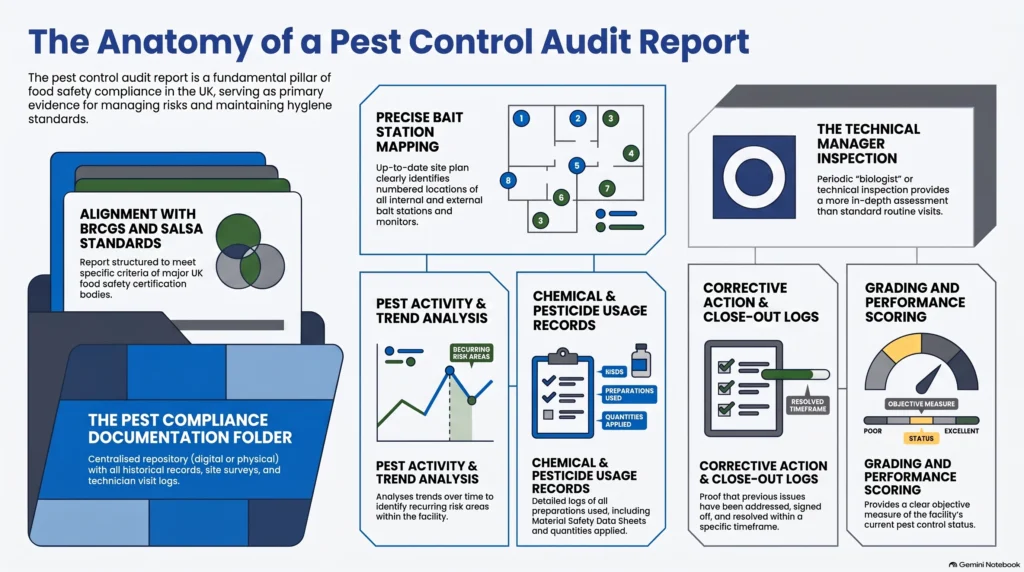
Knowing what a pest control audit report should contain allows site managers to verify their documentation before formal third-party audits. A comprehensive report provides an unbroken record of site activity, inspection data, and statutory compliance. Technical auditors expect reports to detail physical device checks alongside environmental conditions, proofing vulnerabilities, and chemical applications.
Certification bodies scrutinise documentation to ensure pest contractors operate within agreed service specifications and UK legal standards. The table below outlines the primary components required within commercial pest inspection records. Each entry represents a vital data layer needed to satisfy auditor scrutiny under schemes such as BRCGS Issue 9 and SALSA Issue 7.
| Component | Audit Standard Requirement | Operational Purpose |
|---|---|---|
| Device Inspection Log | Numbered check of every mapped monitoring point | Confirms physical verification and reveals localised activity |
| Action Grading and Categorisation | Classification of observations versus non-conformances | Prioritises critical site repairs based on food safety risk |
| Chemical and Biocide Records | Full product names, quantities, and CRRU justifications | Verifies regulatory compliance and statutory pesticide stewardship |
| Trend Analysis and Interpretation | Statistical review with written technical commentary | Demonstrates active risk reduction across consecutive inspection cycles |
| Corrective Action Evidence | Named ownership, target deadlines, and photographic sign-off | Proves closed-loop accountability for identified site defects |
Core Data Recorded During Professional Site Inspections
Device Inspection Logs and Physical Monitoring Data
The device inspection log records the physical status of every numbered monitoring point across the site plan. Technicians inspect internal non-toxic monitors, external bait stations, and insect light traps, noting evidence of activity or physical tampering. Auditors examine these individual records to confirm complete site coverage during each contracted attendance.
When technicians skip devices or record generic checkmarks without location-specific findings, the integrity of the audit trail fails. Modern audit compliance standards demand individual device validation. Missing stations indicate unmonitored ingress routes where rodents or crawling insects can establish harbourage undetected.
Hygiene Observations and Proofing Recommendations
A thorough report details structural defects and environmental hygiene conditions that create pest harbourage or feeding sources. Technicians document damaged door brush strips, unsealed service penetrations, drain defects, and organic waste accumulations. These findings provide site engineering and cleaning teams with direct targets for preventative maintenance.
Auditors pay close attention to recommendations concerning loading dock seals, roller shutter clearances, and floor gullies. Recurring waste spillages or unsealed cable conduits without action show poor environmental control. Auditors treat this pattern as a management breakdown rather than an isolated contractor note.
Severity Grades and Risk Frameworks for Site Findings
Distinction Between Observations and Non-Conformances
Reports must distinguish between minor environmental observations and critical non-conformances that threaten product safety. An observation represents an isolated maintenance defect, such as a worn seal on an external door. A non-conformance denotes an uncontained pest presence, direct food contamination risk, or a systemic failure to rectify previous findings.
Conflating these two classifications causes administrative confusion. Treating active rodent ingress as a routine observation exposes the site to severe audit penalties. Clear grading ensures site leadership allocates capital and labour to high-risk hazards before inspectors arrive.
Severity Categories and Risk Prioritisation
Technical reports categorise hazards into critical, major, and minor risk classifications to establish clear response timelines. Critical findings require immediate operational shutdown or containment within hours. Major defects demand formal corrective action plans within days. Minor issues follow routine maintenance cycles to prevent gradual hygiene deterioration across sensitive facility zones.
Risk scoring reflects the vulnerability of the operational area. A loose mortar joint in an external aggregate yard ranks as a minor issue. However, the same structural defect adjacent to an open high-care production line represents a major hazard. This vulnerability requires immediate proofing and environmental monitoring.
Did You Know?
Under section 4 of the Prevention of Damage by Pests Act 1949, the occupier of non-agricultural land must notify the local authority in writing when rats or mice are living on or resorting to the land in substantial numbers.
Pesticide Usage and Environmental Stewardship Records
Statutory Chemical Application Logs
The audit documentation must account for every professional pesticide and rodenticide applied within the facility boundary. Technicians record exact chemical trade names, active ingredients, batch numbers, targeted pest species, and precise deployment volumes. These entries demonstrate compliance with the Control of Substances Hazardous to Health Regulations 2002.
Site managers must maintain corresponding safety data sheets and COSHH assessments within the primary compliance file. Applying toxic bait without recording the exact weight placed and recovered creates legal risk. The business cannot prove safe chemical custody during an audit without these records.
CRRU Compliance and Justification Statements
Under Campaign for Responsible Rodenticide Use guidelines, reports must record environmental risk assessments before any toxic bait deployment. Permanent toxic baiting around building exteriors is no longer acceptable practice without documented evidence of active infestation. Technicians must justify why non-chemical proofing and trapping methods proved insufficient.
Restricting difenacoum and bromadiolone to use in and around buildings reinforces this documentation duty. Auditors expect reports to detail carcass searches, wildlife risk evaluations, and bait retrieval dates. These records ensure toxic compounds leave the site promptly once technicians resolve the infestation.
Free Pest Control Audit Review
We will review your risk assessment, site plan, visit reports, trend analysis, open recommendations, product records and demo our AI Pest management System.
Trend Analysis and Activity Interpretation
Statistical Mapping Across Operational Zones
Trend analysis compiles historical catch data, monitoring checks, and recorded sightings across specific operational zones over time. Rather than treating each visit as an isolated event, statistical mapping highlights emerging seasonal pressures. It identifies persistent harbourage zones and recurring insect catches across warehouse perimeters, processing lines, and external waste yards.
Evaluating data across distinct zones helps technical teams allocate resources efficiently. When catch rates spike within goods-in areas whilst production halls remain clear, managers focus on incoming supplier pallets. They do not need to assume widespread internal proofing failures.
Written Technical Commentary and Expert Interpretation
A compliant audit report pairs raw numerical charts with written professional interpretation by a qualified technician or field biologist. The commentary explains the biological cause behind recorded data changes and seasonal environmental factors. It evaluates intervention success and recommends specific operational adjustments to maintain long-term pest exclusion.
Auditors assessing sites against BRCGS pest control requirements frequently raise findings where charts lack narrative analysis. An auditor views uninterpreted bar graphs as raw data rather than active management. Technical commentary confirms that the business understands its genuine risk profile.
AI Pest Management
AI pest management is pest control delivered with continuous digital monitoring and analytics rather than paper records, with real time data access across a single or multiple sites.
Corrective Action Management and Close-Out Protocols
Assigned Ownership and Resolution Deadlines
Every recommendation within an inspection report must transition into a formal corrective action with designated ownership and target deadlines. The report assigns tasks directly to internal departments, such as engineering for proofing repairs or hygiene for waste removal. Named accountability ensures structural and sanitation recommendations achieve prompt resolution.
Recommendations left without assigned owners or completion target dates inevitably languish across multiple service cycles. When an auditor discovers the same defect repeated on consecutive service reports, they raise a major non-conformance. This failure highlights ineffective pest governance.
Physical Evidence and Verification Sign-Off
Closing a corrective action requires physical proof rather than simple verbal assertion on the service document. Technicians or site managers must record date-stamped photographic evidence, completed maintenance work orders, or re-inspection signatures. This verifiable trail proves that the business executed the repair to an acceptable preventative standard.
Proper verification prevents recurring defects. Replacing a dock leveller seal requires a photograph showing zero light penetration along the base. The visiting technician inspects the completed work during the next scheduled visit, recording final closure within the database.
How Report Findings Shape Future Service Cycles
Follow-Up Inspections and Frequency Reviews
Findings from the pest control audit report directly establish inspection priorities and device checks for future site visits. Persistent activity triggers mandatory follow-up treatments. Risk profile changes dictate whether contracted visit frequencies must increase under the risk assessment to manage emerging biological pressure.
Rigid service schedules that never adapt to inspection findings violate modern Integrated Pest Management methodologies. When an audit report highlights recurring mouse activity within a packaging store, the technician schedules targeted follow-ups within days. They should not wait for the next routine monthly visit.
Internal Sightings Log Reconciliation
The technician must cross-reference on-site inspection findings with the internal pest sightings log maintained by facility employees. Each recorded staff sighting requires a documented contractor investigation. The technician identifies the entry point, the species involved, and the corrective treatment applied to resolve the incident.
Auditors review the employee sightings log alongside the formal service report to assess site-wide food safety culture. An empty sightings log paired with rodent activity in ceiling voids indicates inadequate staff awareness. It points to poor internal communication, raising immediate compliance concerns.
Digital Reporting Platforms Versus Legacy Paper Documentation
Real-Time Timestamps and Cloud Verification
Digital pest audit documentation provides instantaneous cloud recording with tamper-proof timestamps and embedded GPS verification. Reports completed directly on handheld mobile devices confirm the technician inspected each monitoring station at the stated time. This transparency removes the audit risks associated with illegible handwriting and retrospectively compiled paper folders.
Dedicated platforms allow facility managers to grant auditors secure, read-only digital access during annual assessments. Auditors can review inspection histories, chemical usage logs, and trend analyses instantly. This expedites document review and verifies that all records remained current throughout the year.
Dynamic Device Mapping and Interactive Records
Digital reporting links inspection logs directly to an interactive, dated site plan displaying every numbered monitoring device. When technicians relocate stations or adjust monitoring density to reflect factory layout changes, the digital layout updates immediately. This ensures physical installations always match the official audit documentation precisely.
Legacy paper plans often diverge from factory realities as equipment moves or building extensions open. When an auditor discovers physical bait boxes in unmapped locations, they issue an immediate non-conformance. Inaccurate device layout documentation undermines site audit readiness.
Final Thoughts
Maintaining an exhaustive, professional pest control audit report is an operational necessity for any business audited against UK standards. A compliant report does far more than record routine station checks. It details structural proofing, manages chemical stewardship, and tracks corrective actions through to verified completion. Quality directors who treat documentation as a core operational control protect their facilities from sudden audit failures and regulatory enforcement.
As third-party standards evolve and stewardship rules tighten, paper reporting will continue to give way to digital platforms. Facilities that embrace real-time data capture, action tracking, and interpreted trend analysis will consistently demonstrate compliance. These practices keep pest defences resilient against biological risks and unannounced audit scrutiny.
Request a Free Site Survey
Frequently Asked Questions
A:
An observation identifies an environmental, hygiene, or structural condition that could facilitate pest access or harbourage. Examples include a damaged door brush strip or minor product spillage. In contrast, a non-conformance represents a direct breach of audit standards. This includes active rodent presence in production, uncontained pest ingress, missing statutory documentation, or repeated failure to rectify previous observations. Non-conformances require formal corrective action plans with strict completion deadlines. They can threaten certification status if left unresolved.
A:
BRCGS Issue 9 requires sites to assess and analyse pest inspection results for trends on a regular basis. As a minimum, this happens annually or in the event of an infestation. A compliant report plots catches and sightings across operational zones over time. This identifies emerging patterns, seasonal increases, or localised device failures. Auditors also expect written interpretation from a competent technician or field biologist. The commentary explains what the data indicates and whether previous interventions succeeded. The standard requires the analysis to drive improvements to the pest management procedures.
A:
The report must detail every chemical application on site. Recorded data includes product trade names, active ingredient concentrations, batch numbers, targeted species, and specific quantities deployed or retrieved. Under UK legislation and CRRU stewardship rules, technicians must document environmental risk assessments justifying rodenticide use over non-toxic alternatives. Furthermore, the master audit file must contain current Safety Data Sheets and product label approvals. Site-specific COSHH risk assessments are also mandatory for every biocide held on the premises. Missing chemical paperwork constitutes a significant audit breach.
A:
Repeat recommendations indicate an operational failure in the site's corrective action workflow. When an auditor sees the same proofing defect repeated across consecutive visits without resolution, it demonstrates poor food safety culture. It also reveals ineffective management governance. Auditors expect sites to assign named owners and completion dates to every recommendation. Sites must provide verifiable photographic proof or completed work orders once repairs finish. Without prompt close-out evidence, repeat findings will escalate into formal non-conformances during certification inspections.
A:
Operational teams should review individual visit reports immediately after every technician inspection. This allows staff to address urgent findings and assign maintenance tasks promptly. At a governance level, technical and quality managers should review compiled reports, trend analyses, and employee sightings logs at least quarterly. Annual reviews by a qualified field biologist provide overarching scrutiny. This specialist evaluation assesses the entire integrated pest management programme against site-specific risk assessments before formal certification audits occur.

By choosing Shield Pest Management, you’re partnering with a company that combines local expertise with industry-leading practices. Our commitment to quality, compliance, and customer satisfaction makes us an ideal choice for both residential and commercial pest control needs.