
What Is Commercial Pest Control? A Plain Guide
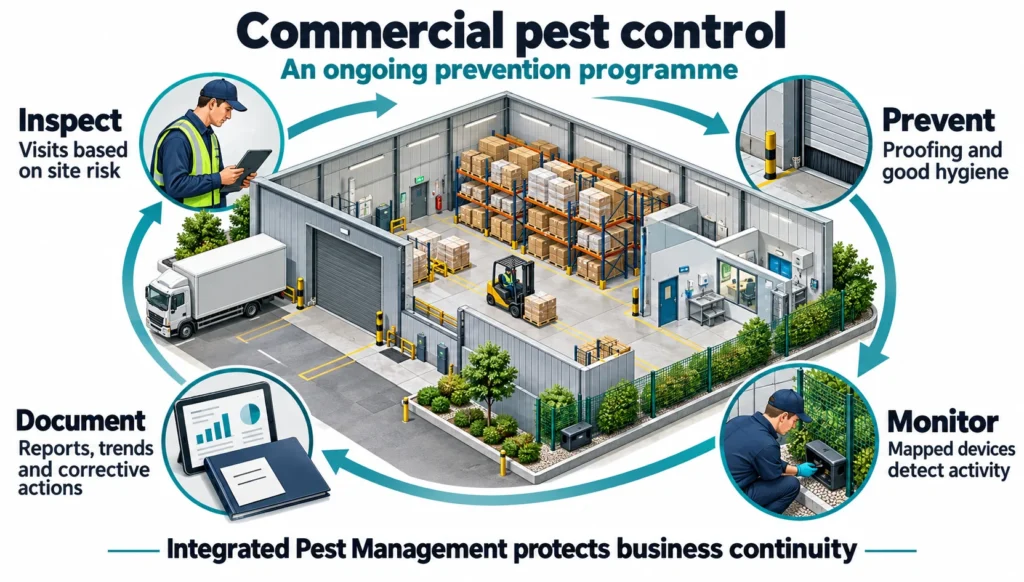
Every trading business carries legal duties, operational risk and reputational exposure linked to public health pests. When managers ask what is commercial pest control, the honest answer goes well beyond spraying when vermin appear. Commercial pest management is a structured prevention programme. It protects stock, premises and trading licences. Providers install monitoring devices, assess structural weakness and build an evidence trail that stands up to inspection.
A domestic call-out resolves one rodent or insect problem in a private home. A commercial contract protects trading continuity, legal liability and audit integrity across regulated premises. Can your current arrangement survive an unannounced Environmental Health visit and a third-party customer audit?
Key Takeaways
- Commercial pest management runs as an ongoing prevention programme, protecting trading licences, premises and brand reputation continuously.
- Documentation carries the service, supplying the due diligence evidence that Environmental Health Officers and scheme auditors expect to see.
- Integrated Pest Management puts physical proofing, hygiene and exclusion ahead of routine chemical application on commercial sites.
- UK legislation requires occupiers to control pests proactively, with enforcement ranging from improvement notices to immediate closure.
- Visit frequency follows documented site risk, so food manufacturing and healthcare sites need far denser inspection schedules.
Core Distinctions Between Domestic and Commercial Provision
Commercial pest management is a contractual service model built around risk mitigation, statutory compliance and trading continuity. A homeowner wants an active nuisance eradicated quickly. A business operator needs routine inspection, permanent monitoring infrastructure and paperwork that proves regulatory due diligence on demand.
Operational scope varies widely between sectors, reflecting different legal liabilities and inspection standards. Commercial contracts set service level agreements, technician qualification requirements and transparent reporting. The table below compares domestic and commercial provision across the categories that matter most to a trading business.
| Operational Factor | Domestic Service | Commercial Service |
|---|---|---|
| Trigger | Reactive to visible pest activity | Proactive scheduled monitoring and prevention |
| Documentation | Basic treatment report or invoice | Audit file, trend data and numbered site maps |
| Regulatory scrutiny | Minimal statutory inspection | Enforcement by EHOs and certification auditors |
| Visit frequency | One-off treatment or short follow-up | Contracted visits set by site risk profile |
| Liability exposure | Private household inconvenience | Closure, supply chain delisting and fines |
Operational Differences Between Commercial and Residential Sites
Preventative Monitoring Versus Reactive Call-Outs
Commercial pest control differs from domestic work in operational intent. Domestic services function almost exclusively on demand. They respond only after an occupant spots vermin. Commercial programmes reverse that dynamic. Scheduled surveillance networks detect emerging threats before breeding populations compromise stock, staff or daily trading operations.
In commercial environments, waiting for a visible sighting represents an operational failure. Technicians deploy calibrated monitoring devices across predefined internal and external inspection points. These devices remain permanently recorded on architectural site plans. Regular inspections establish baseline biological activity. In practice, we find that subtle indicators such as isolated droppings surface long before an infestation becomes visible.
Environmental Scale and Complex Harbourage
Commercial premises present complex environmental architecture demanding specialised survey technique. Warehousing, manufacturing plants and food factories contain riser ducts, cavity voids, dropped ceilings and continuous machinery runs. Technicians evaluate these structural features systematically. The process denies pests the warmth, moisture and secluded harbourage that large industrial buildings unintentionally provide.
A residential treatment covers a few rooms with accessible floor space and simple perimeters. An industrial distribution hub may span tens of thousands of square metres with high-bay racking. Pests exploit expansion joints, cable trays and dock leveller pits. Inspection must therefore cover structural weakness alongside pest biology.
Integrated Pest Management and Device Mapping
Integrated Pest Management as Standard Practice
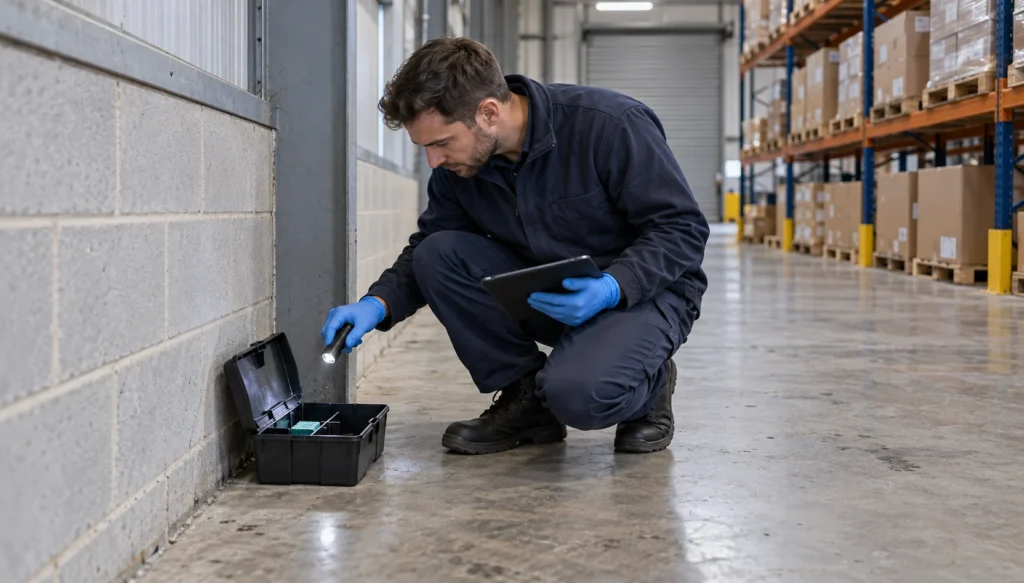
With commercial pest control explained through technical standards, Integrated Pest Management forms the operating philosophy. Technicians avoid routine chemical broadcast treatments. They apply a staged framework instead. That framework combines detailed site surveying, physical exclusion proofing, continuous biological monitoring and targeted intervention across the whole facility.
Modern commercial programmes restrict chemical interventions to confirmed activity. Rodenticide stewardship rules prohibit routine permanent toxic baiting around building exteriors. That restriction protects non-target predators such as barn owls and kestrels. Technicians use non-toxic monitoring blocks inside tamper-resistant stations. Active rodenticides go in only when physical evidence confirms a live population.
Site Mapping and Numbered Device Networks
Systematic accountability requires precise spatial mapping of every pest management asset on site. Technicians assign unique numbers to external bait stations, internal monitoring traps and electronic fly killers. Each location corresponds to a signed, dated site plan. That plan sits in the facility safety file for complete operational transparency.
Numbered inspection points ensure full site visibility and prevent devices being missed during an audit. If an operative records activity at station twenty-four, the technical manager can locate that area instantly. The precision allows rapid investigation of nearby machinery or delivery doors. Technicians can then correct the root cause of ingress.
Did You Know?
Food hygiene offences in England carry an unlimited fine. Conviction on indictment under the Food Safety and Hygiene (England) Regulations 2013 can also bring two years in prison. Officers can close premises immediately through a Hygiene Emergency Prohibition Notice.
Documentation Standards and Regulatory Verification
Contents of the Master Pest Control File
A commercial pest contract rests on defensible paperwork as much as physical eradication. The onsite file holds contractor insurance details, technician competence certificates, risk assessments and material safety data sheets. It demonstrates that the organisation exercises active due diligence. Enforcement officers expect to see it on request.
Third-party auditors and statutory inspectors scrutinise this binder during every formal site assessment. The file should evidence BS EN 16636 certification, BPCA servicing membership and technician BASIS PROMPT registration. Historical service reports, emergency call-out logs and chemical usage records complete the picture. Together they prove the business manages biological risk responsibly.
Trend Analysis and Written Technical Commentary
Raw monitoring numbers without interpretation fail modern audit benchmarks in food and manufacturing. Commercial reporting systems convert device catch counts into trend charts by operational zone. Technicians then add written professional commentary. That commentary explains activity fluctuations and recommends the remedial actions needed to protect site hygiene.
Auditors routinely penalise sites presenting static tables with no analytical notes. A compliant report asks whether insect counts track seasonal temperature, incoming ingredient batches or delayed door repairs. Rising pest pressure demands a documented response. The contractor must record the corrective measures deployed to reverse the trend.
Free Pest Control Audit Review
We will review your risk assessment, site plan, visit reports, trend analysis, open recommendations, product records and demo our AI Pest management System.
UK Statutory Duties and Legal Exposure
Food Safety and Public Health Legislation
UK businesses operate under statutory obligations requiring clean, pest-free premises. The Food Safety and Hygiene (England) Regulations 2013 demand adequate procedures to control pests across food premises. The Prevention of Damage by Pests Act 1949 adds a separate duty. Occupiers must notify the local authority of rats or mice in substantial numbers.
Failure to control pests invites serious legal intervention. Environmental Health Officers may serve Hygiene Improvement Notices. They can also apply to magistrates for a Hygiene Emergency Prohibition Notice. An emergency order closes the premises immediately. Production stops, perishable stock spoils and the reputational damage follows quickly.
Due Diligence as Legal Protection
A documented pest management programme underpins the statutory due diligence defence. Section 21 of the Food Safety Act 1990 requires a defendant to prove they took all reasonable precautions. Current, auditable records demonstrate systematic oversight. Enforcement authorities weigh that evidence closely during any formal investigation or prosecution.
Without visit reports, technician qualification certificates and closed corrective action records, that defence rarely survives court scrutiny. Prosecutors examine the consistency of pest management over time. From experience across the sector, gaps in the record do more damage than the sighting itself. Evidence of sustained contractor oversight also shields directors from personal liability.
AI Pest Management
AI pest management is pest control delivered with continuous digital monitoring and analytics rather than paper records, with real time data access across a single or multiple sites.
Third-Party Audits and Food Safety Standards
Requirements Under BRCGS and SALSA Schemes
Food manufacturing and distribution sites face third-party certification audits with demanding pest management clauses. BRCGS Global Standard Food Safety Issue 9 and SALSA Food and Drink Production Issue 7 both require risk-assessed inspection schedules. Each scheme expects mapped devices, tracked corrective actions and periodic expert review of the programme.
Clause 4.13 of BRCGS Issue 9 covers pest management within site standards. Certificated sites must run a proactive programme delivered by qualified specialists. An in-depth survey by a pest control expert is required at a risk-based frequency, and at least annually. SALSA Issue 7 applies equivalent discipline at clause 1.9 for small and micro producers.
Corrective Action Close-Out and Audit Evidence
Auditing bodies examine how quickly a site resolves technician recommendations. A broken door seal, a missing fly screen or ingredient residue all enter a formal corrective action register. Closure needs evidence. Photographic proof and a dated sign-off satisfy most auditors reviewing the register during a site visit.
Open recommendations carried across consecutive visits remain a common audit failure. Auditors read unaddressed maintenance items as weak food safety culture. The fix is internal workflow rather than more pest treatment. Teams must review contractor reports, release maintenance budget and complete proofing before small defects allow ingress.
Technology and Modern Facility Reporting
Digital Reporting Portals and Action Tracking
Most commercial operations have replaced paper logbooks with cloud reporting platforms. Technicians record device inspections on a handheld during the survey. Timestamps, findings and photographs upload instantly. Pest management platforms such as Insectram then give facility managers immediate access to compliance data and audit records.
Digital reporting changes contract governance by automating trend charts and action tracking. Managers can grant read-only access to a visiting auditor. The auditor then verifies visit timestamps, COSHH assessments and bait usage without waiting for paperwork. Nothing goes missing between service visits.
Remote Electronic Monitoring and Sensor Networks
Connected sensors provide continuous surveillance across critical production zones. They shorten the detection window from weeks to minutes. Battery-powered units report rodent trigger events to a cloud dashboard in real time. Technical teams can then investigate a vulnerable area immediately rather than waiting for the next scheduled visit.
Sensors accelerate detection. They do not replace physical visits by qualified technicians. An automated trap cannot inspect a defective drain seal, judge housekeeping standards or survey a roof void. Expert technicians read sensor data in physical context, identify the route of ingress and reinforce the building defences.
Commercial Contract Expectations and Service Delivery
Service Scope and Planned Visit Frequency
A professional commercial pest control contract sets inspection frequency from an objective site risk assessment. High-risk food processing plants often need monthly or fortnightly attendance. Ambient warehouses may run safely on a quarterly cycle. The scope must also state target species and guaranteed emergency response times.
Facility managers should check contract inclusions carefully. Standard cover usually spans scheduled inspections, routine reporting, non-toxic monitoring and emergency call-outs. Bird exclusion netting, structural proofing and insect fumigation normally sit outside that cover. In practice, we find these are scoped and priced as separate project work.
Technician Qualifications and Accreditations
Commercial clients should insist on recognised technician credentials and current training. Baseline competence means the RSPH Level 2 Award in Pest Management plus active BASIS PROMPT registration. Those credentials confirm the technician understands pesticide restrictions, humane trapping obligations and site safety rules. Ask to see them before contract award.
Contractor accreditation matters just as much to procurement teams. A BPCA servicing member works to published codes of practice and carries appropriate insurance. Certification to BS EN 16636 confirms audited quality control, structured customer communication and responsible rodenticide stewardship. Both are straightforward to verify before signing.
Final Thoughts
A clear grasp of what is commercial pest control turns pest management from an overhead into a safeguard. Structured inspection, physical proofing and transparent digital records protect trading operations from serious disruption. Brand integrity depends on that vigilance being continuous rather than occasional.
Regulatory frameworks keep tightening and supply chain standards keep rising. Proactive pest management now sits inside operational governance, not outside it. Align building maintenance, staff hygiene training and contractor management with Integrated Pest Management principles. Audit-ready premises are built steadily, not assembled the week before an inspection.
Request a Free Site Survey
Frequently Asked Questions
A:
Frequency follows site risk, operational activity and the audit standards that apply. High-risk food manufacturing, bakeries and pharmaceutical sites typically need monthly or fortnightly visits. Lower-risk warehousing, offices and non-food retail often run safely on a quarterly cycle. The site risk assessment sets the number, not habit or convenience. Record the agreed frequency in the master site documentation. Review it annually, and sooner if the operation or the building changes.
A:
UK law requires adequate pest control procedures on commercial premises. The Food Safety and Hygiene (England) Regulations 2013 oblige food businesses to prevent pest access and contamination. The Prevention of Damage by Pests Act 1949 adds a notification duty. Occupiers must tell the local authority about rats or mice in substantial numbers. Businesses without defensible arrangements face improvement notices, prosecution, unlimited fines and closure. Proper records are the evidence of due diligence during any formal inspection.
A:
A compliant file holds the signed service agreement, contractor insurance certificates, technician competence qualifications and COSHH assessments. It must include a dated, numbered site plan showing every device location. Individual visit reports, a staff sightings log and written trend analysis are equally essential. Audited food sites also retain corrective action logs and proofing records. Annual survey reports from a pest control expert complete the evidence pack for third-party inspection.
A:
Routine permanent toxic baiting around commercial perimeters is no longer accepted practice under UK rodenticide stewardship. Campaign for Responsible Rodenticide Use guidance expects non-toxic monitoring bait in permanent boxes. Technicians deploy toxic rodenticide only once evidence confirms an active rodent population. The treatment is a targeted campaign with a defined end point. Once the infestation clears, the toxic bait comes out and non-toxic blocks go back in.
A:
It supplies documented evidence that hazards are prevented systematically. BRCGS Issue 9 and SALSA Issue 7 both require proof of proactive Integrated Pest Management. A professional contractor provides numbered device mapping, dated inspection records and trend analysis with written commentary. Corrective actions are tracked through to close-out. That paperwork lets a technical manager demonstrate control during customer and certification audits without scrambling for records.


By choosing Shield Pest Management, you’re partnering with a company that combines local expertise with industry-leading practices. Our commitment to quality, compliance, and customer satisfaction makes us an ideal choice for both residential and commercial pest control needs.