

ISO 22000 Pest Control Requirements Explained
Food manufacturers seeking certification routinely ask how to evidence pest control during a third-party hygiene audit. Meeting iso 22000 pest control requirements takes far more than a contractor checking bait boxes on a rota. The site needs a verified preventative framework built into its food safety management system. Technical managers must then document control over biological hazards across every processing zone.
Recent updates to the prerequisite programme specifications change where those expectations sit. They also change how auditors evaluate on-site preventative measures. Technical teams need to know which standard governs daily prevention, how duties split between staff and contractors, and what documentation survives scrutiny. Is your pest management system ready for examination under the updated prerequisite standards?
Key Takeaways
- Pest management specifications do not sit within ISO 22000 itself but reside in prerequisite programmes defined under the updated ISO 22002 series.
- Clause 7 of ISO 22002-100:2025 mandates documented pest control programmes built on site-specific risk assessments rather than generic contractor service agreements.
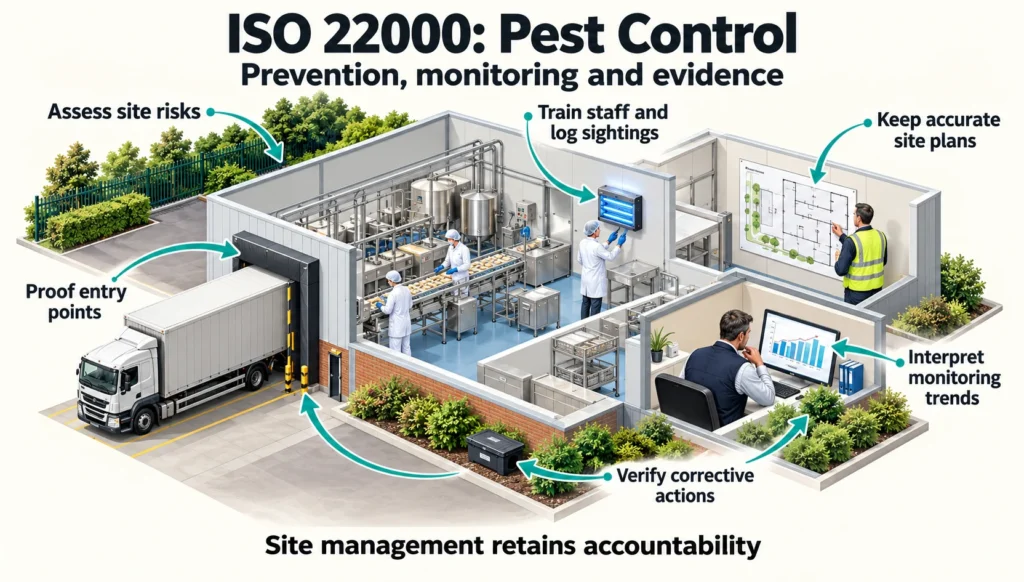
- Primary legal and operational accountability for pest prevention remains with the facility management team rather than transferring onto an appointed external specialist.
- Facilities must produce signed site plans, interpreted pest trend analysis reports, and verified corrective action tracking to demonstrate continuous audit readiness.
- Internal personnel require structured pest awareness training to recognise early infestation indicators and maintain an active site sightings log across production zones.
Core Compliance Elements in Food Safety Standards
ISO 22000:2018 sets the architecture for a food safety management system. Detailed hygiene controls sit in supporting prerequisite standards instead. Technical managers need both documents to answer an auditor properly. The split separates system governance from the physical conditions enforced on the factory floor during a certification visit.
Auditors test prerequisite performance alongside hazard analysis verification. A compliant system links contracted pest services to internal hygiene routines, building fabric proofing and record checks. In practice, we find weak points appear at the join between those duties. The table below sets out the main clause requirements and shows where responsibility falls.
| Standard Clause | Operational Requirement | Primary Responsibility |
|---|---|---|
| ISO 22002-100:2025 Clause 7.1 | Site Pest Risk Assessment | Shared (Site and Contractor) |
| ISO 22002-100:2025 Clause 7.2 | Building Envelope Proofing | Site Operations |
| ISO 22002-100:2025 Clause 7.3 | Monitoring Device Placement | BPCA-Qualified Contractor |
| ISO 22002-100:2025 Clause 7.4 | Trend Analysis and Interpretation | Shared (Technical Review) |
| ISO 22002-100:2025 Clause 7.5 | Staff Awareness and Sightings | Site Operations |
Standard Architecture and Prerequisite Frameworks
Relationship Between ISO 22000 and Technical Specifications
ISO 22000:2018 states management system requirements. It does not describe physical pest management practice on a production site. Technical managers locate those duties by reading the supporting technical specifications. Prerequisite programmes supply the baseline hygiene rules that stop environmental contamination before hazard analysis begins. That distinction matters during every certification audit.
Food safety management runs on two tiers. ISO 22000 covers system management, communication and hazard control methodology, including the HACCP plan. Pest management operates as a prerequisite programme rather than a critical control point. Facilities hold baseline sanitary conditions through those programmes. Biological contamination is then prevented from reaching the process at all.
Evolution to the ISO 22002-100 Series
The ISO 22002 series set sector-specific hygiene baselines for manufacturers, packaging producers and catering operators. ISO 22002-100:2025 consolidates those prerequisite requirements into a single clarified structure. Clause 7 governs pest control directly. The revision gives certification bodies firmer benchmarks and removes much of the ambiguity that older sector documents carried.
Standards move to match production risk. FSSC 22000 Version 6 audits remain permitted until 30 April 2027. The Version 7 upgrade window then runs from 1 May 2027 to 30 April 2028. That transition adopts the ISO 22002-x:2025 series. Sites must realign prerequisite documentation with the new clause numbering before their upgrade audit.
Requirements of ISO 22002-100:2025 Clause 7
Preventative Programme Design and Hygiene Protocols
Clause 7 requires a formal, documented pest management programme. The standard expects preventative strategy built around site-specific biological hazards. Reactive chemical treatment alone will not satisfy an auditor. Sites install physical barriers, run routine sanitation schedules and complete internal inspections. Those measures deny pests access to production and storage areas.
Auditors assess whether the programme discourages activity through environmental control. Production spaces, packaging stores and waste handling areas each need their own hygiene protocol. Each protocol denies pests food, water and harbourage. A contractor agreement does not deliver compliance on its own. Auditors expect visible operational effort from the production team.
Incoming Goods and Harbourage Reduction Controls
Pest prevention duties reach past the perimeter wall to raw material intake. Inbound deliveries carry stored product insects and rodents into otherwise secure buildings. Clause 7 requires a systematic inspection protocol for incoming goods. It also requires vegetation management and waste compound clearance to remove external harbourage around the site.
External yards must not shelter vermin. Keep grass cut, remove standing water and clear redundant machinery or pallet stacks from the building line. Pallets stored hard against an exterior wall block routine inspection. They also create ideal nesting conditions. From experience across the sector, this single habit generates more non-conformances than any other yard issue.
Did You Know?
Under the Food Safety Act 1990, conviction on indictment for a food safety offence carries an unlimited fine. The court may also impose up to two years imprisonment. A documented pest control file supports the due diligence defence set out in section 21 of that Act.
Mandatory Documentation and Audit Evidence
Site Plans and Monitoring Device Registers
Every audited facility holds an accurate site plan, signed and dated, showing the location of all monitoring devices. Auditors check that bait stations, insect light traps and pheromone monitors match the register exactly. Any unrecorded move breaks monitoring integrity. The plan is the first document most auditors request on arrival.
Gaps between the physical layout and the paperwork trigger non-conformances regularly. Each monitoring point needs a unique identification number. That number must appear on visit reports and inspection findings. Digital reporting systems keep a live layout record. Technical managers and auditors then inspect identical device positions across large warehousing and production areas.
Sighting Logs and Technical Inspection Records
The site pest file carries a live staff sightings log alongside contractor visit reports. An empty log over several months invites scrutiny rather than confidence. Auditors read it as a sign of poor staff awareness. Every entry needs prompt investigation, a recorded remedial action and formal sign-off by a named manager.
Visit reports record species identified, activity levels and corrective actions taken. Contractors supply Safety Data Sheets and COSHH assessments for every biocidal product held on site. Those records belong in the master pest file, not a contractor archive. Keeping them to hand turns an audit request into a two-minute task.
Free Pest Control Audit Review
We will review your risk assessment, site plan, visit reports, trend analysis, open recommendations, product records and demo our AI Pest management System.
Division of Site and Contractor Responsibilities
Facility Accountability for Hygiene and Fabric Maintenance
Food safety accountability stays with the site operator. No contractor arrangement moves it. Facilities management maintains building fabric, seals entry points and enforces sanitation across processing lines. Appointing an external pest specialist buys technical support, not a transfer of statutory duty. Certification bodies treat the manufacturer leadership team as the responsible party.
Auditors scrutinise how engineering and hygiene teams respond to contractor recommendations. A technician may flag a torn dock leveller seal or an unsealed service pipe penetration. Site teams must then execute the repair promptly. Proofing actions left open across several visits read as systemic management failure. That pattern damages the audit outcome quickly.
Contractor Competence and Professional Qualifications
Technical managers verify and record the competence of their appointed pest control provider. Contractors should employ BPCA-qualified technicians holding recognised certification such as the RSPH Level 2 Award. Independent trade registration and adequate insurance cover both feature in commercial audit specifications. Evidence of all three belongs in the site compliance folder.
Certification to BS EN 16636 through CEPA gives auditors immediate confidence in contractor capability. Technicians should hold active BASIS PROMPT registration, which proves continuing professional development. Retain current certificates, the public liability insurance schedule and technician qualification records on site. Many retailer codes of practice expect £10 million public liability cover as a minimum.
AI Pest Management
AI pest management is pest control delivered with continuous digital monitoring and analytics rather than paper records, with real time data access across a single or multiple sites.
Practical Application of Integrated Pest Management
Action Thresholds Across Facility Zones
An effective Integrated Pest Management system runs on predetermined action thresholds matched to each operational risk zone. One insect in an external waste yard warrants a different response from activity inside a high-care area. Documented thresholds state precisely when investigation or targeted control becomes mandatory. Vague wording here fails under audit.
Thresholds should reflect real operational risk, not blanket zero-tolerance wording applied to a car park. Crossing an agreed threshold triggers a root-cause investigation first. Chemical application follows only where that investigation justifies it. Review the parameters at least annually. Integrated pest management programmes must track production changes and seasonal pressure to stay credible.
Preventative Exclusion and Physical Proofing Hierarchies
Physical exclusion forms the first tier of a compliant pest management programme. It stops biological hazards before they enter the building. Sites seal vulnerable penetrations, fit durable brush strips to external doors and screen ventilation louvres. Proofing delivers permanent exclusion. Chemical application offers only temporary relief after the breach has occurred.
A mouse exploits a gap the width of a pencil. Door seals and service conduits remain the primary ingress routes on most sites. Operational habits then undermine expensive hardware. Propping a loading bay shutter open for ventilation is the usual culprit. Pair proofing work with staff training to hold envelope integrity through shift changes.
Regulatory Stewardship and Chemical Restrictions
Environmental Stewardship and Anticoagulant Rules
The Campaign for Responsible Rodenticide Use governs professional rodenticide application across the United Kingdom. Its purpose is protecting non-target wildlife from secondary poisoning. Restrictions introduced in January 2025 limit difenacoum and bromadiolone to use in and around buildings. Permanent external toxic baiting no longer counts as acceptable practice under stewardship rules.
Auditors raise a non-conformance where permanent toxic rodenticide sits outside without evidence of active infestation. Technicians use non-toxic monitoring bait in external stations. Rodenticide goes down only once rodent presence is confirmed. Point of sale rules already require proof of CRRU-approved training before a professional rodenticide can be purchased.
Statutory Duties Under British Public Health Law
ISO compliance sits alongside binding United Kingdom food safety legislation rather than replacing it. The Food Safety Act 1990 creates statutory due diligence offences. A complete pest control file becomes central defence evidence in that context. Operators must hold documented proof of adequate controls for inspecting enforcement authorities at any time.
The Prevention of Damage by Pests Act 1949 places a duty on occupiers of non-agricultural land. They must notify the local authority of substantial rodent or mouse infestation. The Food Safety and Hygiene (England) Regulations 2013 allow hygiene emergency prohibition notices. Those notices close a facility immediately where an imminent health risk exists.
Trend Analysis and Continuous Improvement Protocols
Monitoring Data Interpretation Over Time
Clause 7 expects regular trend analysis that converts monitoring data into operational insight. Catch figures and device inspection sheets filed without written commentary will fail. A compliant report states whether activity is rising or falling. It names persistent hotspots and judges whether earlier preventative work actually succeeded.
Reviews should cover electric fly killer catch tray analysis, crawling insect sticky trap counts and external rodent station activity. Breaking catches down by species helps trace root cause. It separates localised drain fly breeding from a wider incoming material problem. Written interpretation gives the auditor tangible evidence of ongoing system oversight.
Corrective Action Tracking and Close-Out
Pest control recommendations convert into formal corrective actions. Each one needs an assigned owner, a realistic deadline and verifiable proof of close-out. Recommendations left open across repeated visits signal weak management control to a certification auditor. Photographic evidence or a completed maintenance work order confirms resolution properly.
Digital reporting platforms timestamp remediation evidence inside the client portal. When a technician flags a structural defect or housekeeping shortfall, the site manager raises an internal maintenance ticket straight away. Every closed action adds a link to the audit trail. That unbroken trail carries the site through annual surveillance assessments.
Final Thoughts
Meeting iso 22000 pest control requirements depends on close integration between production teams and qualified pest professionals. Pest management is not an isolated contractor task. Technical managers embed preventative control into everyday operational routine. Once a site understands the prerequisite programmes in the ISO 22002 series, it protects the building envelope and the process behind it.
Global food safety schemes continue migrating towards the updated technical specifications. Sites with robust documentation frameworks will find the next audit cycle straightforward. Accurate site plans, meaningful trend interpretation and tracked corrective actions build a durable foundation. Consistent stewardship and engaged staff keep that foundation intact across manufacturing, packaging and logistics operations.
Request a Free Site Survey
Frequently Asked Questions
A:
Pest control does not appear in the text of ISO 22000:2018 itself. It functions as a prerequisite programme codified in the ISO 22002 technical specification series. For food manufacturers, those hygiene and preventative controls sit in clause 7 of ISO 22002-100:2025. Prerequisite programmes establish the baseline environmental and operational conditions needed to produce safe food. They support the site HACCP plan rather than operating as a critical control point in their own right.
A:
The pest file needs a signed and dated site plan showing all numbered monitoring devices. It must also hold documented risk assessments, technician qualifications, proof of insurance and safety data sheets for every product used on site. Technical managers add routine service inspection reports and an active staff sightings log. Interpreted trend analysis reviews and a closed-out corrective action register complete the set. Auditors expect physical evidence of repairs attached to each closed action.
A:
No. Legal and standard accountability remains with the food business operator. A contractor provides specialist survey work, device monitoring and technical advice. The site team still maintains structural proofing, enforces internal sanitation and ensures staff record sightings. Auditors check that facilities track and close out contractor recommendations. Appointing a service provider supports compliance, but operational responsibility for preventing contamination never leaves the site.
A:
Standards generally require formal trend analysis at least annually. High-risk manufacturing sites gain far more from monthly or quarterly review. Frequent review lets technical managers spot emerging insect or rodent activity before a population establishes harbourage. A compliant analysis never presents raw capture numbers alone. It carries written technical interpretation explaining fluctuations, assessing seasonal risk, judging earlier remedial work and setting preventative actions for the period ahead.
A:
No. Permanent external toxic baiting fails both UK rodenticide stewardship rules and audited prerequisite standards. The Campaign for Responsible Rodenticide Use restricts anticoagulant deployment to confirmed activity, protecting non-target wildlife from secondary exposure. Auditors issue a non-conformance where external toxic bait sits out as a routine preventative measure. Compliant sites run non-toxic monitoring bait in external stations. Toxic product goes down only after verified physical evidence of rodent infestation.

By choosing Shield Pest Management, you’re partnering with a company that combines local expertise with industry-leading practices. Our commitment to quality, compliance, and customer satisfaction makes us an ideal choice for both residential and commercial pest control needs.