

Industries That Need Pest Control by Law
UK legislation places stringent duties on businesses to maintain hygienic, safe working environments. Food handling, healthcare, hospitality and warehousing all carry statutory obligations to prevent contamination and damage. Identifying the specific industries that need pest control helps operational leaders satisfy enforcement officers and commercial auditors. Failing to manage pests creates serious regulatory risk. Fines and immediate closure notices both follow.
Statutory duties stem from several primary acts and hygiene regulations across Britain. General legislation requires every occupier to address infestations. High-risk sectors must go further, demonstrating formal monitoring, verified competence and meticulous documentation. The practical burden varies sharply between sectors. But which UK industries legally require pest control to maintain everyday trading compliance?
Key Takeaways
- Food businesses must maintain adequate pest procedures under the Food Safety and Hygiene Regulations 2013 to protect consumers from severe contamination risks.
- Section 3 of the Prevention of Damage by Pests Act 1949 obliges land occupiers to notify local authorities of substantial rodent populations.
- Commercial third-party audit schemes including BRCGS and SALSA enforce stringent pest monitoring, technician qualification standards and mandatory annual trend analyses.
- Healthcare settings and residential care providers require discreet pest suppression programmes to uphold rigorous Care Quality Commission hygiene and infection standards.
- Commercial compliance relies on structured pest files holding site risk assessments, technician certifications, current safety data sheets and recorded corrective actions.
Statutory Duties Across Commercial Sectors
Different sectors face distinct compliance standards. Some are set by national statute, others by environmental health guidance or independent certification bodies. The legal framework ranges from universal public health acts to specific hygiene regulations that mandate formal preventative programmes. Operational leaders must understand exactly which duties attach to their own premises and trading activity.
The table below sets out the primary statutory obligations, the governing authority or standard, and the documentation expected across essential commercial environments. Proactive programmes keep businesses above statutory thresholds. They also reduce exposure to penalties and satisfy external auditors during planned and unannounced site reviews alike.
| Commercial Sector | Governing Legislation or Standard | Primary Compliance Obligations |
|---|---|---|
| Food Processing | Food Safety and Hygiene (England) Regulations 2013 | Adequate pest control procedures, proofing, due diligence |
| Hospitality and Catering | Food Safety Act 1990; FHRS inspections | Hygiene emergency prohibition prevention, waste management |
| Warehousing and Logistics | Prevention of Damage by Pests Act 1949 | Rodent notification, goods-in inspection, structural proofing |
| Healthcare and Care Homes | Health and Social Care Act 2008 (Regulated Activities) | Infection prevention, low-toxicity suppression, CQC audit |
| Farming and Agriculture | Red Tractor Standards; CRRU Stewardship | Biocide stewardship, bait plans, non-toxic monitoring |
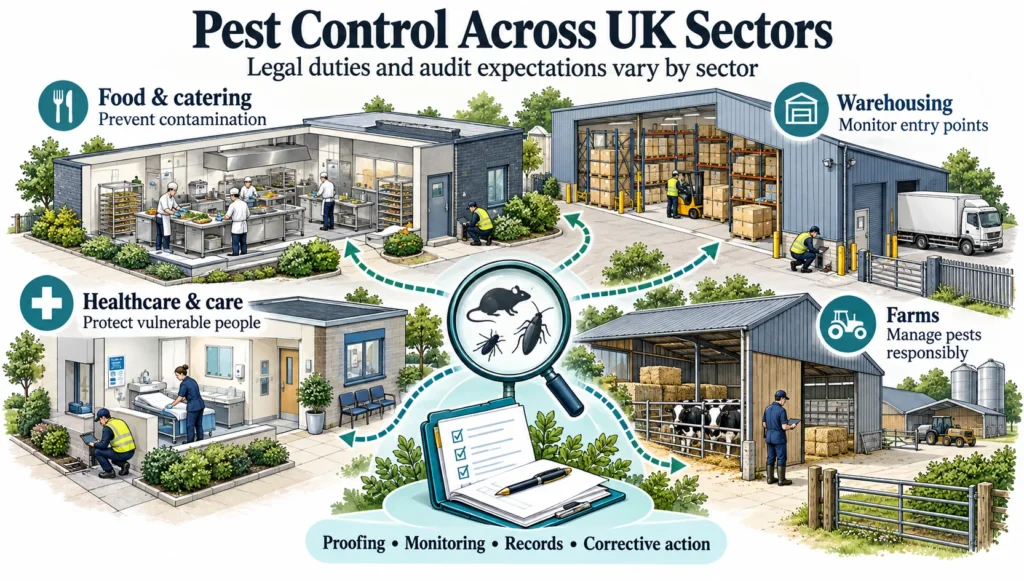
Food Manufacturing and Processing Obligations
Food Safety Legislation and Hygiene Regulations
Food manufacturers operate under strict statutory obligations where legally required pest control forms an essential prerequisite programme. Under the Food Safety and Hygiene (England) Regulations 2013, facilities must maintain adequate procedures to control pests. Failure to prevent contamination can lead to Hygiene Emergency Prohibition Notices that halt production immediately.
Section 9 of the Food Safety Act 1990 penalises selling food that fails health requirements. A documented professional programme supports the statutory due diligence defence. Businesses must show they took all reasonable precautions against contamination by rodents, insects or birds. From experience across the sector, weak record-keeping defeats that defence more often than weak treatment.
Third-Party Certification and Audit Standards
Global food safety certification schemes impose standards that frequently exceed baseline statutory obligations for processors. Under BRCGS Global Standard Food Safety Issue 9, audited facilities must maintain comprehensive pest documentation and detailed site plans. The standard mandates structured monitoring, annual expert field biologist inspections and interpreted activity data.
SALSA Issue 7 requires documented contracts, dated device maps and annual trend analysis. Food businesses supplying major retailers must also satisfy individual customer codes. These specifications enforce strict inspection intervals and tightly defined response windows. Corrective actions must be tracked and closed out in writing to maintain audit compliance.
Hospitality and Commercial Catering Mandates
Environmental Health Inspections and Food Hygiene Ratings
Commercial kitchens face routine enforcement scrutiny from Environmental Health Officers assessing structural conditions and hygiene. Inspecting officers verify pest prevention procedures, checking for active harbourage, waste containment and proper proofing. Negative findings directly harm Food Hygiene Rating Scheme scores. Lower scores reduce consumer footfall and damage pub or restaurant revenue.
Inspectors evaluate whether kitchen drains, grease traps and storage areas remain secure. Officers look for droppings, grease smear marks and damaged packaging. An unmanaged infestation can trigger immediate closure through an emergency notice. Reputational harm then spreads quickly across public review platforms.
Pest Proofing and Structural Kitchen Requirements
Maintaining an impervious building envelope represents a fundamental legal duty for commercial caterers. Pests enter kitchens through worn door seals, open pipework penetrations and compromised drainage points. Operators must seal small gaps and fit fine insect screens to opening windows. Hygiene legislation treats this proofing work as a basic structural standard.
Kitchens also need shatter-resistant electric fly killers, sited away from open preparation surfaces. Glue board units are preferable to electrocution grids because they do not scatter insect fragments. In practice, we find that disciplined housekeeping matters as much as hardware. Proofing denies pests access to harbourage, moisture and organic residues.
Did You Know?
Food hygiene offences under the Food Safety Act 1990 carry an unlimited fine in England and Wales. On conviction on indictment, the court can also impose a prison sentence of up to two years.
Warehousing and Logistics Sector Demands
Cross-Dock and Storage Vulnerabilities
Modern logistics hubs experience high-volume stock turnover, exposing expansive storage facilities to substantial pest ingress. Roller shutter doors and dock levellers represent the primary entry routes for rodents and birds. Facilities managers must maintain rigorous inspection protocols to prevent incoming pallets from introducing stored product insects.
Large sheds require systematic monitoring layouts. Pests often arrive concealed inside inbound raw materials or palletised goods rather than walking through the perimeter. Flour beetles, weevils and warehouse moths establish rapidly within pallet racking. Infested stock then causes significant commercial inventory losses.
Customer Audit Expectations in Transport
Retailers and brand manufacturers expect their third-party logistics partners to mirror production-grade biosecurity controls. Contracts often stipulate compliance with BRCGS Packaging Materials Issue 7 or storage and distribution codes. These standards require fully mapped bait stations, non-toxic monitoring matrices and transparent digital reporting records.
A professional commercial pest control programme establishes complete traceability across extensive distribution parks. Auditing teams scrutinise perimeter clearance, yard housekeeping and waste compactor sanitation. When operating in this sector, racking voids and packaging stores receive the closest attention. Evidence of nesting there can put a contract at risk.
Free Pest Control Audit Review
We will review your risk assessment, site plan, visit reports, trend analysis, open recommendations, product records and demo our AI Pest management System.
Healthcare and Care Home Regulatory Standards
Care Quality Commission Hygiene Expectations
Healthcare providers must maintain clinical environments free from pest activity to protect patient welfare. The Care Quality Commission inspects hospitals and residential care homes, assessing environmental cleanliness and infection prevention. Pests act as pathogen transmission vectors. They present an acute threat to individuals with compromised immune systems.
Clinical settings demand discretion and careful product selection. Technicians cannot deploy conventional chemical sprays near vulnerable residents or medical equipment. Programmes prioritise non-toxic monitoring, mechanical traps and structural proofing instead. That approach suppresses risk without introducing chemical hazards or air quality concerns.
Distinctive Clinical Pest Vulnerabilities
Complex building architecture, extensive service ducting and constant warmth make hospitals particularly vulnerable to insect infestations. Pharaoh ants establish multi-queen colonies that travel through ducting networks into clinical wards. These insects pose a distinctive contamination threat because they are attracted to sterile supplies and wound dressings.
Residual pesticide sprays split pharaoh ant colonies into multiple secondary nests. Technicians must therefore use specialised baiting strategies over several weeks to eradicate the network. Cockroach allergens are also a recognised trigger for respiratory distress. Planned suppression is the only reliable control in these settings.
AI Pest Management
AI pest management is pest control delivered with continuous digital monitoring and analytics rather than paper records, with real time data access across a single or multiple sites.
Education Estate Compliance Framework
Department for Education and Ofsted Scrutiny
Educational establishments hold a statutory duty of care towards students, staff and visiting members of the public. Regulatory bodies such as Ofsted evaluate premises maintenance alongside educational performance. Unaddressed pest infestations breach health standards. The consequences include administrative sanctions, negative publicity and emergency school closures.
Large campuses contain distributed service buildings, dining halls, sports grounds and residential halls. Central refectories carry the same regulatory burden as any commercial catering business. Facilities staff must coordinate pest reporting across the estate. Kitchen teams should log sightings immediately so contractors can intervene quickly.
Low-Toxicity Controls in School Environments
Childcare facilities and schools demand low-toxicity pest management methods that protect young people from biocidal risk. Technicians schedule servicing during planned holiday closures or out-of-hours periods to prevent pupil exposure. Practitioners prioritise physical proofing, drain maintenance and clean waste storage ahead of routine chemical application.
Autumn brings rodent pressure into school basements, plant rooms and boiler houses. External playing fields can suffer from burrowing pests. Roof voids attract seasonal cluster flies and wasps. Early seasonal surveys let estates teams close perimeter gaps before colder weather drives pests indoors.
Residential Housing and Tenancy Duties
Landlord Obligations Under Housing Legislation
Residential landlords and social housing providers must ensure rental properties remain fit for human habitation. The Homes (Fitness for Human Habitation) Act 2018 allows tenants to take direct legal action where infestations undermine domestic safety. Landlords must resolve the structural defects that allow pests to enter dwellings.
Section 3 of the Prevention of Damage by Pests Act 1949 obliges occupiers to notify the local authority of substantial rodent populations. Where rats or mice infest a property, councils can serve enforcement notices under Section 4. Landlords must then rectify defective drains, missing brick vents and open wall penetrations.
Communal Waste and Multi-Occupancy Challenges
Pest risk across multi-occupancy apartment buildings requires coordinated action in communal spaces and shared utility risers. Uncontrolled refuse areas and neglected bin chutes provide abundant food for rodents and flies. Pests also travel vertical service conduits, carrying bed bugs or cockroaches between individual private flats.
Property managers must inspect adjoining apartments whenever treating bed bugs or German cockroaches. Treating a single unit in isolation disperses the infestation rather than ending it. Recurrence is then almost certain. Effective management combines communal proofing, scheduled bin sanitisation and prompt tenant communication.
Agricultural and Farm Assurance Standards
Red Tractor Scheme Requirements
Farm businesses must meet rigorous assurance standards to supply the mainstream UK food market. Red Tractor standards govern animal welfare, environmental safety and biosecurity across most of British agriculture. Certified holdings must hold documented pest management programmes, mapped baiting plans and site-specific environmental risk assessments.
Red Tractor inspectors conduct unannounced spot visits to verify site cleanliness and bait documentation. A minor non-conformance requires verified corrective action within a set deadline to avoid suspension. Serious food safety failures trigger immediate suspension. The holding then cannot trade produce under the scheme mark.
Rodenticide Stewardship and Wildlife Protection
Agricultural pest control operates under strict stewardship rules designed to protect non-target predatory wildlife. The Campaign for Responsible Rodenticide Use sets practice guidelines that limit secondary poisoning of barn owls, kestrels and red kites. Routine permanent baiting around rural farm buildings is no longer accepted practice.
Since 1 January 2026, buyers of professional rodenticides must show a CRRU-approved training certificate issued within the previous five years. An older certificate is accepted only alongside current membership of an approved CPD scheme. Non-toxic monitoring baits come first. Toxic baits follow only once activity is confirmed.
Final Thoughts
Meeting statutory duties starts with recognising the specific industries that need pest control and building proactive procedures around them. High-care processing lines, healthcare wards and large distribution centres all demand demonstrable oversight. Reactive treatment after a sighting leaves a business exposed to enforcement, failed audits and commercial loss.
Commercial pest management continues to shift away from routine chemical use towards integrated, prevention-led control. Operators who keep detailed records, close out structural recommendations and verify technician competence hold the strongest position. Structured compliance programmes provide durable protection against pest pressure across every regulated sector.
Request a Free Site Survey
Frequently Asked Questions
A:
Food manufacturing, commercial catering, hospitality, healthcare, agriculture and residential property management all face direct legal or regulatory duties to control pests. The Prevention of Damage by Pests Act 1949 applies broadly to occupiers of land and buildings. High-risk hygiene sectors face stricter rules. They must show formal monitoring and documented procedures under regulations such as the Food Safety and Hygiene (England) Regulations 2013.
A:
Commercial food premises in England are governed by the Food Safety Act 1990 and the Food Safety and Hygiene (England) Regulations 2013. These rules require businesses to keep facilities clean, well maintained and protected against pest contamination. Operators must demonstrate adequate procedures to control pests at all times. Documented inspection records and signed visit reports form a vital part of the statutory due diligence defence.
A:
Yes. Environmental health officers can serve a Hygiene Emergency Prohibition Notice to close food premises where an active infestation presents an imminent health risk. The notice halts trading on the premises until the hazard is removed. Structural repairs and hygiene controls must also be restored before reopening. Breaching an emergency order leads to prosecution, serious business disruption and substantial financial penalties.
A:
The file must hold the service contract, contractor accreditations, technician qualification records and a dated, signed site plan showing numbered device locations. It should also contain product safety data sheets, COSHH assessments and visit reports covering the retention period. Auditors also expect to see a staff sightings log, corrective action close-out evidence, and an annual trend analysis supported by written professional interpretation.
A:
Professional rodenticides are regulated biocides covered by the CRRU Code of Best Practice. Routine permanent toxic baiting around buildings is no longer acceptable. Since 1 January 2026, purchasers must present a CRRU-approved certificate under five years old, or an older certificate plus approved CPD membership. Contractors should monitor with non-toxic baits first. Every toxic deployment must then be confirmed by activity and justified in writing.
By choosing Shield Pest Management, you’re partnering with a company that combines local expertise with industry-leading practices. Our commitment to quality, compliance, and customer satisfaction makes us an ideal choice for both residential and commercial pest control needs.
