

Food Safety Pest Control Duties Explained
Every commercial food business in the United Kingdom carries strict legal duties to prevent contamination. Effective food safety pest control forms a vital operational barrier. It stops insects, rodents and birds from spoiling stock or spreading pathogens. Statutory regulations require operators to keep premises clean, design out harbourage and verify that control procedures work. Clear documentation then proves continuous compliance during environmental health inspections.
Failure to meet statutory requirements creates severe commercial risk. Penalties range from heavy fines to immediate closure under emergency prohibition powers. Operators must understand how biological hazards compromise product safety. They must also understand how enforcement officers scrutinise site records. Does your current programme withstand statutory scrutiny when an officer arrives unannounced?
Key Takeaways
- UK food legislation requires commercial operators to maintain pest-free environments, eliminating direct contamination risks and protecting public health across all operations.
- The Food Safety Act 1990 establishes a due diligence defence supported directly by a complete, fully documented pest management system.
- Environmental Health Officers hold statutory powers to issue Hygiene Emergency Prohibition Notices that close premises presenting an imminent health risk.
- Pest control operates as a prerequisite programme supporting the Hazard Analysis Critical Control Point system rather than a critical control point.
- Compliance now demands documented Integrated Pest Management, rodenticide stewardship certification, robust proofing measures and verified corrective action tracking across every zone.
Core Regulatory Pillars of Food Safety Pest Control
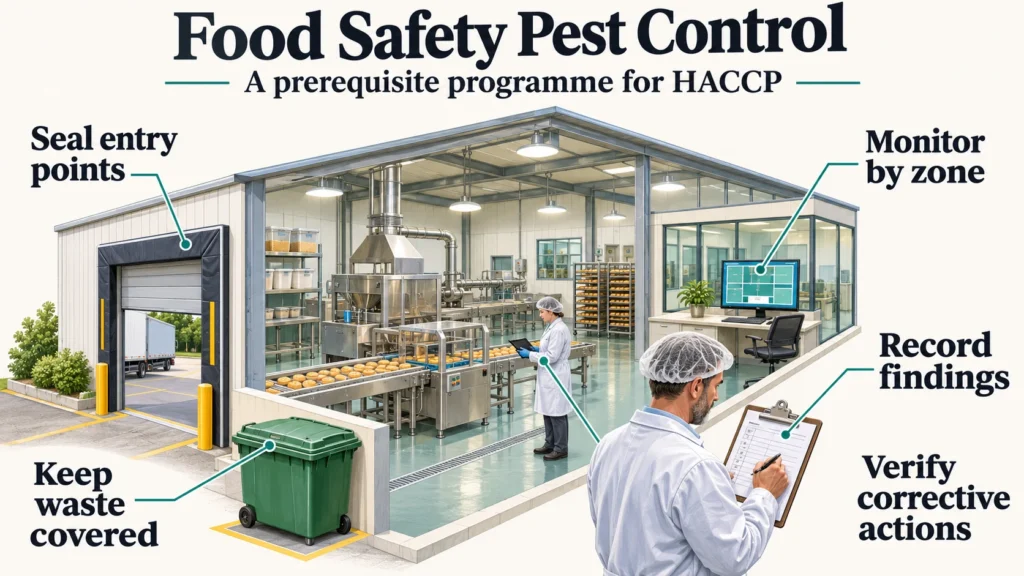
UK food safety law sets clear, non-negotiable standards for commercial food premises. Operators must remove contamination risks through systematic prevention, continuous monitoring and rapid intervention. Robust programmes combine physical proofing with diligent documentation to demonstrate active management. Compliance demands sustained attention to structural repair, internal hygiene and detailed record-keeping across the whole operational footprint.
The regulatory framework spreads specific duties across several statutes. Enforcement officers assess both the physical condition of the premises and the administrative trail inside the pest control file. The table below sets out the core legislative measures, the primary operational duties and the enforcement mechanisms that govern food premises in England.
| Legislation | Core Statutory Duty | Enforcement Mechanism |
|---|---|---|
| LegislationFood Safety Act 1990 | Core Statutory DutyPrevent selling food injurious to health or not of the nature demanded | Enforcement MechanismFines, prosecution and reliance on the due diligence defence |
| LegislationFood Safety and Hygiene (England) Regulations 2013 | Core Statutory DutyKeep premises clean, maintained in good repair and free from pests | Enforcement MechanismHygiene Improvement Notices and Hygiene Emergency Prohibition Notices |
| LegislationPrevention of Damage by Pests Act 1949 | Core Statutory DutyNotify the local authority in writing if rats or mice resort in substantial numbers | Enforcement MechanismStatutory notices under Section 4 and level 1 standard scale fines |
| LegislationEnvironmental Protection Act 1990 | Core Statutory DutyManage waste properly and prevent statutory nuisances prejudicial to health | Enforcement MechanismAbatement notices and local authority remediation orders |
Primary Legislation and Statutory Obligations
Food Safety Act 1990 and the Due Diligence Defence
The Food Safety Act 1990 forms the primary statutory foundation for food standards in Great Britain. It creates criminal offences for businesses that render food injurious to health. Section 21 provides a vital due diligence defence. To rely on it, an operator must prove they took all reasonable precautions to prevent the failure.
Substantiating that defence requires a comprehensive, up-to-date pest control file. The documentation must prove that regular inspections take place. It must also show that identified risks received prompt corrective action, and that competent professionals oversaw every intervention. Without verifiable written records, an operator cannot easily establish due diligence after a contamination incident.
Food Safety and Hygiene (England) Regulations 2013 Requirements
The Food Safety and Hygiene (England) Regulations 2013 impose mandatory operational duties on all food businesses. Operators must keep premises clean, structurally sound and in good repair. The regulations require adequate procedures to control pests. They also require operators to prevent domestic animals from entering food preparation areas.
Devolved administrations enforce equivalent hygiene rules through parallel legislation in Scotland, Wales and Northern Ireland. These statutory instruments allow authorised officers to inspect premises without prior appointment. Officers examine whether daily practice protects raw ingredients, production lines and packaged goods. In practice, we find that warehousing and intake bays attract the closest attention.
Local Authority Powers and Pest Reporting
Prevention of Damage by Pests Act 1949 Occupier Duties
Section 3 of the Prevention of Damage by Pests Act 1949 imposes distinct duties on property occupiers. Commercial occupiers must notify their local authority in writing forthwith if rats or mice resort to the land in substantial numbers. Agricultural premises hold a specific statutory exemption from this notification requirement.
Failing to notify the authority is an offence. On summary conviction it carries a fine not exceeding level 1 on the standard scale, currently £200. Under Section 4, councils may serve formal notices requiring occupiers to destroy pests. Those notices specify the remedial steps required and set strict compliance deadlines.
Substantial Numbers and the Notification Threshold
The 1949 Act sets no numerical threshold for substantial numbers of rodents. That absence of statutory definition creates practical ambiguity for food operators assessing site activity. Occupiers must apply professional judgement instead. They decide whether current sightings or physical evidence require immediate formal notification to the council.
Competent contractors help by conducting structured risk assessments that quantify pest pressure accurately. Objective catch data, tracking dust results and bait box monitoring reveal emerging infestations early. Agreeing clear internal thresholds protects the business from inadvertent non-compliance. From experience across the sector, documented thresholds also shorten any later dispute with an enforcement officer.
Did You Know?
Under Regulation 6 of the Food Safety and Hygiene (England) Regulations 2013, a Hygiene Improvement Notice must give the operator a compliance period of not less than 14 days. Failing to comply with that notice is a separate criminal offence.
Environmental Health Inspections and Enforcement Visits
How Environmental Health Officers Assess Pest Activity
Environmental Health Officers examine food premises thoroughly during scheduled audits and unannounced visits. Officers look well beyond obvious sightings. They search for structural harbourage, grease smears, gnaw marks and droppings. They also inspect equipment voids, dark ceiling spaces, motor housings and storage racking where pests shelter unseen.
Inspectors assess the physical environment alongside the pest management folder. An officer checks whether the business acts promptly on written technician recommendations. Unaddressed building defects signal weak management control. Poor documentation undermines confidence in the operator and directly harms the publicly displayed Food Hygiene Rating score.
Formal Notices and Emergency Closure Powers
Enforcement officers hold tiered statutory powers to address food safety failures found on site. Minor structural defects or procedural omissions usually attract a Hygiene Improvement Notice. That notice mandates specific remedial actions within a defined period. It gives the operator a documented opportunity to rectify the deficiencies identified.
An active infestation posing an imminent risk of injury to health triggers faster escalation. Officers serve a Hygiene Emergency Prohibition Notice, which closes the business or halts specific processes immediately. The authority must then apply to the magistrates’ court within three days. Premises stay shut until the authority certifies that the health risk has gone.
Free Pest Control Audit Review
We will review your risk assessment, site plan, visit reports, trend analysis, open recommendations, product records and demo our AI Pest management System.
HACCP Integration and Prerequisite Programmes
Pest Control as a Prerequisite Foundation
Pest management functions as an essential prerequisite programme within a wider food safety management system. Prerequisite programmes create the foundational environmental conditions needed to produce safe food consistently. They operate independently of critical control points. Instead, they establish baseline hygiene across manufacturing, storage and preparation environments alike.
A compliant Hazard Analysis Critical Control Point plan references the pest control programme directly. The plan must describe the physical scope, contractor arrangements, monitoring schedules and record-keeping processes in place. Treating pest exclusion as a prerequisite keeps environmental hygiene continuous. It prevents operators from treating pest control as an isolated emergency response.
Risk-Based Action Thresholds in Practice
An action threshold is the level of pest activity that triggers immediate corrective intervention. Thresholds are rarely set at zero, because external monitoring stations often register incidental movement. Internal food production zones are different. They demand exceptionally low thresholds compared with external perimeters or waste compounds.
Thresholds must reflect zone-specific risk and the biology of the target species. A single fly inside an open product area demands immediate operational investigation. Documenting the technical basis behind each limit shows officers that management evaluates contamination risk systematically. Robust data replaces guesswork, which auditors consistently reward.
AI Pest Management
AI pest management is pest control delivered with continuous digital monitoring and analytics rather than paper records, with real time data access across a single or multiple sites.
Essential Elements of the Pest Control Audit File
Required Documentation and Site Plan Mapping
The on-site pest control file is the definitive administrative evidence during any regulatory audit. The folder must hold the service agreement, public liability insurance details and proof of technician competence. It must also contain a dated, signed site plan. That plan shows the numbered location of every internal and external device.
Inspectors cross-check physical monitoring devices against the site plan to verify accuracy. The file must also hold product labels and safety data sheets. Control of Substances Hazardous to Health assessments are required for every preparation used on site. Missing paperwork quickly turns an otherwise clean facility into a compliance liability.
Trend Analysis Versus Raw Monitoring Data
Regulatory inspectors and third-party auditors expect clear interpretation of monitoring data over time. Collating visit slips or recording catch numbers no longer satisfies modern auditing standards. Trend analysis demands more. It reviews recorded activity by zone, identifies patterns and explains whether populations are rising, falling or stable.
Competent contractors supply written commentary explaining why specific spikes occurred and what action followed. A proper review confirms whether proofing, deep cleaning or targeted treatment resolved the underlying problem. Raw data without narrative interpretation signals an incomplete monitoring system. External auditors routinely raise formal non-conformances on exactly that point.
Operational Housekeeping and Proofing Defences
Building Envelope Maintenance and Door Discipline
Physical proofing forms the frontline defence in any pest control food hygiene strategy. Mice enter through openings as small as a pencil width. Door seals, dock levellers and pipe penetrations therefore remain the weakest points. Heavy-duty brush strips, metal kick plates and fine insect mesh seal the building envelope effectively.
Operational habits frequently undermine durable hardware. Staff prop loading doors and emergency exits open for ventilation during busy shifts. Unmonitored openings give flying insects and opportunistic rodents direct access to production halls. Training staff in strict door discipline keeps structural barriers effective throughout the working day.
Waste Storage Management and Drainage Defences
Waste management practice directly influences the external pest pressure challenging a building. Commercial bins need tight-fitting lids, documented cleaning schedules and sensible positioning away from personnel entrances. Accumulated food waste creates a potent attractant. Leaking compactor fluids sustain large local rodent and fly populations year-round.
Drainage networks remain the primary underground entry route for brown rats. Defective pipework, open gullies and uncapped inspection chambers let rodents move from sewers into building cavities. Interceptor traps, stainless steel drain mesh and non-return valves provide a durable barrier. Routine CCTV drainage surveys confirm whether that barrier still holds.
Rodenticide Stewardship and Modern Control Methods
CRRU Stewardship Restrictions on Rodenticide Use
Commercial operators must comply with Campaign for Responsible Rodenticide Use guidance when managing rodents. Regulators introduced the stewardship regime because second-generation anticoagulants were contaminating non-target wildlife. Since January 2026, every purchaser of professional rodenticides must show an approved certificate at the point of sale.
Certificates older than five years must be supported by membership of a recognised CPD scheme. Permanent baiting must never be routine practice. It is limited to sites with a high potential for reinvasion where other methods have proved insufficient. Every application needs a written environmental risk assessment, documented justification and regular carcass searches.
Non-Toxic Monitoring Replaces Routine Baiting
Modern food safety standards prioritise prevention-led Integrated Pest Management over automatic chemical application. Facilities now fit permanent bait stations containing non-toxic monitoring blocks rather than active rodenticide. These blocks work as an early warning system. They reveal teeth marks and feeding activity without introducing toxic risk into food environments.
Technicians introduce chemical intervention only once monitoring confirms active rodent presence in a defined zone. Pairing early detection with mechanical traps, physical exclusion and habitat modification achieves durable control safely. Outdoor permanent bait points also require re-inspection at least every four weeks. This approach reduces pesticide use whilst satisfying retailer supply standards.
Final Thoughts
Maintaining high standards of food safety pest control is both a statutory obligation and a commercial safeguard. UK food hygiene regulations require operators to demonstrate active control of biological hazards through documented preventative measures. A well-managed programme combines structural proofing, staff awareness and diligent housekeeping. When management treats pest prevention as a core discipline, inspections and audits become straightforward.
Evaluating your compliance position means examining daily practice rather than waiting for an officer to identify failures. A verifiable system relies on consistent monitoring, timely corrective action close-out and strict environmental stewardship. Strong preventative barriers protect public health and safeguard business continuity. They also keep your food hygiene rating secure for the year ahead.
Request a Free Site Survey
Frequently Asked Questions
A:
Under the Food Safety and Hygiene (England) Regulations 2013 and equivalent devolved legislation, food business operators must keep premises clean and in good repair. They must also put adequate procedures in place to control pests. Those procedures must prevent domestic animals from reaching food preparation areas. Operators must remove potential harbourage, seal entry points and keep verifiable records. Those records must prove that monitoring and corrective controls continue throughout the year.
A:
The Food Safety Act 1990 provides a statutory defence where an operator proves they took all reasonable precautions and exercised all due diligence. An up-to-date pest control file supplies objective proof of systematic management. The file should hold site risk assessments, routine inspection reports and numbered site maps. It should also evidence that staff acted on previous recommendations. These records show an enforcement officer or court that the business actively managed contamination risk.
A:
Yes. An officer may close premises immediately where an active infestation creates an imminent risk of injury to health. The officer serves a Hygiene Emergency Prohibition Notice, which stops trading or prohibits the use of specific equipment. The enforcement authority must then apply to the magistrates' court within three days of service. Premises remain closed until the authority re-inspects the site and certifies that the health hazard has been removed.
A:
No. Pest control is classified as a prerequisite programme rather than a critical control point. Prerequisite programmes establish the baseline environmental and operational conditions needed for safe food production. The HACCP plan must formally reference the pest management programme and its verification records. Daily pest monitoring then functions as a general facility control. It does not operate as a product-specific critical control point with measurable critical limits.
A:
Section 3 of the Prevention of Damage by Pests Act 1949 requires occupiers of non-agricultural land to notify the local authority in writing forthwith. The duty applies where rats or mice resort to the property in substantial numbers. The statute leaves substantial numbers undefined, so occupiers must exercise professional judgement based on monitoring findings. Failure to notify the council is a summary offence. It carries a fine not exceeding level 1 on the standard scale.


By choosing Shield Pest Management, you’re partnering with a company that combines local expertise with industry-leading practices. Our commitment to quality, compliance, and customer satisfaction makes us an ideal choice for both residential and commercial pest control needs.
