

Multi Site Pest Control Contracts Explained
Organisations running several properties face compliance pressures that single-site businesses rarely meet. Effective multi site pest control has to balance group governance against the biological risks of each location. Without a shared model, regional sites drift into separate contractor arrangements and patchy records. A single operational standard protects brand reputation and satisfies statutory hygiene duties. It also means inspectors meet the same due diligence at every address.
How does a facilities director hold rigorous standards across retail, logistics and food production estates without overloading local teams? And how do group frameworks consolidate service records, prove compliance at audit, and keep call-out costs predictable across regions?
Key Takeaways
- Centralised contracts replace scattered regional vendor deals with standard service terms, uniform inspection frequencies and one reporting format across the whole estate.
- Strong programmes band sites by biological risk rather than floor area, so food environments get closer monitoring than dry storage units.
- Digital reporting platforms roll estate data into one dashboard, giving central teams live sight of open actions and outstanding service visits.
- Contractor checks must confirm genuine BPCA servicing membership, BS EN 16636 certification and directly employed technicians rather than unvetted subcontractor networks.
- Clear commercial schedules stop surprise invoices by listing routine inclusions and setting prices for reactive call-outs, proofing and specialist works.
Portfolio Pest Management Structure and Service Models
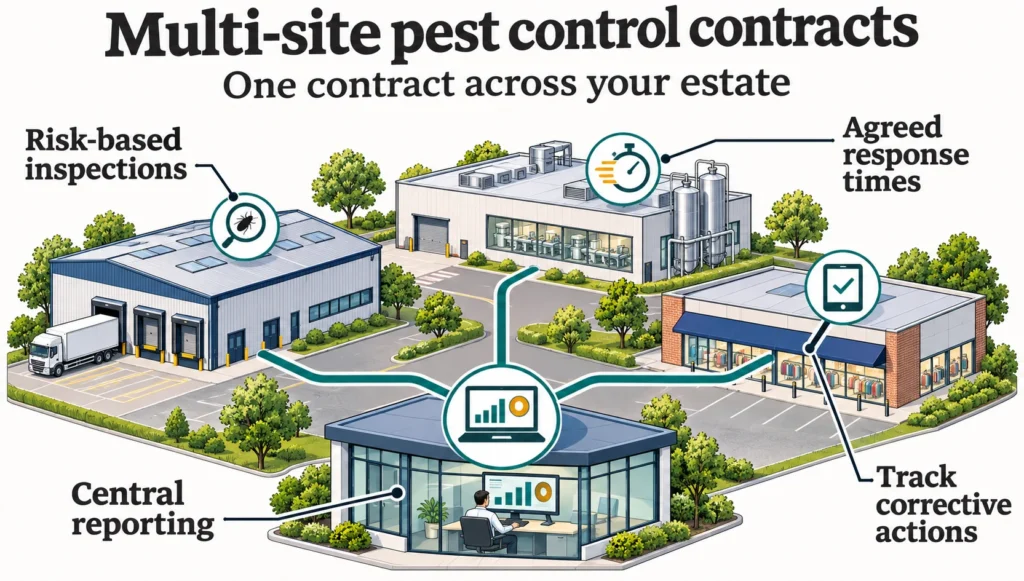
Estate-wide pest management needs a service framework that respects site risk whilst keeping procurement central. One agreement sets the reporting criteria, the documentation standard and the compliance evidence for every property. Managing pest control across multiple sites breaks down when each location buys its own supplier. Methods diverge, response times vary and records stop being comparable.
The table below sets local arrangements against a consolidated portfolio contract. Group agreements fix clear accountability and cut duplicated procurement admin. They also hold every site at the same audit standard. Environmental Health Officers, customers and certification bodies then see consistent evidence wherever they call. In practice, that consistency is what survives an unannounced visit.
| Contract Element | Dispersed Local Providers | Centralised Portfolio Agreement |
|---|---|---|
| Contract ElementAccountability | Dispersed Local ProvidersSplit across site managers and various trades | Centralised Portfolio AgreementOne named account manager and consistent service levels |
| Contract ElementData and Reporting | Dispersed Local ProvidersPaper forms, delayed emails and scattered PDFs | Centralised Portfolio AgreementOne digital portal with estate dashboard roll-ups |
| Contract ElementAudit Standardisation | Dispersed Local ProvidersVariable folders and incompatible trend logs | Centralised Portfolio AgreementStandard audit files for BRCGS, SALSA or EHO review |
| Contract ElementCost Visibility | Dispersed Local ProvidersUnpredictable regional rates and hidden call-out fees | Centralised Portfolio AgreementConsolidated billing and an agreed schedule of rates |
| Contract ElementTechnical Consistency | Dispersed Local ProvidersMixed technician training, equipment and methods | Centralised Portfolio AgreementOne IPM procedure and directly employed technicians |
Portfolio Governance and Risk Classification
Operational Risk Profiles Across Disparate Sites
A sound multi-site programme grades every premises on biological vulnerability, not gross floor area. Food handling zones, open loading bays and older buildings need denser monitoring and more frequent visits. Dry storage and corporate offices need less. Group contracts should carry those distinctions in the core servicing schedule itself.
Under an integrated programme, each property gets a survey before baseline servicing starts. A food plant under BRCGS Issue 9 needs intensive rodent and crawling insect monitoring. A neighbouring distribution hub has different priorities. There, the work centres on roller shutter proofing and high-bay bird exclusion. Clear risk bands direct spend at real threats rather than arbitrary calendar intervals.
Central Contract Frameworks Versus Local Agreements
Central frameworks give estate managers uniform governance, negotiated rates and one point of accountability. Local supplier deals cannot match that. Letting each branch appoint its own contractor creates administrative friction and incompatible paperwork. Service quality then varies without anyone noticing. Group agreements set enforceable standards that apply identically everywhere.
Where sites negotiate alone, central procurement loses sight of annual spend. Insurance certificates and safety assessments also go unchecked. Regional contracts often omit seasonal wasp work or rodent follow-up visits. Disputed invoices follow. A corporate agreement states what scheduled servicing covers and how supplementary works are priced. From experience across the sector, that clarity is where the savings actually sit.
Centralised Reporting and Digital Portfolios
Unified Data Collection and Real-Time Visibility
Digital reporting replaces handwritten logbooks with timestamped electronic inspection records at every property. Technicians scan numbered devices in sequence and register activity as they work. Environmental observations go in at the same point. Central technical teams then read validated records straight away, instead of waiting for paper to arrive.
Modern programmes document compliance through a portal. Survey findings and photographic evidence are captured on site before the technician leaves. That removes re-entry errors and builds an audit trail nobody can dispute. Estates teams can check completed visits, outstanding actions and technician notes whenever they like. No one has to chase a site manager for scanned sheets.
Multi-Site Dashboard Integration for Estates Teams
Portfolio dashboards pull separate location records into one executive view. Corporate managers can then read estate-wide pest exposure at a glance. Summary screens flag bottlenecks, ageing proofing recommendations and unresolved hygiene defects across buildings. Central teams direct maintenance spend at the places where pest risk threatens operational continuity.
Facilities directors do not need to open hundreds of service sheets. Heat maps and status filters do the sorting. If three northern distribution sheds show repeated rodent ingress at dock levellers, the maintenance contract can be changed once. Audits get easier too. Technical directors grant read-only portal access to third-party inspectors, and the ring binders stay in the cupboard.
Did You Know?
Under the Food Safety and Hygiene (England) Regulations 2013, a hygiene offence tried on indictment carries an unlimited fine and up to two years’ imprisonment. Equivalent penalties apply under the devolved regulations in Scotland, Wales and Northern Ireland.
Compliance Standards and Technical Consistency
Harmonised Baseline Inspections Across Regions
Consistency between regional branches depends on identical inspection criteria, device numbering and threshold definitions. Geography should make no difference. Where local sites run their own routines, comparison becomes impossible and compliance gaps multiply quietly. A standardised Integrated Pest Management framework holds proofing, hygiene and monitoring standards level across the estate.
Standardisation matters most under strict quality schemes. The Food Safety and Hygiene (England) Regulations 2013 and the devolved equivalents require adequate pest procedures. A harmonised system keeps site plans, product data sheets, COSHH assessments and risk reviews identical everywhere. When an Environmental Health Officer visits any branch, the documentation supports the organisation’s due diligence defence under the Food Safety Act 1990.
Independent Technical Surveys and Field Biologist Audits
Specialist technical reviews judge site hygiene, building fabric and contractor performance from outside the servicing relationship. Routine visits track pest activity. A field biologist audit examines the structural weaknesses and harbourage behind that activity. Group contracts should mandate these reviews for manufacturing and processing assets, not treat them as optional.
On food-certified sites, an in-depth survey by a qualified biologist or technical specialist is an explicit audit requirement. These surveys reach roof voids, concealed ductwork and external drainage that routine visits cannot cover properly. Across a large estate, an annual biologist survey at each high-risk site exposes underlying problems early. Issues get resolved before a certification body finds them.
Free Pest Control Audit Review
We will review your risk assessment, site plan, visit reports, trend analysis, open recommendations, product records and demo our AI Pest management System.
Operational Roles and Service Escalation Paths
Allocation of Duties Between Central and Local Teams
Clear boundaries between central procurement and local site managers prevent gaps when pest issues arise. Corporate teams own supplier negotiation, contract scope and service level monitoring. Site teams own daily hygiene, the sightings log and technician access. Documented responsibilities mean the attending technician gets full cooperation on arrival.
In multi-tenant or managed buildings, responsibility blurs between landlord, managing agent and tenant. Shared service risers, common roof spaces and external refuse compounds get neglected and become harbourage. A structured national agreement states the exact maintenance perimeter for each party. Local teams must keep the sightings log honestly. In practice, we find an empty log over several months draws more auditor suspicion than a populated one.
Protocol for Severe Infestation Response and Remediation
A robust contract states the escalation route for sudden biological threats in plain terms. Rapid technical attendance and coordinated remediation should not wait on local sign-off. If a distribution centre finds rodent ingress, or a hotel finds bed bugs, the protocol bypasses routine authorisation. Early intervention prevents operational closure.
Significant activity calls for structured follow-up visits to confirm eradication. Treating the event as a one-off visit is a common failure. For rodent work, Campaign for Responsible Rodenticide Use guidance requires justified rodenticide use, maintained non-toxic monitoring and carcass retrieval. In hospitality and residential settings, adjoining rooms need immediate inspection. Pests move along service conduits and wall cavities faster than most teams expect.
AI Pest Management
AI pest management is pest control delivered with continuous digital monitoring and analytics rather than paper records, with real time data access across a single or multiple sites.
Contract Architecture and Commercial Mechanisms
Core Service Inclusions and Scheduled Visit Models
Transparent procurement means stating which species, inspections and reporting services sit inside the fixed annual fee. Routine programmes should cover commensal rodents and common crawling insects as standard. Preventative monitoring inspections belong there too. Vague scope creates friction later, when a routine call arrives on the invoice as extra works.
When setting up commercial frameworks through national pest control contracts, confirm whether emergency call-outs for covered species are included or charged. The contract should state scheduled visit numbers per year for each property type. Frequency must follow recorded risk, not convention. Digital reporting portals, trend analysis and regulatory documentation should sit in the baseline fee, not appear as a later addition.
Variable Project Pricing and Excluded Specialist Treatments
Baseline fees rarely cover specialist remediation, so a pre-agreed schedule of rates matters. Feral pigeon proofing, guano decontamination, wasp nest treatment and structural fly screening are capital projects. They are not routine servicing. Negotiating those rates before an incident prevents inflated emergency pricing when the work becomes urgent.
Bird management shows why secondary services need precise terms. Work on feral pigeons or gulls sits under the Wildlife and Countryside Act 1981 and the relevant general licences, such as GL42 in England. It often involves height access, netting and specialist sanitation. Structural proofing is similar. Replacing dock seals or sealing cable penetrations needs stated hourly rates and material schedules.
Contractor Capability and Labour Standards
Industry Credentials and Verifiable Competence
Appointing an estate-wide provider requires independent checks on technical competence, registrations and safety compliance at every servicing branch. Professional affiliation shows the contractor works to published industry codes rather than local habit. Commercial buyers should inspect the certificates themselves. Documentary evidence protects the organisation’s own statutory compliance position.
Check for full British Pest Control Association servicing membership and BS EN 16636 certification, the European standard for pest management services. Attending technicians should hold a recognised qualification such as the RSPH Level 2 Award in Pest Management. Active BASIS PROMPT registration shows continuing professional development. For industrial and logistics work, CHAS accreditation confirms safe systems of work and proper COSHH assessment.
Direct Labour Models Versus Subcontractor Networks
National delivery models split between directly employed technician teams and third-party subcontractor networks. Some providers advertise nationwide coverage, then broker the work to local contractors they have not vetted. Service consistency, accountability and reporting quality all suffer. Confirming direct employment secures uniform training and reliable communication across every location.
Subcontracting creates real friction for estates teams managing pest control across multiple sites. Subcontractors run separate reporting systems and vary their baiting methods. They also close out structural recommendations on different criteria. A directly employed workforce applies one standard of due diligence on shared digital infrastructure. Ask any prospective contractor plainly whether servicing technicians are employees or agency staff.
Contract Performance and Estate-Wide Review
Objective Metrics for Group-Level Monitoring
Judging a pest management contract means tracking operational performance, not counting chemical treatments. Useful indicators cover schedule adherence, emergency response times and the average age of open corrective actions. Those figures show whether prevention is working. Treatment volume shows only how often the contractor has been called back.
Crude measures reward the wrong behaviour. Counting traps installed or kilograms of bait laid encourages reaction instead of exclusion. In facilities management, contract reviews should examine the age of open proofing recommendations. If technicians flag damaged door seals across regional warehouses and nobody repairs them, infestations follow. Corrective action close-out rates give a far more honest reading of compliance.
Regional Trend Evaluation and Root Cause Analysis
Estate-level trend analysis combines monitoring history across sites to expose systemic risk. Catch trends by region or business unit show where seasonal ingress and supply chain problems repeat. Technical directors can then apply preventative controls before activity spreads. Documented trend interpretation also satisfies third-party audit requirements on its own terms.
Good trend work looks past the numbers to the cause. A rise in stored product moths across several manufacturing sites may point to infested raw material from a shared supplier. Local sanitation may be fine. Autumn spikes in rodent activity across a region call for coordinated perimeter proofing before external populations move indoors. Written analysis turns raw service data into management intelligence.
Final Thoughts
Consolidating estate protection under a single multi site pest control contract moves an organisation from reactive firefighting to risk-based management. Standard service agreements, uniform inspection frequencies and integrated digital reporting hold technical standards level across every facility. Removing regional variation and unvetted subcontractor layers gives estate directors compliance oversight that survives client and regulatory audit.
Rodenticide stewardship is tightening and audit standards now demand more transparency. Structured estate agreements supply the rigour that scrutiny requires. Organisations that judge suppliers on verifiable credentials, transparent pricing and live reporting build durable defences across a portfolio. The resulting visibility protects brand equity and keeps health and safety performance consistent from site to site.
Request a Free Site Survey
Frequently Asked Questions
A:
Ask whether technicians are directly employed or subcontracted across the portfolio. Request proof of BPCA servicing membership and BS EN 16636 certification. Check technician qualifications, current BASIS PROMPT records and public liability insurance levels. Confirm that your central team gets direct portal access with multi-site dashboard views. Establish who writes the interpreted trend analysis. Finally, pin down guaranteed emergency response times and the specialist treatments excluded from the core fee.
A:
Standard agreements cover scheduled inspections and routine treatment for commensal rodents and crawling insects. Specialist and capital remediation usually sits outside. Common exclusions include bird proofing, netting installation, guano decontamination, wasp nest removal and intensive bed bug eradication. Structural proofing, drain valve installation and fly screen fitting are normally billed separately. Call-outs outside standard working hours often are too. Review the schedule of rates so excluded services carry transparent pricing before you need them.
A:
Measure risk reduction and service delivery rather than biocide volume. Reliable indicators include visit adherence against the agreed schedule, emergency attendance times and third-party audit outcomes across regional properties. Track the average age and resolution rate of open corrective actions. Watch activity trend direction by zone. High bait box counts and frequent treatments usually signal continuing failure. Prompt close-outs and falling activity trends show that control is holding.
A:
Subcontracted networks deliver inconsistent service quality across regional properties. Documentation formats differ, qualification levels vary and operational thresholds are applied unevenly. When an infestation occurs, accountability blurs between the principal contractor and the servicing agent. Subcontractors rarely share one digital platform, so estate-wide trend analysis and consolidated reporting become impossible. Central procurement loses dashboard visibility altogether. A directly employed model keeps standards, training and accountability uniform throughout the estate.
A:
Digital systems record inspections on site with precise timestamps, numbered device mapping and photographic evidence. That record proves scheduled visits took place. It also shows monitoring points match the approved site plan. Central dashboards hold historical trend analysis and confirm that structural recommendations were closed out. During a food safety or hygiene audit, administrators can grant read-only portal access to the inspector. Nobody has to locate paper folders.
By choosing Shield Pest Management, you’re partnering with a company that combines local expertise with industry-leading practices. Our commitment to quality, compliance, and customer satisfaction makes us an ideal choice for both residential and commercial pest control needs.
