

Pest Control Documentation Auditors Expect
Third-party auditors place substantial weight on the pest binder or digital compliance portal. They look for a coherent preventive programme, not a series of disconnected chemical treatments. Strong pest control documentation proves statutory compliance, technical competence and active facility maintenance under BRCGS, SALSA and ISO 22000. Missing or outdated records trigger non-conformances even when no live pests are present.
A well-ordered compliance file gives Environmental Health Officers and quality assessors the objective proof they need. Every record reflects operational diligence, from contractor certifications to dated trend reviews and verified remedial work. Would an unannounced inspection find your file complete, or would it expose gaps across your pest management programme?
Key Takeaways
- Auditors judge pest management on documented evidence, so weak record-keeping triggers non-conformances even during periods of zero recorded pest activity.
- A compliant site plan shows every numbered monitoring point, and the layout on the factory floor must mirror the recorded map.
- Raw catch numbers fail audit standards, because assessors require written technical interpretation explaining biological trends, operational risks and preventive action taken.
- Corrective action logs need photographic evidence and recorded sign-offs, since recommendations carried across several visits signal systemic procedural failure.
- Staff sightings logs evidence operational culture, showing that trained internal teams monitor and report pest risks between scheduled contractor visits.
Essential Records for Pest Control Compliance
Auditors work through a defined set of records to confirm that pest management sits inside a formal structure. Checking your pest control file contents against the relevant scheme standard keeps every document defensible during an unannounced visit. Unsigned plans and missing certificates compromise the site regardless of pest pressure.
The table below sets out the core documentation modules that assessors inspect across food production, logistics and healthcare sites. Maintaining each module in order demonstrates statutory compliance and alignment with recognised standards such as BRCGS Issue 9 and SALSA Issue 7. Each component verifies a different element of technical control.
| Document Module | Auditor Requirement | Compliance Impact |
|---|---|---|
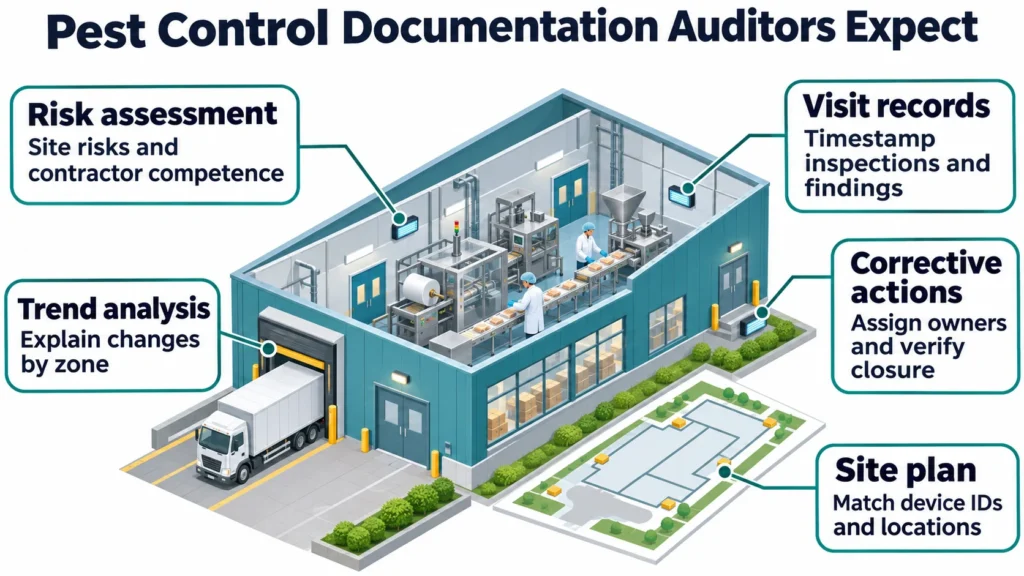
| Document ModuleContract and Scope | Auditor RequirementActive service agreement detailing visit frequency and specification | Compliance ImpactVerifies agreed service levels and technical responsibilities |
| Document ModuleSite Plan | Auditor RequirementSigned, dated map displaying every numbered monitoring point | Compliance ImpactEnsures device placement matches the risk assessment |
| Document ModuleRisk Assessment and COSHH | Auditor RequirementSite-specific hazard appraisal and product safety data sheets | Compliance ImpactSatisfies legal health, safety and pesticide obligations |
| Document ModuleInspection Reports | Auditor RequirementTimestamped technician logs detailing findings and hygiene issues | Compliance ImpactConfirms regular physical monitoring and site oversight |
| Document ModuleTrend Analysis | Auditor RequirementPlotted activity records with written technical commentary | Compliance ImpactDemonstrates proactive evaluation of seasonal risk patterns |
| Document ModuleCorrective Action Log | Auditor RequirementDated register showing named owners and close-out evidence | Compliance ImpactProves identified structural and hygiene defects are resolved |
Foundational Service Agreements and Credential Records
Service Contracts and Defined Coverage Schedules
Auditors read the service agreement first. They check that contracted visit frequency matches the documented risk level of the site. A vague contract with no defined schedule or emergency attendance clause fails scheme requirements immediately. The scope must name target species, routine inspection frequency and the agreed reporting method.
BRCGS Issue 9 expects clear operational boundaries between client duties and contractor duties. Visit frequency should reflect measured risk rather than habit. In practice, high-care food production usually needs monthly or fortnightly attendance. A dry ambient warehouse may operate safely on a quarterly cycle. Technical managers should record the reasoning behind the chosen frequency, so assessors can see a deliberate decision.
Technician Qualifications and Trade Body Certifications
Assessors want proof of competence before they review any site activity. The file must hold current technician qualifications, such as RSPH Level 2 awards, alongside active BASIS PROMPT registration. These records confirm that attending staff hold verified skills. They also show that continuing professional development remains up to date.
Corporate credentials carry equal weight. Membership of the British Pest Control Association confirms adherence to a published code of best practice. Certification against BS EN 16636 gives independent assurance that the provider meets the European standard for pest management services. A valid public liability insurance certificate must also sit in the file. Knowing the documents to keep in your pest control folder lets technical teams assemble a complete file before assessors arrive.
Site Plans and Device Mapping Standards
Numbered Device Layouts and Physical Alignment
A compliant site plan records the location and reference number of every monitoring device. Auditors cross-check the plan against the physical layout during the walkthrough. Any gap between the drawing and the devices on the floor triggers a non-conformance. Accuracy matters more than presentation in this document.
Numbering must stay consistent across external bait stations, internal rodent traps and electronic fly units. When machinery moves or the layout changes, the contractor updates the drawing promptly. Traps lifted during a deep clean or floor repaint must return to their marked positions. From experience across the sector, auditors head for perimeter fencing and loading docks first, checking that external stations remain anchored and correctly numbered.
Signatures, Revision Dates and Version Control
Assessors expect the site plan to carry signatures and a clear revision date. An unapproved or undated drawing suggests uncontrolled documentation, which breaches prerequisite requirements. Both the lead technician and the nominated site manager should sign each revision. The signed version proves the layout has been reviewed and accepted.
An annual review keeps device positions aligned with current operational risk. BRCGS and SALSA both expect written confirmation that the layout has been reviewed, even where nothing has moved. Recording the review date on the drawing itself gives assessors immediate evidence. Sites holding separate internal and external plans must keep version numbers aligned across the whole technical manual.
Did You Know?
Section 3 of the Prevention of Damage by Pests Act 1949 places a statutory duty on the occupier of any land. Once it comes to their knowledge that rats or mice are living on or resorting to the land in substantial numbers, they must notify the local authority in writing.
Risk Assessments and Chemical Safety Files
Site-Specific Assessments and Action Thresholds
Pest control documentation must include a site-specific risk assessment covering every operational zone. Generic templates fail third-party audits, because they ignore the building fabric and the processes inside it. Assessors also look for documented action thresholds. Those thresholds define the catch level that forces an operational response.
Thresholds must reflect the hygiene zones within a single building. High-care processing areas demand zero tolerance for crawling and flying insects. External loading bays may carry a low baseline before investigation begins. The assessment should record who set each threshold and the technical reasoning behind it. Schemes expect an annual review that captures structural changes, new ingredient suppliers or revised waste handling arrangements.
CRRU Compliance and Chemical Safety Sheets
Auditors expect full transparency on every substance stored or applied on site. The file must hold manufacturer safety data sheets, COSHH assessments and evidence of compliance with Campaign for Responsible Rodenticide Use guidance. Rodenticide use without recorded justification is a serious failure. Assessors treat permanent perimeter baiting as an immediate concern.
Stewardship rules now restrict second generation anticoagulants tightly. HSE amended the authorisations of 41 SGAR products, removing open area and waste dump use. Since 1 January 2025, using any SGAR in open areas or around waste dumps has been illegal. Products containing difenacoum and bromadiolone are limited to use in and around buildings. External boxes should therefore hold non-toxic monitoring bait. Rodenticide belongs in the record only as a justified short-term treatment with a recorded removal date.
Free Pest Control Audit Review
We will review your risk assessment, site plan, visit reports, trend analysis, open recommendations, product records and demo our AI Pest management System.
Inspection Reports and Visit Verification Protocols
Timestamped Attendance Logs and Detailed Findings
Inspection reports show whether technicians carried out a genuine survey or a quick check. Each record needs clear arrival and departure times, confirming adequate coverage of internal and external areas. Notes must describe hygiene conditions, proofing status and the result at every device. Vague entries invite scrutiny.
Assessors check whether reports capture structural defects. Damaged brush strips, unsealed pipe penetrations and floor gaps all allow pest entry. Logs must name the species found, the number of individuals and the exact location. A report marked all clear carries little weight when bait stations show heavy wear. Technicians should also note cleaning standards, machinery residues and the condition of external waste bins.
Digital Reporting Portals and Verification Trails
Digital platforms have largely replaced paper folders in demanding third-party audits. A portal captures the on-site timestamp and uploads photographic evidence before the technician leaves. Auditors often prefer read-only portal access. Digital records remove the risk of lost paperwork, transcription errors and retrospective changes to historic visit data.
A secure platform lets technical managers prove traceability on demand. Immediate upload of visit logs evidences compliance with the contracted frequency. Portals also link trap scans to the digital site plan, confirming that the technician reached each station on the route. Retailer auditors frequently ask for historic logs from earlier quarters, and search filters answer those requests in seconds.
AI Pest Management
AI pest management is pest control delivered with continuous digital monitoring and analytics rather than paper records, with real time data access across a single or multiple sites.
Trend Analysis and Data Interpretation Requirements
Catch Data Collation Across Zones and Seasons
Schemes require sites to aggregate monitoring data across extended operating cycles. Combining insect catch trays, pheromone counts and rodent activity records exposes seasonal peaks and local harbourage. Tabulated figures alone satisfy nobody. The data needs clear chronological and geographic categorisation before any interpretation can follow.
Data must separate pest categories to avoid masking a specific contamination risk. Merging all electric fly killer catches into one total hides localised drain fly activity near packaging lines. Professional reports plot catches by device, by production department and by external boundary. Good collation lets technical staff compare summer flying insect pressure against autumn rodent pressure, which supports decisions on proofing and resource allocation.
Written Commentary and Preventive Actions
Auditors reject trend charts that carry no written interpretation from a qualified specialist. The commentary must explain what the movement indicates about hygiene, supplier integrity or seasonal biology. Assessors then look for the consequence. They want to see each activity peak linked to a targeted intervention or a documented review.
A single spike on one warehouse pheromone trap needs a written diagnosis. The analysis should weigh whether incoming raw materials carried the insects, or whether old stock residue supported breeding in racking voids. It must then state the corrective action taken. Follow-up monitoring confirms whether the population fell. An annual review should judge overall programme efficacy and propose improvements for the year ahead.
Corrective Action Logs and Close-Out Evidence
Action Ownership and Target Deadlines
A recommendation becomes an auditable corrective action once it carries a named owner and a deadline. Assessors penalise sites where technician advice circulates without accountability. Every hygiene finding, proofing defect and housekeeping issue belongs in a tracked register. The register is the only reliable proof of follow-through.
Consider a damaged seal on a loading dock door. That finding cannot sit indefinitely as advice. The log should assign the repair to the maintenance manager or facilities lead, with a completion window set by risk severity. High-risk entry points need immediate containment. Minor proofing work may carry a twenty-eight-day target. Auditors check that target dates are realistic and actively monitored by the food safety team.
Verifiable Proof of Remediation
Closing an action needs objective evidence rather than verbal assurance from site staff. Auditors look for date-stamped photographs, contractor invoices or signed internal maintenance records before accepting an item as resolved. Recommendations left open across consecutive inspections attract a non-conformance under GFSI-benchmarked schemes. Repetition is the signal they watch for.
Repeated open findings read as a weak food safety culture. Where successive reports note the same unsealed pipe penetration, assessors conclude that the management system is not working. A follow-up note from the technician validates the close-out and confirms that the harbourage or entry route has gone. Before and after photographs held in the file give assessors evidence they can accept without argument.
Internal Oversight, Staff Logs and Field Audits
Employee Sightings Registers and Follow-Ups
Auditors use the internal sightings log to gauge day-to-day engagement on the floor. A blank log covering a full operating year usually raises suspicion rather than confidence. Assessors expect staff to record incidental insect or bird sightings. They then check what investigation followed each entry.
Employee reporting reflects vigilance across processing lines and storage areas. Each entry should state the date, the time, the exact location and the suspected species. Every entry also needs a recorded response. That may be immediate housekeeping, a localised inspection by the contractor or targeted trap deployment. Prompt reporting followed by decisive investigation proves that internal teams support the programme between scheduled visits.
Independent Field Biologist Reports and Training Records
Major food standards require a periodic inspection by an independent field biologist or senior technical specialist. These audits examine structural integrity, sanitation and overall programme efficacy beyond routine servicing. The resulting survey report belongs in the compliance file. Staff pest awareness training certificates should sit alongside it.
BRCGS Issue 9 requires an in-depth inspection at a frequency set by risk. High-risk food manufacturers typically commission one annually or twice a year. The field biologist gives an authoritative critique of existing controls and identifies subtle harbourage that routine visits miss. Comparing the file against a formal checklist keeps training certificates and annual reports ready for immediate presentation.
Final Thoughts
Complete pest control documentation is not an administrative exercise for audit day. It is the backbone of commercial pest defence and food safety integrity. Assessors across BRCGS, SALSA and retail schemes want objective proof of a structured preventive programme. Current site plans, risk assessments, inspection records and trend reviews satisfy external inspectors and prevent contamination reaching production.
Rodenticide stewardship and scheme requirements continue to tighten, so expectations around transparency and digital traceability will rise further. Sites that treat compliance records as live management tools hold higher standards year-round. Regular internal review against recognised expectations keeps operations resilient, compliant and ready for an unannounced visit.
Request a Free Site Survey
Frequently Asked Questions
A:
Auditors concentrate on five elements. They want a documented programme built on a site-specific risk assessment, verifiable proof of contractor competence. They want an accurate, signed site plan that matches the devices on the floor and they want trend analysis carrying written technical interpretation rather than raw catch tallies. Finally, they want a corrective action register showing that structural and hygiene issues were closed out with objective evidence.
A:
Most non-conformances concern procedure and evidence rather than live infestation. A site can show zero activity on the floor and still fail. An undated site plan, missing technician qualifications or proofing actions left open across several visits will each generate a finding. Schemes assess whether a management system functions as designed. Absence of pests on the day of the audit proves very little on its own.
A:
A chart of raw catch numbers is uninterpreted data. BRCGS and SALSA both require written professional commentary explaining what the figures mean. The commentary should state whether activity is rising or falling. It should identify whether catches cluster in particular hygiene zones. It should weigh external factors such as weather or nearby construction and it must also confirm whether interventions brought activity back below the agreed action threshold.
A:
Yes. A blank log covering a long period usually prompts questions rather than praise. Assessors know that occasional flying insects and minor external sightings occur in any commercial building. Zero entries often indicate that staff were never trained to use the log, or that reporting is discouraged. An active log with dated entries and recorded investigations demonstrates an engaged food safety culture.
A:
A portal provides timestamped verification that inspections happened when scheduled. Quality managers can grant auditors read-only access for the duration of the visit. Assessors then examine live site plans, review trend reports and inspect before and after photographs of closed corrective actions. That immediate transparency removes the scramble to assemble files before an audit. It also demonstrates continuous operational control rather than periodic catch-up.


By choosing Shield Pest Management, you’re partnering with a company that combines local expertise with industry-leading practices. Our commitment to quality, compliance, and customer satisfaction makes us an ideal choice for both residential and commercial pest control needs.
