

Retailer Pest Control Specifications Explained
Food manufacturing sites across the United Kingdom operate inside a layered compliance environment. Third-party certification sets the baseline, yet commercial contracts impose tighter demands on top of it. Technical managers soon find that retailer pest control specifications demand far more operational evidence than a standard food safety audit. Satisfying a major retail buyer means proving continuous active control, not merely the absence of pests.
Quality teams juggling several retail contracts face a real administrative burden. Each buyer publishes its own technical annexe, and the clauses rarely align. So how does a busy processing facility fold overlapping supermarket requirements into one efficient, defensible regime without duplicating daily effort?
Key Takeaways
- Supermarket supplier codes act as prescriptive add-ons above third-party certification rather than replacing baseline food safety schemes such as BRCGS or SALSA.
- Retail specifications routinely demand fixed inspection calendars, faster reactive attendance, and higher monitoring device densities across every production and dispatch zone.
- Independent field biologist surveys must occur more often under retail frameworks, with documented root-cause analysis behind every recorded pest finding.
- Stewardship rules prohibit permanent external rodenticide baiting, so sites rely on non-toxic monitoring, physical proofing, and evidence-led temporary treatment.
- Building one programme around the strictest customer clause removes procedural friction and keeps the site ready for unannounced retail audits.
Baseline Standards and Additional Supermarket Expectations
Third-party certification provides the operational foundation for food processing hygiene in the UK. Major supermarket chains then layer their own technical standards on top to protect private label integrity. Knowing where the two tiers diverge is what keeps a complex manufacturing or packing site commercially compliant throughout the year.
The matrix below sets out the main procedural shifts between base certification requirements and typical UK supermarket expectations. In practice, we find technical managers use a comparison of this kind to pinpoint where an existing programme needs strengthening. Each row reflects a clause that retail auditors examine closely during site assessments.
| Audit Parameter | Base BRCGS Issue 9 Requirement | Supermarket Supplier Code Expectation |
|---|---|---|
| Audit ParameterInspection Frequency | Base BRCGS Issue 9 RequirementSet by documented risk assessment | Supermarket Supplier Code ExpectationMandated minimum calendar, often monthly or fortnightly |
| Audit ParameterField Biologist Audits | Base BRCGS Issue 9 RequirementAnnual or risk-justified expert review | Supermarket Supplier Code ExpectationSix-monthly or quarterly technical inspection |
| Audit ParameterCorrective Action Closure | Base BRCGS Issue 9 RequirementRisk-based resolution with documented records | Supermarket Supplier Code ExpectationContractual deadline, frequently fourteen days |
| Audit ParameterToxic Rodenticide Use | Base BRCGS Issue 9 RequirementPermitted under CRRU stewardship rules | Supermarket Supplier Code ExpectationNon-toxic monitoring default with chemical sign-off |
| Audit ParameterProgramme Ownership | Base BRCGS Issue 9 RequirementTrained personnel managing the contract | Supermarket Supplier Code ExpectationNamed internal pest champion required |
Technical Differences Across Retailer Requirements
Fixed Inspection Calendars and Call-Out Times
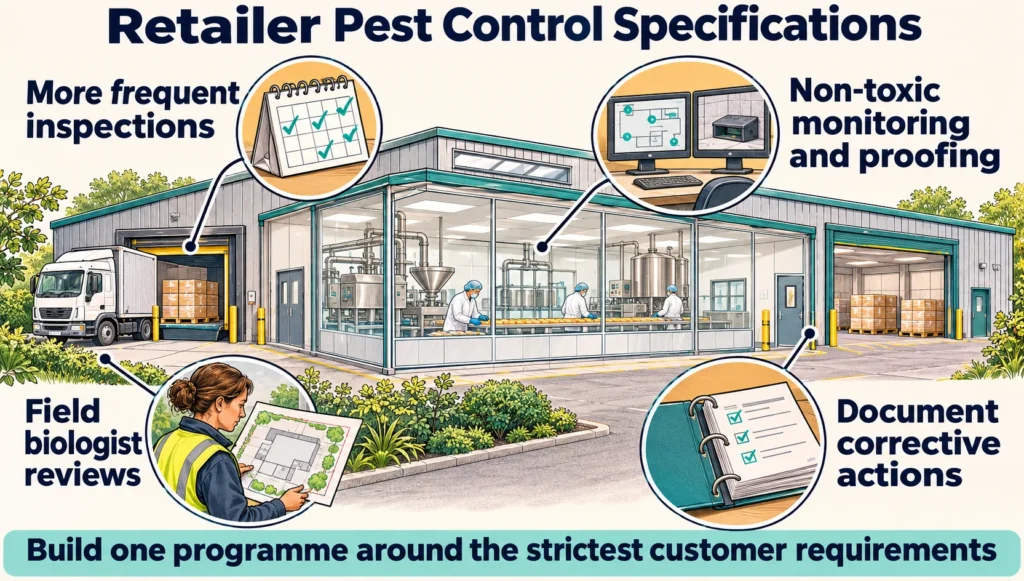
Retailer codes strip out the discretion that base certification allows on visit scheduling. Baseline standards let a site set intervals from its own risk assessment. Supermarket annexes instead dictate a rigid minimum calendar. Monthly or fortnightly attendance becomes contractual, whatever the site history shows.
Emergency response times tighten as well. When staff report a rodent sighting or fly activity in a sensitive production area, many supermarket supplier codes require contractor attendance within four to six hours. The incident must be contained immediately and reported to the retail technical contact. That service level depends on a provider with genuine regional coverage.
Device Density and Zone-Specific Monitoring
Supermarket specifications set elevated densities for electronic fly units and mechanical traps inside production areas. They often stipulate exact spacing along internal walls, pedestrian entrances, and dispatch bays. Devices must form an unbroken detection line. Auditors then check each position against a dated floor plan during the walk round.
Zone differentiation is rigorous under these frameworks. High-care areas require specialised non-toxic monitoring, whilst low-care packing halls carry higher densities of glue-board electric fly killers. Device numbering must match the plan exactly. From experience across the sector, one mislabelled unit is enough to raise a documentation non-conformance.
Expert Scrutiny and Independent Oversight
Field Biologist Audit Requirements
Major supermarket codes expect routine survey work from an independent field biologist holding advanced credentials. General technicians carry out the monitoring visits. Retailers want a higher-level biological audit at least twice a year. These surveys assess systemic site risk rather than simply recording bait box checks.
The biologist report carries real weight during a customer audit. The visiting specialist inspects ceiling voids, sub-floor service ducts, and elevated structural members that daily checks never reach. Recommendations must be actioned and closed. Leaving them open generates severe non-conformances that put a supply contract at risk.
Root-Cause Investigation Standards
Retailers require a full root-cause investigation after any pest detection, however minor. Trapping an incoming rodent or clearing one fly strike does not satisfy a technical auditor. The site must show how the pest breached the building envelope. It must also explain why the existing controls failed.
Supplier codes want written evidence of preventative action against recurring entry routes. That means reviewing raw ingredient streams, external waste collection schedules, and structural integrity around the affected zone. The analytical sequence belongs in the pest control folder. Documented reasoning is what demonstrates a functioning food safety culture.
Did You Know?
Pest control failure is not only an audit problem. Under the Food Safety and Hygiene (England) Regulations 2013, a food business convicted on indictment faces an unlimited fine, imprisonment for up to two years, or both.
Digital Reporting and Activity Logging
Timestamped Data and Trend Interpretation
Paper service sheets are largely obsolete under modern supermarket technical standards. Retail auditors expect a real-time digital portal that timestamps technician attendance on site. Device scans confirm that every internal and external station was physically inspected. The portal record becomes the primary evidence of service delivery.
Trend analysis needs written interpretation, not a bare graph of catch counts. Auditors look for commentary on seasonal pressure, species distribution, and variation between operational zones. This is where retailer codes go beyond BRCGS pest control, because granular analysis of minor insect catches must drive a documented response.
Sightings Log Management on the Factory Floor
The on-site sightings log gives an auditor a direct view of staff vigilance. Retailer codes require factory floor personnel to record any sighting immediately in an accessible register. The attending technician must then review open entries at every visit. Closure evidence sits alongside each recorded entry.
An empty log across a full year invites suspicion rather than praise. Retail inspectors know that occasional fly incursions and warehouse spiders occur in large distribution centres. Active recording, prompt contractor triage, and documented closure read as honesty. A blank register reads as under-reporting.
Free Pest Control Audit Review
We will review your risk assessment, site plan, visit reports, trend analysis, open recommendations, product records and demo our AI Pest management System.
Chemical Restrictions and Environmental Governance
Rodenticide Stewardship and Bait Restrictions
Supermarket codes enforce the Campaign for Responsible Rodenticide Use guidelines across supplier networks. Permanent toxic baiting around an external perimeter is prohibited under responsible stewardship. External boxes must hold non-toxic monitoring blocks instead. Those blocks work purely as an early warning mechanism for incoming rodent pressure.
Deploying toxic bait requires confirmed activity, a documented risk assessment, and a defined treatment window. Chemical intervention must stop once monitoring confirms control. Technical managers keep an exhaustive pesticide usage log covering active ingredients, exact gram weights, and batch numbers. Auditors cross-check that log against service reports.
Insecticide Application Boundaries
Broad-spectrum space spraying faces heavy restriction inside retail food manufacturing premises. Routine prophylactic treatment is unacceptable to technical auditors because of contamination risk. Technicians must work with targeted methods instead. Gel baits inside machinery housings and crack-and-crevice applications are the accepted approach in production environments.
Any chemical intervention needs formal prior approval from the client technical team. Safety data sheets, COSHH assessments, and product labels must sit in the site safety register before application. Retail auditors compare those approvals against actual technician reports. A treatment applied without sign-off is a straightforward non-conformance.
AI Pest Management
AI pest management is pest control delivered with continuous digital monitoring and analytics rather than paper records, with real time data access across a single or multiple sites.
Building Fabric and Physical Exclusion Standards
Proofing Thresholds for High-Risk Areas
Exclusion is the primary barrier under rigorous retailer pest control specifications. Building envelopes must be sealed against ingress, recognising that a house mouse passes through a gap the width of a pencil. Auditors test brush strips on personnel doors. They also inspect loading dock seals for daylight penetration.
High-risk processing boundaries need specialised physical proofing to isolate sensitive packing equipment. Fine stainless-steel mesh covers ventilation intakes, service pipe penetrations take metallic mortar, and heavy-duty curtains close internal openings. These defences need continuous inspection. Proofing that fails quietly is how contamination events begin.
Corrective Action Close-Out Deadlines
Corrective action logs are among the most heavily scrutinised records during an unannounced supermarket inspection. Technician recommendations on housekeeping, drainage, or structural defects need immediate operational attention. Retail standards usually require an owner and a target closure date against every observation. Many contracts set a fourteen day deadline.
Leaving recommendations open across consecutive visits attracts an immediate penalty. Auditors treat repeated proofing notes as evidence of weak management commitment. Photographic evidence or an engineering work order should sit against the portal record. Closure without evidence is not closure in audit terms.
Staff Competence and Internal Accountability
Pest Awareness Training Programmes
Retailer standards expect factory floor personnel to show pest awareness appropriate to their duties. Machine operators, cleaners, and warehouse handlers need to recognise the signs of rodent or insect presence. Training records must confirm that induction covers reporting procedures. Hygiene risks from pest activity belong in the same session.
Content should cover stored product insects, basic rodent biology, and fly contamination pathways. Refresher training runs annually, and again after any significant structural renovation. Certificates belong in the technical file where an auditor can retrieve them quickly. Training evidence is one of the clearest culture indicators available.
Internal Pest Champion Accountability
Supermarket codes require a named member of internal management to lead the pest programme. That individual holds accountability for managing the contractor and tracking corrective actions across departments. Retailers explicitly forbid passing full technical accountability to an outsourced servicing provider. The role must sit inside the business.
The coordinator needs enough authority to commission engineering repairs and enforce cleaning regimes. They attend the technician debrief after each visit and sign the service report. In practice, we find sites with a genuinely empowered champion close actions far faster. Authority, not job title, determines whether the programme works.
Practical Integration of Multiple Customer Codes
Harmonisation to the Strictest Clause
Conflicting technical standards from several retail customers can overwhelm a technical department. A facility supplying multiple supermarket brands cannot run parallel pest systems across different production halls. The workable answer is to map every customer standard clause by clause. The site then adopts the most demanding version throughout.
If one customer mandates fortnightly inspections and another accepts monthly visits, fortnightly becomes the site standard. The same logic applies to device density, field biologist frequency, and reporting format. One programme then satisfies every audit. It also simplifies contractor management and removes the risk of the wrong specification reaching the wrong hall.
Audit Readiness Under Unannounced Inspection
Major retail brands rely on unannounced technical audits to assess genuine operating standards. Assembling paperwork or correcting proofing defects on the morning of an inspection is not an option. The pest documentation file must stay complete every working day. Verification cannot be a pre-audit activity.
Digital portals make audit presentation straightforward by granting inspectors read-only access. An auditor can verify device layout maps, biologist reports, trend commentary, and training registers without waiting for a folder. Clean digital records demonstrate control. They also protect the supermarket supply contract that depends on them.
Final Thoughts
Compliance with diverse retailer pest control specifications requires more than a passive service contract and a baseline certificate. UK food manufacturers need preventative frameworks built on structural proofing, independent biological oversight, and transparent digital reporting. Harmonising the site to the strictest customer clause protects operational integrity and commercial reputation alike.
Audit success rests on daily diligence, prompt corrective action closure, and real collaboration between site personnel and qualified pest management professionals. Sites that treat integrated pest management as a continuous discipline stay audit ready and keep the confidence of their retail customers.
Request a Free Site Survey
Frequently Asked Questions
A:
Retailer specifications sit on top of baseline schemes such as BRCGS Issue 9 or SALSA rather than replacing them. Baseline standards permit flexible, risk-assessed inspection schedules and annual expert surveys. Supermarket supplier codes typically impose fixed inspection calendars, mandatory quarterly or six-monthly field biologist audits, shorter reactive response times, and higher monitoring device densities. They also restrict chemical use more tightly and demand documented root-cause analysis with fast corrective action closure for every recorded pest finding.
A:
Running parallel programmes inside one facility is impractical and creates real compliance risk. The standard approach is to benchmark every customer specification against your existing programme, then apply the strictest individual clause site-wide. Adopting the highest requirement for inspection frequency, device density, biologist oversight, and reporting format guarantees compliance during an audit from any buyer. It also simplifies technician routines and removes the chance of the wrong specification being applied in the wrong production hall.
A:
Retailers expect independently audited technical competence. Contractors should hold full servicing membership of the British Pest Control Association and certification against BS EN 16636 through CEPA. Attending technicians normally need the RSPH Level 2 Award in Pest Management, supported by active BASIS PROMPT registration to evidence continuing professional development. Field biologists conducting specialist technical audits should hold a relevant degree or equivalent biological credentials. Always check each buyer's annexe, because named requirements vary between retailers.
A:
A raw table or an unannotated graph shows catch counts without demonstrating understanding. Supermarket auditors want written commentary explaining what the data indicates about population movement, seasonal pressure, and hygiene variation between specific zones. The report should state which investigative steps elevated activity triggered, and whether earlier preventative work proved effective. That interpretation converts monitoring figures into usable quality management evidence, which is the purpose of trend analysis.
A:
No. Permanent external toxic baiting is prohibited under the CRRU Code of Best Practice and under the major supermarket supplier codes that reference it. External perimeter boxes must contain non-toxic monitoring blocks that work as an early warning tool. Toxic rodenticide may only be deployed as a temporary intervention once activity has been confirmed and documented in a site-specific risk assessment. Bait must be removed as soon as control is achieved.



By choosing Shield Pest Management, you’re partnering with a company that combines local expertise with industry-leading practices. Our commitment to quality, compliance, and customer satisfaction makes us an ideal choice for both residential and commercial pest control needs.
