
Pest Proofing Survey: Where to Start
Every commercial facility faces constant pressure from rodents, insects, and birds seeking shelter, warmth, and food. A pest proofing survey is the first real step in defending the site envelope. Chemical treatment only suppresses activity. A structural survey finds the external flaws, worn seals, and open service penetrations that let pests in. It gives facilities managers a factual basis for spending, so money lands on the primary entry points rather than on symptoms.
Without a survey method, maintenance teams react to sightings instead of fixing causes. Unranked repair lists drain budgets whilst acute structural gaps stay open. How does a technical manager move from an endless backlog of minor defects to a defensible, risk-rated programme of physical exclusion?
Key Takeaways
- A structural survey assesses every envelope breach and establishes defensible building proofing priorities across complex commercial and industrial operations.
- External doors and loading docks fail most often, demanding durable compression seals alongside operational discipline from shift teams.
- Unsealed service penetrations give rodents a direct route into production zones, so steel mesh and mortar replace soft foam.
- Defective drainage lets subterranean rat populations bypass external monitoring entirely, making sub-surface inspection essential on food manufacturing sites.
- Converting survey findings into a risk-ranked schedule allows facilities teams to close critical hygiene defects before audit deadlines.
Hierarchy of Building Envelope Vulnerabilities
A systematic survey sorts the structural envelope into categories of failure, ranked by pest pressure and access frequency. Those baseline categories stop maintenance teams spending money on cosmetic repairs whilst a critical access route stays wide open to rodent ingress. The table below is the starting framework used on most commercial and industrial sites.
The order reflects pest biology rather than building trades. It runs from ground-level movement paths, through subterranean infrastructure, up to elevated nesting points. The six zones below set out the typical failure mechanism found during survey work and the initial risk category attached to each one.
| Envelope Zone | Common Failure Point | Initial Risk Category |
|---|---|---|
| External Pedestrian and Roller Doors | Worn brush strips, damaged thresholds, and floor gaps | Critical |
| Dock Levellers and Loading Bays | Side-curtain voids, pit debris, and unsealed gaps | Critical |
| Service Penetrations | Unsealed conduit, cable trays, and pipe sleeves | High |
| Sub-surface Drainage | Dry traps, displaced gully grids, and broken junctions | High |
| Roofline and Eaves | Damaged soffits, slipped tiles, and unmeshed vents | Medium |
| External Perimeter Ground | Vegetation encroaching on walls and refuse storage | Medium |

External Access Points and Threshold Integrity
High-Traffic Roller Shutters
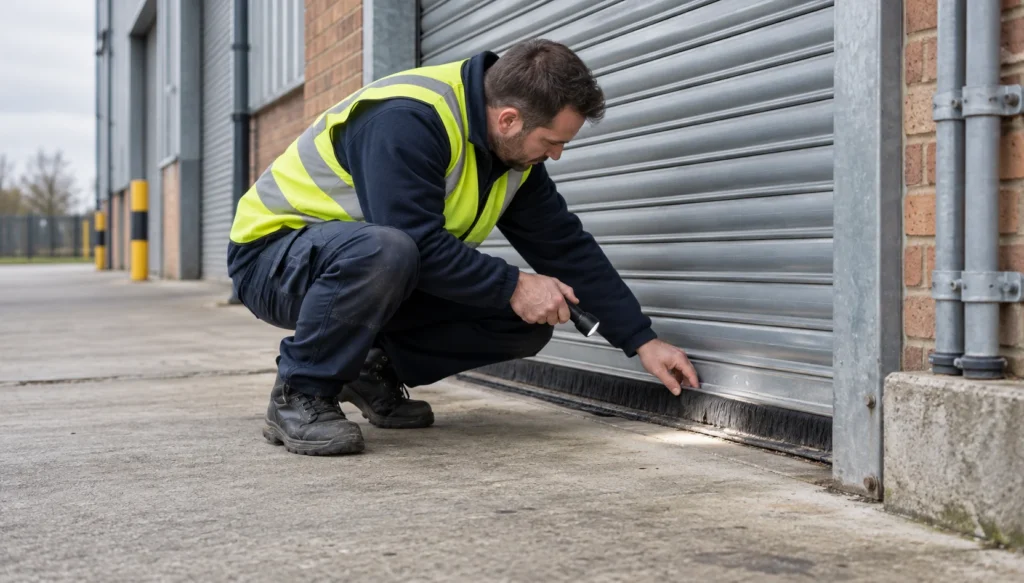
Roller shutter doors represent the primary physical gateway between external distribution yards and internal warehouse floors. Heavy forklift traffic rapidly destroys standard bottom seals, creating openings that readily permit rodents to enter active storage zones without resistance. Maintenance teams must inspect these perimeter thresholds frequently to maintain structural exclusion standards.
Technicians check guide alignment, the condition of rubber floor sweeps, and any gap running along the lintel. Steel-reinforced brush seals or elastomeric rubber profiles close the undulations in worn concrete. Hardware alone will not hold the line. Propping a shutter open through a shift cancels the benefit of every seal fitted beneath it.
Pedestrian Fire Escapes
External personnel doors and emergency exits drop on their hinges over time. The result is a bottom threshold wide enough to admit pests. A mouse needs roughly six millimetres of clearance, about the width of a pencil, to pass beneath a door leaf. These quiet exits warrant scrutiny at every audit.
Surveys regularly find warped metal doors, rotted timber jambs, and missing weather seals on low-traffic runs. Remedial work involves metal kick plates, continuous aluminium threshold plates, and nylon brush seals fixed to the leaf base. Securing these doors removes a concealed route straight into racking and production areas.
Loading Bay Infrastructure and Dock Seals
Dock Leveller Enclosures
Dock levellers are difficult to proof because the mechanism needs clearance voids around the pit. Those pits collect pallet splinters, food residue, and windblown litter. The result is warm, undisturbed harbourage a few metres from open stock. Unsealed pits let rodents walk from the delivery yard into the warehouse.
Surveyors inspect rubber side curtains, chain-pull grommets, and perimeter pit seals with the platform raised under permit. Remediation uses triangular sealing blocks, nylon brush strips, and steel brush profiles that stay in contact through the full travel of the plate. Routine pit cleaning removes the food source drawing rodents into the mechanics.
Inflatable Dock Shelters
Inflatable and mechanical dock pads shield goods during transfer. Torn head curtains and punctured side cushions undo that protection quickly. Damaged canopy fabric opens a direct vector for birds, flies, and climbing rodents during every loading cycle. Depots handling open or short-life food stock cannot tolerate that gap.
Inspection covers the framing and fabric tension of each shelter, looking for rips, loose stays, and worn corner pads. Replacing wear pleats and resealing canopy flashing against the brickwork restores the barrier. Internal PVC strip curtains add a second layer. Together they cut aerial insect ingress across open goods-in bays.
Did You Know?
Section 4 of the Prevention of Damage by Pests Act 1949 places a legal duty on the occupier. Where rats or mice are present in substantial numbers, the occupier must notify the local authority in writing. The duty sits with the occupier, not the pest control contractor.
Service Penetrations and Utility Runs
Pipe Sleeves and Cable Trays
Retrofitted plant and machinery often leaves core-drilled holes through external brickwork open. Rodents treat vertical cable trays and pipework as ladders, climbing from ground level into ceiling and wall voids. A survey traces every external service run to the point where it breaches the fabric.
Inspections audit plant penetrations, refrigeration lines, and electrical conduit at the perimeter wall. Expanding polyurethane foam offers no rodent resistance and disappears under gnawing within days. Correct remediation packs the void tightly with woven stainless-steel mesh. A dense sand-and-cement mortar or a metal-loaded mastic then finishes the seal.
Riser Shafts and Mezzanines
Internal risers connect dirty sub-floor zones to clean production areas. They function as hidden transit routes once pests breach the outer wall. Open service voids carry activity across fire compartments without detection. Sealing these shafts isolates pressure to one zone and prevents cross-contamination between departments.
Internal inspection means opening access panels, lifting mezzanine flooring, and checking suspended ceiling cavities. Galvanised steel plates around conduit, closed ceiling voids, and caulked floor penetrations contain the problem. Segmenting the building internally stops minor localised activity reaching high-care processing rooms.
Free Pest Control Audit Review
We will review your risk assessment, site plan, visit reports, trend analysis, open recommendations, product records and demo our AI Pest management System.
Sub-Floor Infrastructure and Drainage Networks
Defective Drainage Pipework
Drainage is the main subterranean route for brown rats moving out of the public sewer. Damaged junctions, displaced inspection covers, and capped-off disused connections let rats bypass every external bait station on site. Engineers should treat drain integrity as a primary line of defence, not a plumbing detail.
Survey work lifts drainage covers, examines localised floor subsidence, and checks effluent trenches for excavation. Where activity persists with no visible surface entry, CCTV drain diagnostics locate the broken tie. Stainless-steel non-return valves then block the route whilst wastewater still flows out freely.
Floor Gullies and Open Traps
Internal gullies and floor drains rely on a water seal to hold back odour and insect emergence. A dry trap or a broken basket lets drain flies, pharaoh ants, and sewer pests breed unchecked beneath the production floor. Maintenance schedules must keep water levels topped up across every gully.
A technical assessment confirms that drains hold water and carry tight, corrosion-resistant mesh covers. Bespoke stainless-steel inserts and firm sanitation routines strip out the fatty organic film inside effluent lines. Working hydraulic traps separate the manufacturing environment from the microbiological load sitting below the slab.
AI Pest Management
AI pest management is pest control delivered with continuous digital monitoring and analytics rather than paper records, with real time data access across a single or multiple sites.
Rooflines, Flashings, and High-Level Ingress
Eaves, Vents, and Soffits
Eaves and rooflines weather continuously, opening entry points for grey squirrels, starlings, and feral pigeons. Gaps along profiled metal cladding or rotted timber fascia give direct access to ceiling voids. High-level inspection covers these junctions so nesting birds cannot break through into warehouse or production ceilings.
Surveyors work from elevated platforms or ground optics, checking soffits, gutter junctions, and air bricks. Heavy-gauge welded galvanised mesh across intake louvres, eaves gaps, and roof valleys excludes aerial invaders. Closing these routes removes the nesting sites. It also stops ectoparasites dropping into offices and production space below.
Solar Panel Arrays
Roof-mounted arrays create sheltered micro-climates that feral pigeons colonise readily. Accumulated droppings corrode wiring, degrade fixings, and cut generation yield. The fouling also seeds secondary insect pressure in the roof void. Dealing with harbourage under the panels protects both electrical output and the building fabric.
High-level surveys record the volume of fouling beneath the array, the mounting type, and the perimeter clearance. Remediation starts with bio-clearing the guano. Rigid UV-stabilised polycarbonate clips and stainless-steel mesh skirts then close the gap. Fitted correctly, solar skirts exclude birds without voiding the panel manufacturer warranty.
Remediation Priorities Ranked by Operational Risk
Risk Scoring Methodologies
Good survey reporting turns a scattered defect list into a ranked schedule. In practice, facilities managers gain far more ground by prioritising proofing work by risk than by clearing cosmetic faults first. A risk-based framework pushes capital at acute biological hazards before peripheral maintenance consumes the budget.
Technical teams score defects on a composite matrix of pest pressure, proximity to open food, and consequence severity. A mouse-sized gap opening into a high-care food hall scores critical and needs same-day intervention. A vegetation defect at an external boundary fence earns a scheduled rating inside thirty days.
Budget Allocation and Scheduling
Splitting remediation into clear bands gives the most exclusion per pound spent. Fixed building proofing priorities let engineering managers book heavy fabrication against planned line shutdowns. Phased scheduling matches contractor availability to internal maintenance cycles across the financial year, which keeps disruption and cost under control.
The matrix groups actions into immediate critical repairs, short-term fabric sealing, and planned structural upgrades. Every high-risk defect carries a named owner, a close-out date, and photographic sign-off. Matching spend to verified vulnerabilities builds a physical boundary that minimises recurring chemical intervention.
Documentation, Tracking, and Audit Evidence
Corrective Action Close-Out
Third-party schemes such as BRCGS and SALSA expect evidence that every identified pest defect has been resolved. Open proofing recommendations carried across consecutive quarterly visits attract an automatic finding. Quality teams should track structural recommendations in a central register to show active estate governance.
Digital tracking suits this well. Technicians log each defect with a location reference and photographs. Once engineering completes the repair, the portal records the date, the materials used, and the technician sign-off. That trail proves to a visiting retail auditor that the business controls its environmental hazards.
IPM and Rodenticide Stewardship
Physical proofing sits at the base of any serious Integrated Pest Management programme. It removes the dependence on routine rodenticide use. CRRU stewardship rules now restrict professional rodenticides to targeted treatment where activity is confirmed and recorded. Structural exclusion is how sites meet that standard.
Documented exclusion work also evidences compliance during enforcement reviews. From experience across the sector, a site that systematically closes envelope defects rarely needs external baiting at all. Clear proofing records support a due diligence defence under the Food Safety Act 1990 at Environmental Health inspection.
Final Thoughts
A methodical pest proofing survey gives facilities teams an engineering-based foundation for site biosecurity. Structured inspection of doors, dock levellers, service conduits, and rooflines replaces haphazard maintenance. Spending follows verified biological threat. Physical exclusion then becomes the primary defence rather than perpetual reactive treatment.
Securing the envelope takes sustained collaboration between operations, maintenance, and technical pest specialists. As scrutiny of rodenticide use tightens, durable structural barriers become the only defensible position. A proofing schedule backed by photographic evidence and prompt close-out protects brand integrity and keeps the perimeter intact.
Request a Free Site Survey
Frequently Asked Questions
A:
The objective is to assess the whole physical envelope and identify the openings, gaps, and defects pests use for entry or harbourage. A survey moves a site away from reactive chemical treatment towards long-term exclusion. Technicians examine loading docks, fire exits, roof eaves, service penetrations, and below-ground drainage. The report then sets out a prioritised action plan, so operations teams can direct repair spending where it removes the most risk.
A:
Surveyors cross-reference the size of each envelope gap with its proximity to critical operational zones and the local pest pressure. A gap opening directly into an open food packaging area carries an acute classification and demands immediate repair. A defect on an external yard perimeter scores lower. That structured comparison stops maintenance teams spending time on cosmetic work whilst a primary rodent pathway into the production line stays open.
A:
Standard expanding polyurethane foam has no structural resistance to gnawing. Brown rats and house mice have continuously growing incisors and cut through soft foam, insulation, and plastic seals without difficulty. Permanent exclusion needs hard materials such as woven stainless-steel wire mesh, galvanised flashing, cement mortar, or a metal-loaded sealant. Foam gives a false sense of security. The route is usually open again within days of application.
A:
Food safety standards such as BRCGS and SALSA require structural barriers that prevent pest ingress. Auditors inspect site integrity and read the pest control file to check that survey recommendations have been tracked and closed. Repeated open recommendations with no corrective action routinely trigger a non-conformance. Holding photographic evidence of completed repairs inside a digital audit file demonstrates operational control and food safety culture to customer assessors.
A:
Effective envelope proofing greatly reduces reliance on rodenticides and aligns a site with CRRU stewardship codes. Permanent external toxic baiting is no longer accepted practice in the UK without confirmed, documented activity. Strong physical exclusion keeps external populations outside the building, which lets contractors swap permanent poison for non-toxic monitoring. Spending on threshold seals, dock levellers, and sealed utility penetrations delivers a durable and environmentally defensible programme.



By choosing Shield Pest Management, you’re partnering with a company that combines local expertise with industry-leading practices. Our commitment to quality, compliance, and customer satisfaction makes us an ideal choice for both residential and commercial pest control needs.