
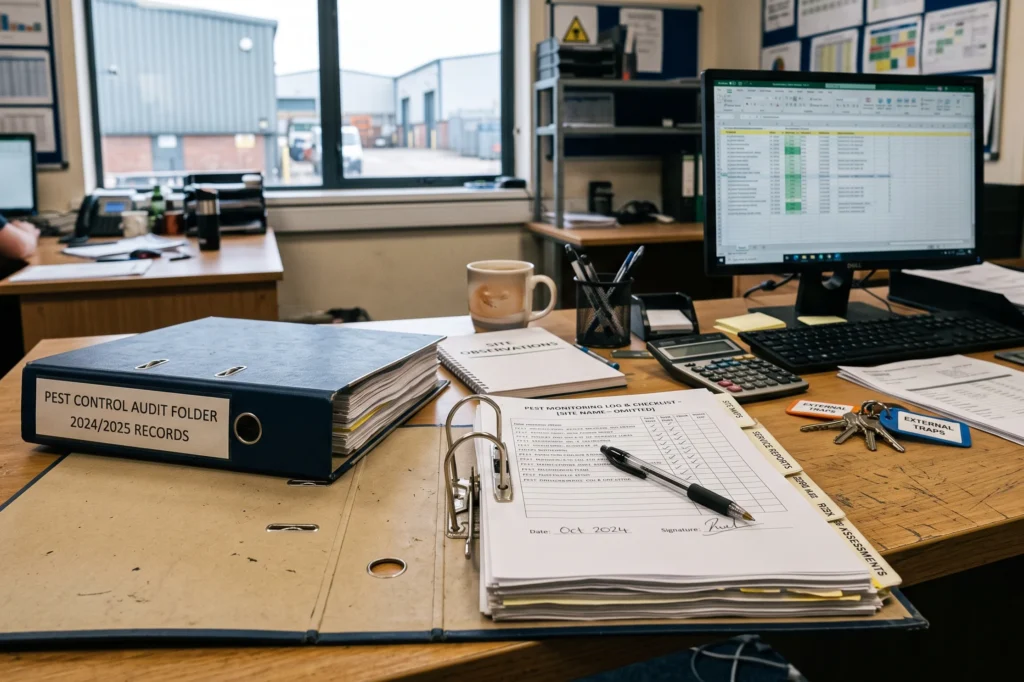
Pest Control Audit Checklist for UK Food Sites
Operating a food manufacturing or processing facility in the United Kingdom requires rigorous adherence to third-party safety standards. During unannounced inspections or scheduled surveillance assessments, technical managers face intense scrutiny of prerequisite hygiene programmes. A robust pest control audit checklist confirms that physical defences, contractor records and monitoring data align with compliance standards. Reviewing these requirements systematically allows potential non-conformances to be resolved before an external auditor enters the facility.
Auditors from third-party certification schemes scrutinise documentation as rigorously as production lines, dock levellers and waste compounds. When pest activity occurs or building proofing deteriorates, does your on-site file demonstrate immediate corrective action, verified root-cause analysis and professional technical oversight?
Key Takeaways
- A comprehensive site file requires current technician qualifications, valid insurance certificates, safety data sheets, and a signed, dated layout plan showing all numbered monitoring points.
- Trend analysis must deliver detailed written interpretation of pest activity across distinct facility zones rather than presenting raw numerical trap catch data without operational context.
- External auditors frequently penalise repeated structural proofing defects, delayed corrective action close-outs, and uninvestigated gaps recorded within on-site staff sighting logs.
- Rodenticide stewardship rules prohibit routine toxic baiting around building exteriors, so non-toxic monitoring remains standard until confirmed activity justifies targeted treatment.
- Conducting disciplined pre-audit inspections across loading docks, suspended ceilings, and waste storage areas ensures physical site conditions accurately match documented pest management records.
Core Components of Audit Readiness
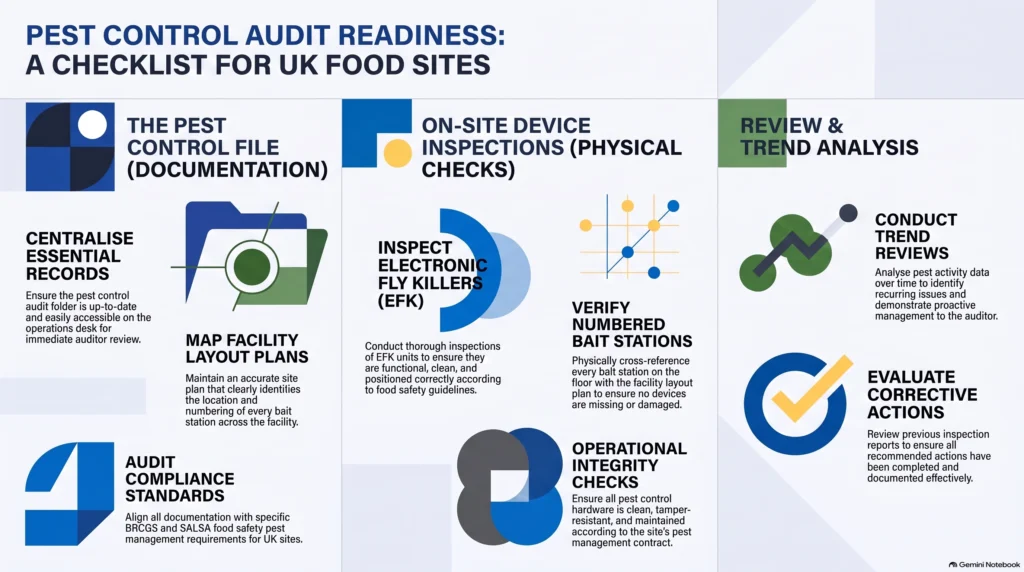
Demonstrating compliance requires systematic alignment between documented records and actual physical conditions across the factory floor. Technical auditors assess five principal areas during an evaluation. These are administrative credentials, device layout, monitoring data, corrective action tracking and specialist biological reviews. Every element requires verifiable proof of routine oversight and continuous maintenance.
Failure in any single operational area undermines the credibility of the entire pest management system. Food manufacturers must treat their compliance folder as an active quality management tool rather than an archived filing cabinet. The summary table below details the essential audit criteria, documentation and physical evidence required across commercial food premises.
| Audit Component | Documentation Requirement | Physical On-Site Evidence |
|---|---|---|
| Contractor Credentials | BPCA membership, RSPH or BPCA Level 2 certificates, liability insurance | Attending technician matches listed qualification records |
| Device Management | Signed and dated site plan showing numbered locations | Physical trap tags match drawing positions and bait types |
| Trend Analysis | Reviews at least annually with written interpretation | Documented threshold reviews aligned with site risk zones |
| Corrective Actions | Action register with assigned owners and target dates | Physical repairs completed with proofing materials intact |
| Stewardship Compliance | Environmental risk assessments and rodenticide treatment records | Non-toxic monitoring blocks inside external bait boxes |
Technical Documentation and Contract Credentials
Statutory Certifications and Contractor Qualifications
Auditors inspect contractor credentials to confirm technical competence and legal compliance before reviewing operational logs. Every pest management file must contain proof of BPCA servicing membership, current technician Level 2 qualifications, continuous BASIS PROMPT registration and public liability insurance. Missing credentials immediately undermine supplier assurance across certified food production environments.
Certification bodies auditing against BRCGS Food Safety Issue 9 or the SALSA Standard require verifiable competence. Audit compliant pest control means the folder holds current certificates for every visiting technician. It should also evidence company accreditation under BS EN 16636. Relief technicians covering leave periods must have their qualifications filed before work commences. Safety data sheets and COSHH assessments for every biocide used on site must remain accessible to operational staff.
Site Plans and Numbered Device Registers
A compliant pest control plan requires an accurate layout map detailing every numbered monitoring device. The site plan must clearly indicate external rodent bait boxes, internal non-toxic monitors, pheromone traps and electric fly killers. Auditors verify that the physical locations across the facility match the dated, signed schematic exactly.
Discrepancies between physical device placement and drawing numbers represent an immediate audit failure. When plant layouts shift, racking moves or building works expand, the site plan needs revision. Each revision receives a fresh signature and date. Technicians maintain a corresponding register recording device type, target pest species and inspection frequency. If floor maintenance damages or displaces a station, the file records the variance and its reinstallation.
Physical Inspection Priorities Across the Facility
High-Risk Ingress Routes and Door Thresholds
Auditors inspect perimeter doors and dock levellers because entry gaps represent primary ingress risks for rodents. Weather seals, brush strips and rubber gaskets must close any gap wider than six millimetres, which a young mouse can pass through. Loading bays propped open during operational shifts breach hygiene rules and attract non-conformances.
Dock levellers present a substantial vulnerability in logistics environments. Drop plates, side curtains and pit bottoms require routine hygiene inspections to remove accumulated food debris. External pedestrian doors must fit snugly against frames, with brush strips replaced whenever light shows beneath thresholds. Auditors also examine cable runs and pipe penetrations through exterior walls. They expect permanent seals of metal mesh and specialist sealant, not expanding foam.
Production Voids and High-Level Walkways
Internal inspections focus heavily on elevated service runs, mezzanine voids and suspended ceilings above open product lines. Rodents and insects frequently exploit hidden conduits where warmth, dust and harbourage accumulate undisturbed. Auditors examine these concealed spaces to confirm technicians inspect structural cavities rather than checking floor-level stations alone.
Overhead infrastructure demands the same inspection discipline applied to accessible floor perimeters. High-level cable trays, ventilation ducting and structural steel beams accumulate organic residues that sustain stored product insects. Facilities must provide safe access equipment or crawling boards for thorough inspection of ceiling voids. Auditors cross-reference service reports against high-level areas. Restricted access zones must receive scheduled reviews rather than recurring exemptions.
Did You Know?
UK rodenticide labels state that if bait is still being eaten after a 35-day treatment period with no decline in rodent activity, the likely cause must be determined. Simply continuing to bait without investigating reinvasion routes, bait shyness or resistance breaches the product label.
Trend Analysis and Data Interpretation Requirements
Written Commentary on Activity Data
Presenting raw catch figures without analytical commentary represents one of the most frequent non-conformances during food safety audits. Auditors require written evaluation explaining whether recorded pest activity is rising or falling over defined periods. Clear documentation must interpret biological trends, evaluate environmental triggers and assess whether past interventions succeeded.
Certification standards penalise facilities that merely file graphs without qualitative review. The technical narrative must explain why specific monitoring stations registered activity. It should connect spikes to seasonal weather, incoming raw ingredient batches or building fabric defects. BRCGS Food Safety Issue 9 requires this trend analysis at least annually and following any infestation. In practice, we find that professional reviews show auditors the business understands its ecological pressures.
Action Thresholds by Zone and Species
Audit standards demand documented action thresholds tailored specifically to facility zones and individual target species. A single pest occurrence inside a high-care production room demands immediate investigation, whereas external perimeter captures follow different escalation criteria. Auditors verify that exceeding an agreed threshold prompts root-cause analysis rather than passive monitoring.
A compliant programme divides the site into distinct risk zones. Typical zones include external grounds, ambient ingredient storage, packaging rooms and production lines. Under Integrated Pest Management principles, threshold breaches must trigger a clear escalation protocol. This includes root-cause investigation, enhanced deep cleaning, fabric repairs and increased inspection frequency. Auditors examine the log to confirm the investigation date and verified resolution for every breach.
Free Pest Control Audit Review
We will review your risk assessment, site plan, visit reports, trend analysis, open recommendations, product records and demo our AI Pest management System.
Corrective Action Tracking and Verification Evidence
Named Owners and Completion Deadlines
Pest management recommendations must transition directly into documented corrective action logs carrying named owners and defined timescales. Leaving technician advice open without formal responsibility indicates an ineffective hygiene management system to visiting technical assessors. Auditors evaluate whether identified proofing repairs, structural defects or cleaning recommendations receive prompt internal prioritisation.
Technicians routinely highlight maintenance actions on visit reports, such as damaged door seals, drain defects or ingredient spillages beneath conveyors. If these recommendations sit unaddressed across successive inspections, auditors raise major non-conformances for systemic failure. Every recommendation belongs in an internal engineering or hygiene register. The system allocates completion deadlines based on pest risk severity, ensuring accountability across department heads.
Physical Close-Out and Re-Inspection Evidence
Closing out an audit finding requires tangible verification rather than simple verbal assertion from the technical department. Facilities must document photographic proof, maintenance work orders and signed technician re-inspection notes in the compliance file. Demonstrating verified completion proves the food safety culture actively responds to emerging operational risks.
Auditors scrutinise the gap between maintenance sign-off and subsequent pest control verification. An engineering department may mark an automated door repair complete. The compliance loop stays open until the pest technician inspects that repair. Digital platforms streamline this process by attaching dated photographs of completed proofing to the service ticket. Retaining this evidence confirms that physical repairs closed ingress routes effectively and permanently.
AI Pest Management
AI pest management is pest control delivered with continuous digital monitoring and analytics rather than paper records, with real time data access across a single or multiple sites.
Electronic Fly Killers and Catch Tray Diagnostics
Electronic Fly Killer Siting and Tube Compliance
Electronic fly killers must be sited away from exposed food preparation surfaces to eliminate physical contamination risks. Auditors inspect unit locations to ensure attractant lights are not visible from external doorways, which draws flying insects inside. Food sites must fit shatterproof UV tubes and document planned tube replacement regimes.
High-risk food manufacturing environments avoid traditional high-voltage grid units because electrocution can scatter insect fragments across processing lines. Glueboard units provide hygienic containment and prevent fragment scatter above open products. Ultraviolet tubes lose attractant output over time, long before visible light fails. Units therefore require annual tube replacement schedules. Certificate logs should record serial numbers and change dates.
Glueboard Catch Analysis for Source Identification
Audited food sites must analyse electronic fly killer catch trays rather than merely emptying insect remains periodically. Identifying specific fly species reveals whether breeding occurs within internal drains, decomposing waste or external vegetation. Written analysis transforms routine catch counting into a diagnostic tool that demonstrates proactive pest prevention.
Technicians must record catch counts by insect category during scheduled inspections. Houseflies, blowflies, fruit flies and drain flies are counted separately. A surge in fruit flies or drain flies indicates internal hygiene failures. Typical causes include fermenting residues beneath machinery or damaged drainage seals. Spikes in blowflies point towards external refuse problems or nearby carcasses. Species analysis proves the site investigates origins rather than tolerating recurring infestations.
Rodenticide Stewardship and Regulatory Alignment
Adherence to the CRRU Code of Best Practice
Professional rodenticide use in the UK falls under the Rodenticide Stewardship Regime, overseen by the Campaign for Responsible Rodenticide Use. Product labels give the CRRU Code of Best Practice legal force, so breaching a label condition is a legal breach. Auditors confirm contractors prioritise proofing, hygiene and non-toxic monitoring before any chemical intervention.
Routine toxic baiting around building exteriors is not acceptable practice across UK commercial sites. Facilities should maintain perimeter monitoring using non-toxic indicator blocks. These reveal gnaw marks without introducing toxins into local wildlife food chains. Contractors buying professional rodenticides must hold a recognised certificate of competence. Auditors check that chemical baiting is a targeted response to confirmed activity, not a permanent contract baseline.
Justification and Records for Toxic Bait Deployments
Deploying professional rodenticide requires recorded justification based on confirmed rodent activity. Product labels restrict permanent baiting to sites facing a high risk of reinvasion where other control methods have already proven insufficient. Only certain difenacoum and bromadiolone products carry this authorisation. Auditors expect the decision, risk assessment and review dates on file.
When verified activity demands chemical treatment, the file must hold an environmental risk assessment. Technicians record bait station numbers, active ingredients, batch numbers and quantities placed. Follow-up inspections monitor consumption and search for rodent carcasses. Unused bait must be recovered once activity ceases. Where outdoor permanent baiting is justified, labels require inspections at least every four weeks. Failing to retrieve bait breaches label conditions and generates major audit findings.
Unannounced Audit Readiness and Staff Roles
Active Staff Sightings Logs
A fully utilised staff sightings log provides auditors with clear evidence of an active, engaged food safety culture. An empty sightings log often indicates inadequate reporting mechanisms or poor workforce awareness rather than perfect pest exclusion. Inspectors examine logged sightings to ensure facility teams investigated every incident and recorded prompt outcomes.
Staff members work across the production facility continuously, whereas pest technicians attend on scheduled visit intervals. When employees observe an insect or rodent, they must record the date, exact location, species and their name immediately. Technical managers review entries daily and alert the contractor when incidents demand urgent attendance. The file then records the technician’s findings and formally closes out each sighting.
Certificated Pest Awareness Training
Retailer specifications frequently require site managers to maintain certificated employee training in fundamental pest awareness. Food handlers need structured training to recognise early evidence of pest activity, reporting protocols and personal hygiene responsibilities. Training certificates filed within the compliance folder prove that the company does not delegate all responsibility externally.
Training programmes should cover rodent biology, insect recognition, proofing maintenance and waste management standards. New operational employees should complete basic awareness training during induction, followed by periodic refresher courses. From experience across the sector, auditors often ask floor staff how they would report a sighting. Attendance registers and formal certificates in the compliance file demonstrate shared responsibility for site hygiene.
Final Thoughts
Maintaining a comprehensive pest control audit checklist bridges the gap between everyday hygiene operations and formal compliance requirements. When food manufacturers align physical maintenance, contractor documentation and workforce engagement, audits become routine validations of site integrity. Treating pest management as an ongoing quality assurance discipline safeguards brand reputation and consumer safety.
Retailers and certification bodies continue to place greater emphasis on digital reporting, non-toxic monitoring and environmental stewardship. Facilities that modernise documentation, fix underlying structural vulnerabilities and embed strong reporting cultures stay prepared for unannounced inspections. Continuous vigilance across production lines, storage warehouses and perimeter boundaries keeps operations resilient year after year.
Request a Free Site Survey
Frequently Asked Questions
A:
Auditors examine administrative credentials, operational visit records and monitoring data within the pest folder. They review the service contract, contractor insurance certificates, technician qualifications and current BASIS PROMPT registrations. The auditor will inspect the signed site plan, check pesticide safety data sheets and examine the staff sightings log. Crucially, they scrutinise recent trend analysis reports. They also verify whether highlighted corrective actions have documented proof of close-out.
A:
Achieving compliance starts with a documented integrated pest management programme built on site-specific risk assessments. The facility must use a competent contractor, maintain accurate device maps and enforce strict hygiene and proofing standards. Non-toxic monitoring should remain standard practice unless confirmed pest presence justifies targeted chemical treatment. Technical managers must also document trend reviews, investigate threshold breaches and train staff to record pest observations promptly.
A:
Anticoagulant rodenticides can cause secondary poisoning in predatory wildlife such as barn owls and kestrels. The UK stewardship regime therefore restricts routine toxic baiting through legally binding product labels. External bait boxes should normally hold non-toxic monitoring blocks. Active rodenticide is deployed only after confirmed activity justifies a targeted, documented treatment. Permanent baiting is limited to certain difenacoum and bromadiolone products at sites with a high reinvasion risk.
A:
BRCGS Food Safety Issue 9 requires pest activity trends to be analysed at least annually and after any infestation. High-risk food manufacturing environments benefit from monthly or quarterly reviews. Frequency matters less than quality, though. The data must include written professional interpretation explaining biological trends and environmental causes. Charts without critical evaluation fall short, because auditors need evidence that the data informs preventive site management.
A:
Acceptable close-out evidence requires verifiable physical proof rather than verbal confirmation or a ticked box on a service sheet. Facilities should provide dated photographs of completed repairs, internal engineering job sign-off sheets or invoices from specialist proofing contractors. The pest management technician should then inspect the completed repair during the next scheduled visit. That technician records written sign-off directly within the compliance reporting system.

By choosing Shield Pest Management, you’re partnering with a company that combines local expertise with industry-leading practices. Our commitment to quality, compliance, and customer satisfaction makes us an ideal choice for both residential and commercial pest control needs.