

Pest Control Risk Assessment Template Guide
Every commercial facility faces pest pressures that can compromise food safety, damage structural assets, and trigger audit non-conformances. Relying on an off-the-shelf pest control risk assessment template gives operational teams false security before scrutiny exposes gaps. A generic checklist cannot capture internal harbourage risks, drainage vulnerabilities, or seasonal migration corridors unique to your property. Operational leaders must establish defensible assessment systems. These systems govern service schedules, monitoring density, and daily preventive controls across production facilities.
How do technical managers transform static document templates into dynamic risk tools that satisfy rigorous third-party audits? What specific environmental criteria and scoring methodologies ensure your contractor deploys appropriate monitoring hardware rather than defaulting to arbitrary visits? Can a bespoke assessment truly bridge the gap between compliance theory and operational factory reality?
Key Takeaways
- A generic pest control risk assessment template fails third-party audits because it ignores facility layout, structural fabric, and regional environmental vectors.
- Auditors demand a site specific risk assessment that directly justifies device density, inspection intervals, and chemical deployment under strict UK stewardship rules.
- Robust risk scoring frameworks must evaluate likelihood against severity across distinct production, storage, and perimeter zones rather than averaging whole-site conditions.
- Documented assessment reviews must occur annually or immediately following structural modifications, significant activity spikes, or changes to internal manufacturing processes.
- Digital reporting platforms ensure open corrective actions, photographic proof, and technician visit logs remain fully accessible during unannounced Environmental Health Officer inspections.
Facility Risk Tiers and Matching Assessment Standards
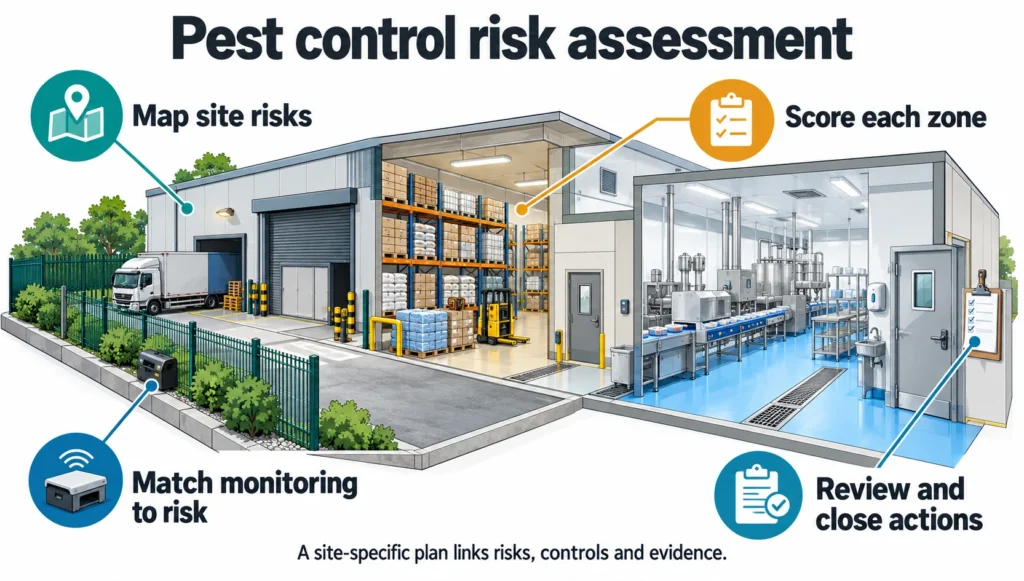
Modern compliance schemes require commercial operations to prove pest defences reflect actual physical risk. A comprehensive evaluation serves as the operational blueprint for your entire pest programme. It dictates where monitoring equipment sits across the site. Furthermore, it determines how often technicians inspect the facility. It also highlights physical exclusion priorities that require capital investment.
The comparative matrix below outlines how essential assessment criteria translate into practical site standards. These benchmarks illustrate the structural distinctions auditors expect to see documented within primary site records. Every tier demands distinct inspection routines and monitoring methods to safeguard building integrity and operational hygiene.
| Facility Risk Tier | Typical Operational Profile | Primary Assessment Focus | Standard Visit Frequency |
|---|---|---|---|
| High Risk | Food production, pharmaceutical manufacturing, high-care packaging | Exclusion integrity, internal harbourage, zero-tolerance thresholds | Monthly, fortnightly, or weekly by risk |
| Medium Risk | Ambient warehousing, logistics hubs, packaging storage | Dock door seals, pallet turnover, goods-in inspection protocols | Monthly to eight-weekly intervals |
| Low Risk | Non-food engineering, dry trade counters, general offices | Perimeter harbourage, waste storage, personnel door discipline | Quarterly routine inspections |
Regulatory Drivers for Commercial Risk Assessments
Statutory Obligations Under United Kingdom Law
United Kingdom legislation establishes clear legal duties for commercial property occupiers regarding public health pests. The Prevention of Damage by Pests Act 1949 requires occupiers to notify local authorities about significant rodent numbers. Additionally, the Food Safety Act 1990 establishes the critical due diligence defence for food businesses.
A defensible site specific risk assessment demonstrates that your business took all reasonable precautions. Under the Food Safety and Hygiene (England) Regulations 2013, premises must maintain adequate pest procedures. Enforcement officers can issue Hygiene Emergency Prohibition Notices that close operations instantly. Maintaining an appraisal provides legal protection against statutory nuisance claims under the Environmental Protection Act 1990.
Third-Party Certification Standards and Expectations
Independent certification bodies place pest documentation at the centre of physical site audits. Major schemes like BRCGS Issue 9, SALSA Issue 7, and FSSC 22000 require written programmes. These programmes must stem from objective appraisals rather than standard service packages. Auditors inspect the relationship between documented risks and site reality.
Scheme auditors scrutinise whether documented risk ratings justify actual servicing routines. When evaluating commercial pest control files, assessors expect written explanations connecting potential vectors to physical controls. BRCGS clause 4.14 requires that expert technical assessments support internal risk profiles. Failing to demonstrate this technical lineage results in formal non-conformances during supplier audits.
Essential Information Required in Risk Documentation
Baseline Environmental and Structural Parameters
Technical assessments must thoroughly detail the physical premises, construction materials, and surrounding land use. Documenting adjacent watercourses, neighbouring waste processing sites, and railway sidings identifies external pest reservoirs. These reservoirs threaten building envelopes before technicians place a single monitor. Clear baseline parameters ensure the survey reflects external ecological vectors.
Inspectors must record building age, cladding integrity, pipe penetrations, sub-floor voids, and false ceiling designs. Knowing what a pest control risk assessment must include prevents critical oversights around loading docks and effluent drainage channels. The document must define high-care, low-care, and storage zones distinctly. Clear boundaries between raw materials and finished products help prevent cross-contamination.
Target Species Profiles and Biological Risks
A rigorous appraisal profiles specific pest species capable of exploiting identified structural weaknesses or process residues. Rodent evaluations must differentiate between brown rats entering through damaged drainage and house mice exploiting tiny voids. Profiling target species allows technicians to understand pest behaviour and design suitable monitoring programmes for the property.
Stored product insects require dedicated evaluation within milling, baking, and dry ingredient environments. The risk profile must also assess flying insect pressure generated by external refuse areas or wet drains. Documenting biological vectors ensures technicians select appropriate monitoring devices and lures. This tailored strategy delivers far better protection than generic traps.
Did You Know?
Breaching regulation 19(1) of the Food Safety and Hygiene (England) Regulations 2013 is triable either way. On conviction on indictment, an individual faces an unlimited fine and up to two years in custody. Organisations face unlimited fines in both the magistrates’ court and the Crown Court.
Objective Risk Matrix Methodologies
Likelihood and Consequence Scoring Methods
Objective risk evaluation requires a transparent numerical matrix that combines pest entry likelihood with contamination severity. Likelihood ratings evaluate historical infestation records, external pressure, building condition, and stock turnover speed. These factors determine how easily pests breach physical barriers. Clear scoring methods remove subjective guesswork from the initial site inspection process.
Severity scorings assess operational impacts should a breach occur on site. These impacts include food contact contamination, legal enforcement notices, structural damage, and brand loss. A five-by-five scoring matrix produces overall ratings that place operational areas into clear risk categories. In practice, we find this numerical clarity directs proofing expenditure toward the most critical vulnerabilities first.
Zonal Risk Categorisation Across Sites
Applying uniform risk ratings across an entire manufacturing or warehousing compound represents a critical compliance mistake. External waste yards, loading bays, boiler houses, and packaging halls exhibit vastly different harbourage dynamics. They also feature distinct hygiene levels and entry potentials. Segmenting facilities into zones ensures risk scoring accurately reflects local operational conditions.
Segregating facilities into distinct zones prevents the dilution of critical control areas by lower-risk office spaces. An external pallet store might carry elevated likelihood scores for rodent activity. Conversely, a high-care sandwich preparation room exhibits extreme severity ratings for insect contamination. Documenting zonal variances ensures technical teams allocate monitoring equipment and sanitation audits proportionally across the footprint.
Free Pest Control Audit Review
We will review your risk assessment, site plan, visit reports, trend analysis, open recommendations, product records and demo our AI Pest management System.
Device Density and Inspection Scheduling
Device Mapping Driven by Risk Ratings
Calculated risk scores directly govern the physical density and spatial distribution of monitoring hardware across internal and external zones. High-risk ingredient storage areas demand dense arrays of non-toxic monitoring stations and insect light traps. These devices sit along habitual pest transit routes. Robust data mapping ensures adequate trap placement without unnecessary clutter.
Every device must appear on an up-to-date, dated, and signed site layout plan. Relocating a monitor without updating documentation invalidates the underlying risk profile and creates an audit non-conformance. Zonal scoring prevents over-allocating traps in sterile office corridors. Crucially, it ensures high-risk points like dock leveller pits receive sufficient monitoring coverage.
Evidence-Based Visit Frequencies
Contract visit frequencies must reflect documented environmental risk rather than standard calendar packages. Facilities handling open, ready-to-eat foods often require fortnightly or weekly technical inspections to verify barrier integrity. Conversely, low-risk warehousing units can safely operate on less frequent schedules. Aligning inspection intervals with real risk ensures effective protection and commercial efficiency.
Under an integrated pest management framework, any planned adjustment in service intervals requires formal reassessment. Technicians must record the justification within the central pest file. Arbitrary attendance reductions without empirical risk documentation represent an immediate compliance failure during formal retailer audits. Regular reviews verify that current visit schedules match changing site conditions.
AI Pest Management
AI pest management is pest control delivered with continuous digital monitoring and analytics rather than paper records, with real time data access across a single or multiple sites.
Non-Chemical Controls and Stewardship
Physical Proofing and Harbourage Removal
Modern pest assessments must prioritise physical exclusion, environmental sanitation, and harbourage removal before considering chemical intervention options. Identifying missing brush strips beneath personnel doors, damaged roller shutter seals, and broken drainage covers provides clear maintenance priorities. Addressing these physical defects prevents pests from entering the building fabric and establishing internal colonies.
A pencil-sized gap under an external door permits effortless access for juvenile house mice. Assessments must highlight operational disciplines to keep loading dock doors closed when not in use. From experience across the sector, eliminating external vegetation belts and clearing redundant machinery removes essential harbourage. These practical measures reduce external pest pressure without chemical contamination.
Stewardship Rules for Professional Rodenticide Deployment
Environmental regulations and the Campaign for Responsible Rodenticide Use Code severely restrict outdoor rodenticide deployment. The CRRU stewardship regime bans permanent outdoor baiting as a default practice. This restriction prevents secondary poisoning of non-target wildlife such as barn owls and kestrels. Assessments must demonstrate that non-chemical methods were considered first.
Since 1 January 2025, using any second generation anticoagulant rodenticide in open areas or at waste dumps is illegal. Difenacoum and bromadiolone remain authorised only in and around buildings. A compliant risk appraisal must show that non-toxic monitoring was used first. Rodenticides can only be deployed after confirmed pest activity. Professional buyers must hold approved certification to purchase these products.
Technical Competence and Field Biologist Oversight
Professional Contractor Qualifications and Accreditations
Third-party audits require demonstrable technical competence from every pest professional servicing commercial facilities. Technicians must hold recognised qualifications such as the RSPH Level 2 Award in Pest Management. In addition, contractors should maintain membership in professional trade bodies like the British Pest Control Association. Ongoing registration confirms commitment to continuing development.
Auditors cross-reference technician training records and insurance coverage during documentation checks. Contractors certified to BS EN 16636 through CEPA provide immediate assurance of robust service standards. Public liability cover of £10 million satisfies most commercial procurement requirements. Documenting contractor credentials inside the audit folder ensures visiting inspectors verify professional competence without delay.
Detailed Field Biologist Audits and Technical Reviews
Major food safety schemes expect periodic specialist inspections beyond routine service visits. BRCGS Issue 9 clause 4.14.10 requires an in-depth pest management assessment at least annually. A qualified pest management expert must carry it out. These assessments deliver an independent appraisal of site hygiene, proofing integrity, and programme performance. They provide critical verification for technical management.
The specialist report evaluates high-level building structures, ductwork, and plant voids. In practice, we find these inspections uncover obscure ingress points that routine visits overlook. Auditors pay close attention to recommendations raised within technical assessment reports. Incorporating these expert findings into the central risk assessment maintains continuous compliance across all manufacturing zones.
Document Governance and Audit Evidence
Trigger Events Requiring Document Reassessment
A commercial risk assessment must function as a living operational document rather than an archived certificate. Technical teams must formally review and update risk ratings annually at minimum. Immediate reassessments are necessary following structural building extensions, machinery adjustments, or severe activity outbreaks. Recording review dates confirms proactive management of operational changes.
Introducing new raw ingredient suppliers or packaging formats also requires prompt risk recalibration. Persistent drainage issues similarly warrant an immediate review of rodent entry pathways. Auditors routinely verify that documentation review dates correspond with recorded site incidents. Facilities that fail to update risk assessments after structural modifications face avoidable non-conformances.
Trend Analysis and Corrective Action Verification
Third-party auditors demand verifiable proof that risk assessments actively inform operational decisions. Risk profiles must integrate directly with ongoing trend analysis data, comparing recorded device catches against established action thresholds. Written interpretation explains whether activity is rising or falling across zones. This ongoing review demonstrates that monitoring data triggers appropriate investigation.
Inspectors scrutinise the facility corrective action log to confirm recommendations were resolved. A recommendation repeated across several consecutive visits constitutes an audit non-conformance. This failure demonstrates a system that identifies problems but fails to rectify them. Uploading time-stamped photographs and completed maintenance work orders into digital portals provides unassailable proof of compliance.
Final Thoughts
A well-constructed pest control risk assessment template forms the foundation of an effective commercial pest management system. Moving beyond static paperwork allows organisations to establish dynamic, evidence-based defences. These defences safeguard product integrity and protect commercial reputations. Ensuring your assessment reflects true structural conditions and legal requirements prevents costly audit failures. Furthermore, it fosters a robust operational hygiene culture across the entire site.
Forward-thinking technical leaders regularly review environmental parameters and invest in physical proofing. They also align internal protocols with modern stewardship standards. Maintaining detailed digital records and enforcing swift corrective action close-outs keeps facility defences resilient. Rigorous risk governance keeps operational premises audit-ready, legally defensible, and structurally secure throughout the year.
Request a Free Site Survey
Frequently Asked Questions
A:
Generic templates fail because they lack operational specificity, treating diverse facilities with identical assumptions. Scheme auditors inspect physical site boundaries, drainage networks, process flows, and structural weaknesses unique to individual premises. A generic form cannot evaluate local environmental vectors or neighbouring harbourage risks. Furthermore, it cannot justify monitoring device layouts or technician inspection frequencies. Assessors require evidence-based risk evaluations rather than broad tick-box exercises that ignore factory realities. Every commercial property demands a tailored assessment.
A:
Facilities must review pest risk assessments at least once every twelve months to maintain compliance with certification standards. However, immediate formal reviews become mandatory whenever significant operational changes occur on site. Common triggers include structural building alterations, drainage modifications, and changes to processing machinery. Introducing new raw materials or experiencing persistent pest activity also warrants an immediate reassessment. Documenting these interim reviews proves that the business maintains proactive governance over environmental risks. This avoids treating assessments as mere annual paperwork.
A:
Visit frequencies must directly reflect calculated risk scores rather than standard commercial service contracts. High-risk food processing plants producing open foods face severe contamination consequences. These environments demand weekly or fortnightly inspections to verify barrier integrity. Conversely, low-risk packaging warehouses can operate safely on six to eight-weekly visits based on historical data. Any increase or decrease in attendance intervals requires formal recorded justification within the risk assessment. This discipline links operational evidence directly to technician scheduling.
A:
The Campaign for Responsible Rodenticide Use stewardship regime dictates that chemical rodenticides cannot serve as routine preventive measures. Risk assessments must reflect this rule by prioritising physical proofing, environmental hygiene, and non-toxic monitoring. Toxic bait deployment requires documented proof of active rodent infestation. It also requires environmental evaluations to safeguard non-target wildlife. Incorporating CRRU principles ensures the site avoids permanent outdoor toxic baiting. This approach maintains strict compliance with UK biocide authorisations and environmental standards.
A:
Auditors examine the site specific risk assessment, technician competence certificates, and insurance documentation. They also check an accurate site plan displaying numbered monitoring stations. They cross-reference visit reports against contracted schedules and scrutinise written trend analysis. Crucially, auditors examine the sightings log and corrective action register. They check that proofing recommendations were assigned responsible owners and completed within realistic deadlines. Furthermore, they seek work orders or photographic proof to confirm close-outs.


By choosing Shield Pest Management, you’re partnering with a company that combines local expertise with industry-leading practices. Our commitment to quality, compliance, and customer satisfaction makes us an ideal choice for both residential and commercial pest control needs.