
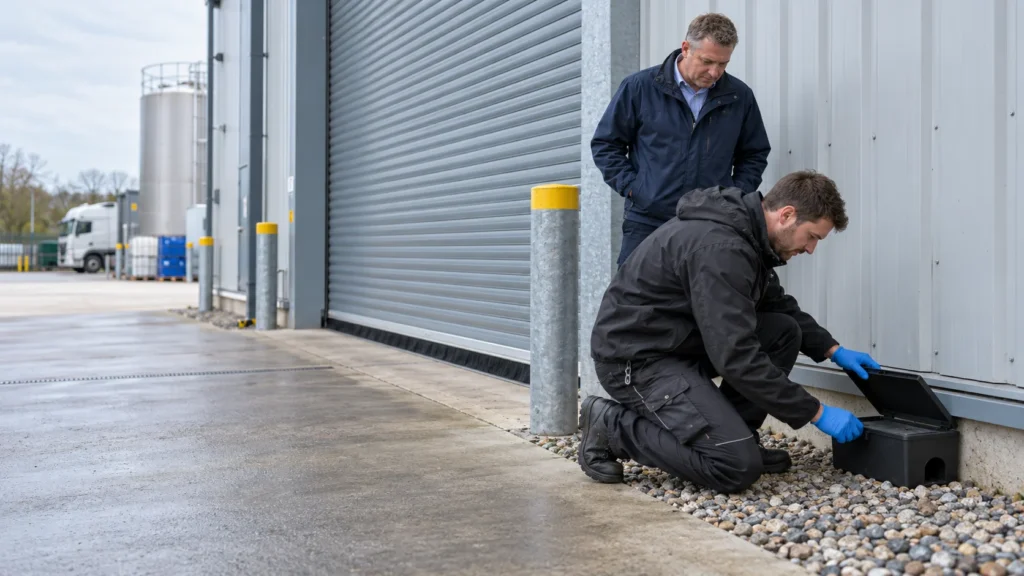
How to Pass a BRC Pest Control Audit
Securing a high grade on a food manufacturing site demands meticulous preparation. A brc pest control audit tests your physical defences and your administrative records together. Clause 4.14 of the BRCGS Global Standard Food Safety Issue 9 sets the criteria for pest exclusion and monitoring. Technical managers often find that small gaps in paperwork undermine an otherwise strong assessment. A single neglected bait station can cost your site a grade.
Do your systems provide the exact proof an auditor expects during the document review? The questions auditors ask, the folder contents they demand, and the fabric faults they record all follow a predictable pattern. Knowing that pattern protects your rating. How prepared is your pest management system for scrutiny on audit day?
Key Takeaways
- Documented pest programmes require site-specific risk assessments, qualified contractor credentials, and active alignment with BRCGS Global Standard Food Safety Issue 9 requirements.
- Accurate trend analysis demands written expert commentary explaining recorded pest activity patterns rather than uninterpreted charts showing raw monitoring numbers.
- Physical site walks regularly expose common breaches such as compromised roller shutter seals, open drainage gullies, and unmonitored external waste areas.
- Technical managers must assign named owners and realistic completion target dates to every corrective action raised by pest technicians.
- Field biologist inspections provide technical oversight and establish the formal verification reviews that auditors inspect during certification evaluations.
Core Elements of BRCGS Pest Compliance
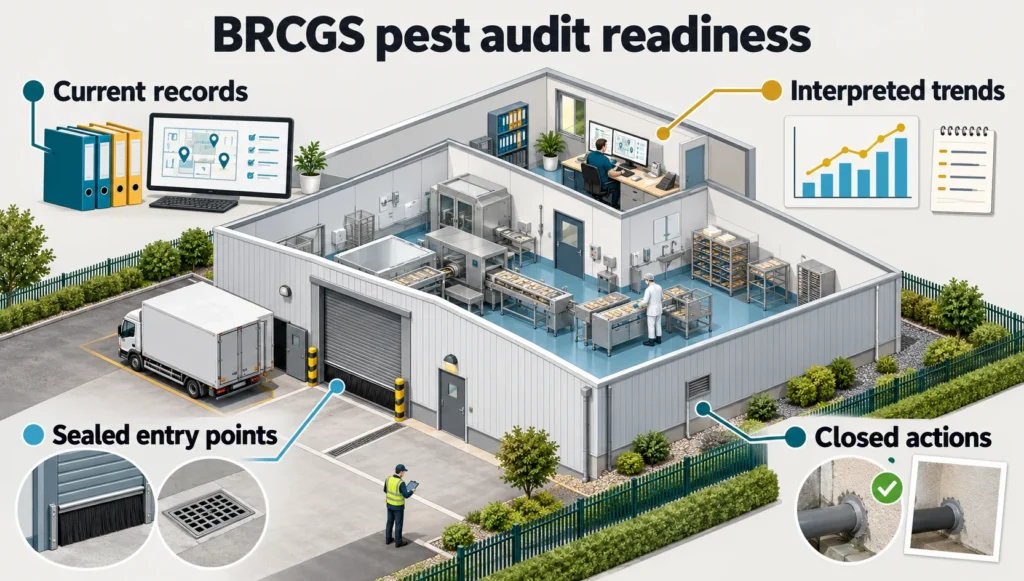
A successful pest management inspection rests on two pillars. The first is robust administrative record keeping. The second is clean physical infrastructure. Auditors scrutinise procedural controls alongside physical barriers. They want confirmation that your facility minimises contamination risk. Aligning internal documentation with external servicing records proves consistent oversight and safeguards commercial production.
The standard demands clear evidence that preventative measures work across every operational zone. Each monitoring device, written assessment, and service report must reflect real site conditions. The reference table below summarises the essential audit focal points. It sets out the documentation auditors inspect and the physical evidence your site needs to demonstrate compliance.
| Audit Component | Documentation Checked | Physical Site Evidence |
|---|---|---|
| Programme Management | Service agreement, BPCA accreditations, risk assessment | Mapped, numbered monitoring devices in verified positions |
| Trend Analysis | Quarterly catch figures, written biologist commentary | Clean fly killers, non-toxic monitoring stations |
| Ingress Prevention | Proofing logs, contractor recommendation records | Sealed dock levellers, brush strips on external doors |
| Corrective Actions | Signed action tracker with close-out photographic evidence | Rectified building fabric defects, cleared external waste |
| Technical Oversight | Annual field biologist inspection reports, action plans | Clean production voids, secured high-level service runs |
BRCGS Clause 4.14 Pest Management Requirements
Current Issue 9 Requirements
BRCGS Global Standard Food Safety Issue 9 sets out pest management within clause 4.14. The standard requires a fully documented programme built on a site-specific risk assessment. Facilities must maintain clear device plans. They must contract competent technicians. They must also hold formal reviews that evidence active biological risk management.
The standard favours proactive preventative systems over reactive chemical treatment. Production environments demand continuous monitoring. Non-toxic methods should be used wherever practical. Technical teams must show that pest management operates as an integral prerequisite programme. That programme underpins the wider site HACCP infrastructure and supports every downstream control.
Contractor Competence and Qualifications
Auditors expect external pest contractors to prove rigorous professional competence. Technicians servicing food premises should hold the RSPH Level 2 Award in Pest Management. Active BASIS PROMPT registration should sit alongside it. Third-party accreditation confirms verified competence, whether through British Pest Control Association membership or BS EN 16636 certification.
Sites that engage professional suppliers gain qualified technical expertise and structured documentation systems. Auditors also check insurance levels when reviewing service contracts. Public liability coverage must be adequate for the site. In practice, we find annual verification of technician training records is the simplest way to satisfy retailer supplier approval requirements.
Essential BRCGS Pest Documentation for Audit Day
The Core Audit Folder Structure
A compliant pest audit folder assembles every critical operational record into one logical, accessible file. The core file requires the active service contract and technician credentials. It also holds safety data sheets and an updated site plan. Auditors review this material first to assess whether genuine operational control exists.
Complete brcgs pest documentation prevents procedural non-conformances during the morning opening session. The file must contain emergency call-out procedures and current product approval schedules. COSHH assessments are required for every active biocide. Keeping digital copies on an online reporting platform lets technical teams locate evidence instantly when auditors request verification.
Device Mapping and Site Plans
Site plans must display the precise location and serial number of every monitoring device. Technicians and site managers must sign and date the map after any change. This applies whenever bait stations, insect traps, or electric fly killers move position. Discrepancies between the physical layout and the documented map trigger immediate non-conformances.
Auditors cross-reference physical bait box locations against the master layout during the walkthrough. Building modifications or temporary machinery relocations often force renumbering. Those changes demand immediate documentation updates. Mismatched numbering undermines auditor confidence. Unrecorded trap installations suggest poor communication between your maintenance team and the external pest contractor.
Did You Know?
BRCGS Global Standard Food Safety Issue 9 places pest management at clause 4.14. Sub-clause 4.14.9 requires sites to keep records of pest-proofing work. Many food businesses overlook that specific record until the auditor asks for it. Certification against Issue 9 began on 1 February 2023.
Data Interpretation and Trend Analysis Demands
Written Commentary Versus Raw Figures
Auditors require written expert commentary interpreting recorded pest data. Spreadsheets and charts alone will not satisfy them. Meaningful trend analysis explains the operational causes behind activity fluctuations in specific factory zones. A graph without professional interpretation fails scrutiny, because raw data does not demonstrate proactive biological risk management.
Professional reporting must judge whether recorded numbers reflect seasonal migration, localised hygiene failure, or a breach in the building fabric. Technical personnel must document the operational impact of any spike in crawling insects or rodent catches. Clear narrative summaries show auditors that management understands the risk and acts on it.
Review Frequencies and Action Thresholds
Facilities must set defined action thresholds for every monitored species across each risk zone. High-care processing areas demand investigation after a single insect catch. Peripheral warehouses tolerate minor baseline variation. Formal trend reviews must occur annually at minimum. High-risk manufacturing plants frequently require quarterly or monthly evaluation instead.
Documented action limits ensure staff intervene before an incursion compromises food safety. Crossing an agreed threshold must trigger a root-cause investigation. Routine chemical application is not an acceptable response. Auditors look for written records confirming that technical teams reviewed the trend patterns and adjusted servicing routines accordingly.
Free Pest Control Audit Review
We will review your risk assessment, site plan, visit reports, trend analysis, open recommendations, product records and demo our AI Pest management System.
Physical Site Walkthrough and Fabric Inspection
External Perimeters and Waste Compounds
The site walk begins at the property boundary. Auditors inspect vegetation, drainage gullies, and external waste facilities. Perimeters must stay free of redundant machinery, overgrown weeds, and standing water. Each offers potential harbourage. Secure, lidded refuse compactors sited away from primary access points reduce external rodent attraction.
Auditors examine external walls for clear inspection strips around the building base. Those strips permit visual monitoring. Storing raw pallets or waste against external cladding creates shelter for rodents and obscures burrows. Clear gravel perimeters and sealed external gullies stop environmental pests congregating beside operational loading bays.
Internal Production and High-Care Zones
Inspectors examine internal production areas for harbourage points, equipment voids, and food residue. Auditors pay close attention to high-care wash-down zones, motor housings, and mezzanine floors. Moisture and warmth in those locations support insect development. Every internal monitoring unit must stay securely fixed, numbered, and free of food splash.
High-level cable trays and ceiling voids are critical inspection points. Roof leaks and roosting birds introduce severe contamination hazards there. Machinery pedestals and hollow equipment frames need regular deep cleaning. That work denies harbourage to German cockroaches and stored product insects. Clean, well-lit environments make daily inspection straightforward.
AI Pest Management
AI pest management is pest control delivered with continuous digital monitoring and analytics rather than paper records, with real time data access across a single or multiple sites.
Proofing Standards and Ingress Prevention Defences
Doors, Dock Levellers, and Shutters
Defective external doors remain the most common structural entry route into food processing buildings. Roller shutters and personnel exits need durable brush or rubber seals. Those seals must eliminate light gaps beneath the threshold. A clearance of only a few millimetres allows house mice into active storage or production areas.
Dock levellers require heavy-duty draught brushes and tailored side seals. These close the gaps created during vehicle unloading. Poor habits defeat good hardware instantly. Propping emergency exits open for ventilation is the usual culprit. Strict door discipline keeps external barriers intact throughout every manufacturing shift and prevents unmonitored ingress.
Drainage and Service Penetrations
Defective drainage gives brown rats direct subterranean access into storage and preparation areas. Open inspection gullies and dry traps create an easy route. Unsealed service pipes passing through walls do the same. Non-return drainage valves and wire mesh collars around pipework prevent this form of structural entry.
Auditors examine utility penetrations closely. Electrical conduit, refrigeration lines, and steam pipes all enter from external plant areas. Expanding foam alone does not deter rodent gnawing. Technicians must specify metal plates, wire mesh, or proofing compounds. Sealing subterranean ducts stops pests travelling undetected from boiler houses into food preparation zones.
Corrective Action Tracking and Staff Reporting
Action Tracking and Close-Out Verification
Contractor recommendations must translate into documented corrective actions. Each action needs an assigned owner, a priority rating, and a target completion date. Auditors review historical service sheets to confirm that management resolved highlighted defects. Effective close-out demands tangible verification through work orders, photographs, or technician re-inspection notes.
Carrying unresolved proofing or hygiene recommendations across several audit cycles signals a management breakdown. Technical teams should review open actions weekly. Steady progress on structural maintenance depends on that rhythm. From experience across the sector, photographic evidence of completed repairs logged online gives auditors indisputable proof of corrective action.
Sightings Logs and Staff Engagement
Every food manufacturing facility must maintain an active pest sightings log. All operational and hygiene personnel need access to it. Auditors treat a completely blank log with suspicion, because minor insect observations occur naturally on large industrial sites. Each incident requires documented investigation, intervention, and formal signed close-out.
Retailers and certification bodies expect sites to train employees in biological awareness. Open reporting habits must be encouraged. A blame-free culture ensures operators record suspicious evidence immediately. Fear of reprimand suppresses reporting. Regular training turns shop-floor workers into reliable eyes and ears for the wider pest management system.
Preparation Strategies to Pass a BRCGS Audit
Pre-Audit Readiness Inspections
A thorough pre-audit inspection simulates the walkthrough an auditor performs on the day. Internal audits must check device condition, test electric fly killer performance, and examine building fabric seals. Every operational sector needs coverage. Identifying deficiencies weeks ahead leaves time to complete proofing repairs and update documentation.
Technical managers learning how to pass a brc pest control audit coordinate detailed site walks with their pest contractor. A qualified field biologist conducting an in-depth survey reveals subtle risks that routine monthly visits miss. Resolving outstanding housekeeping issues and updating bait station maps beforehand prevents costly audit day surprises.
Auditor Walkthroughs and Professional Demeanour
Technical managers should guide the auditor through the pest control file before the factory inspection begins. An orderly folder builds immediate credibility. It must hold current certificates, verified risk assessments, and interpreted trend reports. Direct answers about past pest activity demonstrate genuine accountability for biological risk.
Escorting personnel should carry the site map when touring production lines. Location queries then get answered promptly. Auditors sometimes identify an unrecorded fabric defect. Acknowledging the finding calmly and logging an immediate corrective action displays a positive food safety culture. Complete historical records reassure the auditor that standards remain consistently high.
Final Thoughts
Full compliance during a brc pest control audit requires continuous vigilance. Physical infrastructure and administrative systems both need attention. Facilities that maintain complete documentation and conduct regular trend analysis protect their certification status. Prompt resolution of contractor recommendations protects reputation too. Pest prevention works as a daily discipline, not an annual exercise.
Food safety standards continue to advance. Integrated pest management will rely increasingly on data transparency, remote monitoring technology, and robust environmental stewardship. Sites that invest in preventative structural proofing, staff training, and rigorous contractor oversight will pass inspections smoothly. That investment secures consumer trust and keeps commercial operations running without interruption.
Request a Free Site Survey
Frequently Asked Questions
A:
Technicians servicing BRCGS-certified food production facilities must prove certified technical competence. In the UK, the recognised baseline is the Royal Society for Public Health Level 2 Award in Pest Management. Technicians should also hold active BASIS PROMPT registration. That registration validates ongoing professional development. Engaging a servicing company with British Pest Control Association membership or BS EN 16636 certification gives auditors verified evidence. It shows attending personnel understand food industry standards.
A:
BRCGS requires sites to set field biologist inspection frequency using a site-specific risk assessment. High-risk processing plants, bakeries, and meat facilities typically need quarterly or bi-annual inspections. Lower-risk ambient packaging and storage sites may run an annual review instead. Retailer codes of practice often mandate at least four biologist visits each year. Auditors expect the complete survey reports, detailed recommendations, and written close-out evidence in the audit folder.
A:
Auditors issue non-conformances for unmonitored pest activity and untreated infestations. Severe structural breaches permitting direct ingress into open food zones carry the same weight. Documentation failures also trigger findings. Examples include missing trend interpretation, outdated site plans that mismatch trap locations, and actions carried across multiple visits. Permanent toxic rodenticide deployment without documented activity justification breaches CRRU stewardship guidelines. That practice also results in a non-conformance.
A:
Electric fly killers must never sit directly above exposed food, packaging materials, or open preparation lines. Siting units over food contact surfaces risks contamination from insect fragments. Units must also stay out of sight from outside the building. UV tubes visible through open access doors draw flying insects inward. Glue board units with shatter-resistant tubes are preferred over electrocution grids. All units need a scheduled tube replacement regime.
A:
Auditors reject raw catch data because graphs and spreadsheets do not prove operational risk management. The standard requires sites to show they understand what the data means. They must also identify the environmental factors driving any fluctuation. Effective trend analysis includes written commentary explaining seasonal patterns, ingress points, or hygiene defects. The narrative must outline the corrective interventions applied. It must confirm whether those actions brought catch numbers under control.

By choosing Shield Pest Management, you’re partnering with a company that combines local expertise with industry-leading practices. Our commitment to quality, compliance, and customer satisfaction makes us an ideal choice for both residential and commercial pest control needs.