

Commercial Pest Control Contract: What to Check
Entering into a commercial pest control contract is a significant operational commitment for any UK business. A poorly drafted agreement exposes facilities to unexpected call-out charges and severe audit non-conformances. Unmanaged pest pressures also threaten operational continuity across manufacturing, storage, and office premises. Procurement teams must ensure supplier contracts clearly establish technician competence, inspection scope, and transparent reporting from day one. Taking time to scrutinise these core terms prevents costly disputes and regulatory enforcement action.
Every commercial facility carries unique operational risks that require proactive prevention rather than reactive chemical treatments. Before signing an agreement, facilities managers must evaluate device allocation, visit schedules, and accountability measures. Does your current contract establish sufficient operational clarity to protect your business against sudden audit failures and unexpected liabilities?
Key Takeaways
- Visit frequency must follow documented site risk, not habit, tradition or the cheapest schedule a supplier offers.
- Listed target species decide your bill, so check which pests sit outside the fixed annual fee.
- Digital records completed on site before the technician leaves give auditors the evidence trail they expect.
- Confirm BPCA servicing membership, BS EN 16636 certification and current technician qualifications before you sign anything.
- Permanent toxic baiting is no longer a default, so contracts must show proofing and non-toxic monitoring first.
Contract Clauses Every Commercial Buyer Should Check
A rigorous service specification protects commercial premises from unexpected pest activity and regulatory penalties. Contract documents must establish explicit operational baselines rather than vague servicing promises. When evaluating vendor proposals, operations managers should verify how technician attendance, emergency coverage, and physical documentation are delivered across the operational year.
The table below outlines the primary contractual clauses every commercial business should review before signing. Assessing these core metrics ensures your agreement aligns with regulatory expectations, industry standards, and daily operational requirements. Doing so prevents costly contractual disputes, unexpected call-out invoices, and avoidable audit non-conformances across your facility.
| Contract Clause | Standard Commercial Expectation | High-Risk Food Site Expectation |
|---|---|---|
| Visit Frequency | Bi-monthly or quarterly inspections | Monthly to weekly scheduled attendances |
| Emergency Response | Specified response time window | Guaranteed priority out-of-hours coverage |
| Device Allocation | Fixed inventory mapped to site plan | High-density monitoring with trap sensors |
| Reporting Method | Digital report uploaded post-service | Immediate digital portal access with trends |
| Audit Documentation | Basic statutory COSHH and visit logs | Full third-party audit file and biologist reviews |
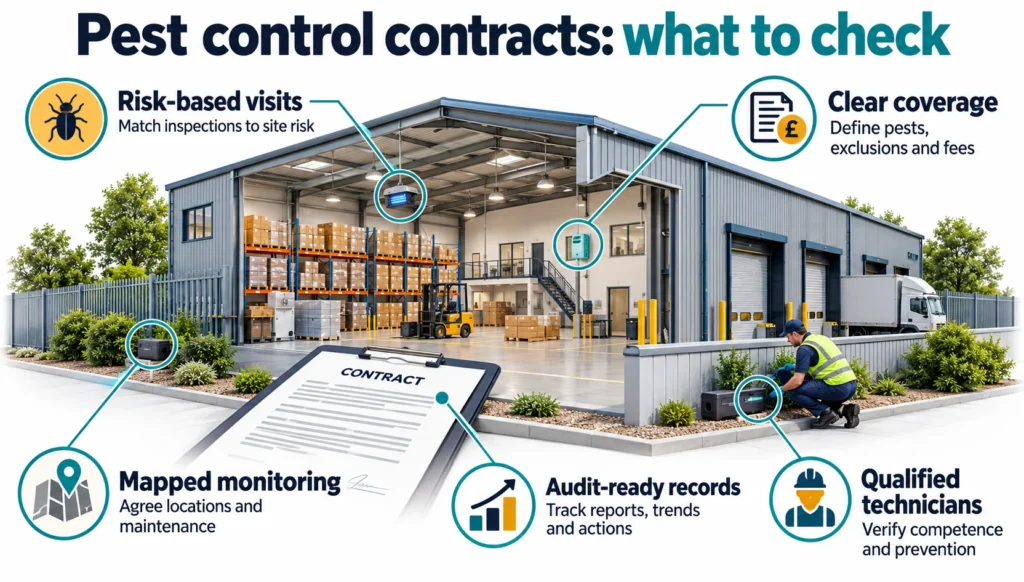
Visit Frequency and Service Scheduling
Risk-Based Service Intervals
Visit frequency must be determined by documented site risk rather than arbitrary tradition or cost cutting. A commercial pest control contract should specify regular visits tailored to your specific premises. This applies equally to quarterly storage checks and weekly food monitoring. Routine visits allow technicians to detect early activity before serious issues arise.
Under standards such as BRCGS Issue 9, auditors expect service intervals to reflect operational hazards. Past activity on site must also shape the schedule. If an agreement sets quarterly visits for a high-risk manufacturing environment, the site risks non-conformance. Contract schedules must remain adaptable. They should permit increases in frequency when pest pressures rise or seasonal variables alter baseline risk.
Contractual Response Times for Emergencies
Emergency response clauses must define exact attendance commitments when live pest activity compromises operational hygiene. Knowing what to look for in a commercial pest control contract ensures you secure clear service level agreements. Reliable providers establish prompt attendance windows for urgent call-outs rather than relying on vague best-endeavour promises.
Contracts should clearly distinguish between routine service follow-ups and emergency call-outs. When sudden activity occurs, commercial facilities require prompt attendance to halt stock contamination. Agreements must detail whether emergency attendances incur additional fees. Buyers should also verify whether weekend coverage is included and how escalations are handled.
Coverage Scope and Pest Exclusions
Covered Species Versus Additional Charges
A professional service agreement must explicitly state which target pests fall under the fixed annual charge. Rodents like brown rats and house mice usually form the core coverage. Most agreements also include common crawling insects such as cockroaches. Other species often carry separate, unpredictable fee structures that inflate your annual expenditure.
Disputes frequently arise when secondary pests appear unexpectedly on site. Species such as grey squirrels, feral pigeons, and stored product insects require specialised interventions. If these pests are excluded from core coverage, resolving an outbreak requires separate proposals. This delays treatment and increases operational risk. Procurement teams must ensure target pests reflect genuine operational hazards.
Seasonal Invaders and Specialised Interventions
Seasonal pest pressures can quickly disrupt production environments if contractual provisions fail to address them proactively. Wasps, cluster flies, and stored product beetles frequently emerge during warm months. These pests require rapid physical intervention or specialised monitoring systems. Basic service contracts often leave these seasonal risks unaddressed, causing sudden operational headaches.
Check whether seasonal interventions require supplementary contracts or individual job billings. Wasp nest treatments, fly screen maintenance, and pheromone lure replacements represent recurring operational tasks. Clear definitions within a comprehensive agreement prevent surprise invoices. They ensure seasonal monitoring supplies and routine maintenance sit inside the core service fee.
Did You Know?
Section 3 of the Prevention of Damage by Pests Act 1949 places a legal duty on occupiers of land. Where rats or mice are present in substantial numbers, the occupier must notify the local authority in writing. The duty sits with the site, not with the appointed contractor.
Device Allocation and Monitoring Infrastructure
Documented Device Density and Placement Plans
Every commercial agreement must record the precise inventory and location of all monitoring stations on site. A comprehensive pest control service agreement should mandate an up-to-date, signed site plan. This plan must clearly cross-reference every numbered internal and external monitoring device deployed across the entire facility without ambiguity.
Auditors regularly fail facilities where the physical layout does not match the master site plan. During contract formation, confirm that device counts reflect a thorough site survey. Tamper-resistant bait stations and insect monitoring points must be maintained and cleaned. Any damaged units should be replaced promptly without contentious billing disputes.
Electronic Fly Killers and Monitoring Maintenance
Flying insect management requires specific contractual clauses governing the maintenance, inspection, and tube replacement schedules for electronic units. Agreements must state whether shatter-resistant UV tubes or modern LED units are serviced, cleaned, and tested at appropriate intervals. Regular servicing ensures continuous attraction throughout the heavy flying insect season.
Catch tray analysis is vital for identifying emerging hygiene risks before stock contamination occurs. Contracts should specify that technicians inspect and record catch tray contents rather than merely emptying them. The agreement must also define who supplies replacement consumables, such as glue boards and lamps. Settling these points avoids unexpected supply invoices.
Free Pest Control Audit Review
We will review your risk assessment, site plan, visit reports, trend analysis, open recommendations, product records and demo our AI Pest management System.
Digital Reporting and Audit Documentation
Immediate Site Reporting and Document Portals
Modern pest management demands immediate, transparent reporting that eliminates manual paperwork delays and data discrepancies. Contract specifications should require that digital service records are completed on site before the visiting technician departs. This rapid delivery ensures complete operational transparency and immediate visibility for facility management teams.
A quality service arrangement should give clients direct access to a digital compliance portal. This infrastructure houses visit records, risk assessments, safety data sheets, and COSHH assessments in one location. Facilities subjected to unannounced food safety audits benefit significantly. Read-only portal access can be granted instantly to external inspectors.
Trend Analysis and Corrective Action Tracking
Meaningful trend analysis requires ongoing written interpretation rather than the passive collection of raw catch data. The contract must stipulate that the service provider analyses activity patterns over time. Good reports identify seasonal spikes, localised pressure zones, and root causes. This detailed analysis helps managers address underlying pest attractants effectively.
Corrective action tracking represents another critical audit vulnerability. When technicians identify proofing defects or hygiene concerns, these items must become timestamped actions with named owners. A competent contract establishes clear accountability. The provider closes out each recommendation with photographic evidence rather than repeating it across successive visits.
AI Pest Management
AI pest management is pest control delivered with continuous digital monitoring and analytics rather than paper records, with real time data access across a single or multiple sites.
Regulatory Compliance and Rodenticide Stewardship
Adherence to Rodenticide Stewardship Rules
Pest control agreements must comply with the Campaign for Responsible Rodenticide Use code and statutory biocidal regulations. Routine permanent toxic baiting as a default servicing habit is no longer acceptable. Contract models that rely on permanent external toxins now present a serious legal and compliance risk for property occupiers.
Since January 2025, difenacoum and bromadiolone have been restricted to use in and around buildings only. Open area and waste dump use is now unlawful for every second-generation anticoagulant. Contracts must specify that rodenticide use is justified, time-limited and recorded. Permanent stations should hold non-toxic monitoring blocks as the standard early-warning method.
Environmental and Wildlife Protection Obligations
Commercial contracts must respect strict wildlife legislation, including the Wildlife and Countryside Act 1981. The Animal Welfare Act 2006 applies equally to trapping and dispatch methods. Any lethal bird control concerning feral pigeons must operate within the conditions of a valid general licence. Non-lethal deterrents must be considered first.
Service agreements should explicitly detail humane trapping standards, checking frequencies, and responsible carcass disposal protocols. When wildlife interventions are necessary, the contract must document lawful justification. A proofing-first methodology should always take precedence. This transparent approach protects commercial site occupiers from statutory fines and severe reputational damage.
Contractor Credentials and Quality Assurance
Professional Certifications and Trade Accreditations
Independent verification of contractor competence protects your organisation from substandard servicing and regulatory scrutiny. A robust contract should confirm that the servicing company holds verified British Pest Control Association membership. It should also demonstrate certification against the European pest management standard BS EN 16636 through CEPA.
These credentials ensure the provider follows published codes of best practice and submits to regular technical audits. The contract should also verify technician qualifications. Staff should hold baseline awards, such as the RSPH Level 2 in Pest Management. They should also maintain active BASIS PROMPT registration to evidence continuing professional development.
Direct Employment Versus Subcontracted Labour
Service delivery standards depend heavily on whether a contractor deploys directly employed technicians or relies upon third-party subcontractors. Contracts should clearly state whether the servicing company uses its own vetted, insured, and qualified staff. Permanent employees deliver more consistent inspections, proofing, and urgent call-outs across your premises.
Directly employed teams generally demonstrate greater accountability, operational consistency, and familiarity with client sites. If specialist subcontracting is permitted for scaffolding or powered access equipment, the contract must establish clear boundaries. Core pest monitoring and chemical applications should remain under the direct control of qualified, permanent personnel.
Commercial Terms and Performance Management
Transparent Pricing Models and Hidden Costs
Commercial agreements require complete transparency regarding scheduled service fees, emergency call-out tariffs, and out-of-scope work billing. Procurement teams must scrutinise contracts to identify hidden charges before signing. Common extras include supplementary fees for follow-up visits, bait replenishment costs, or mandatory travel surcharges. Checking these terms ensures predictable operational budgeting.
Examine the contract terms governing price adjustments, indexation clauses, and agreement renewal notices. Multi-year agreements should establish predictable review mechanisms tied to published economic indicators. Covering replacement monitoring devices and minor proofing advice within the core fee prevents contentious billing disputes. This clarity protects both parties throughout the contracted term.
Key Performance Indicators and Contract Termination
Effective contract governance relies upon measurable performance metrics that reflect genuine operational control rather than superficial activity volumes. Service agreements should include specific key performance indicators. These metrics evaluate visit adherence, emergency response punctuality, and the average age of open corrective actions. Tracking these factors sustains service quality.
Contracts must also define realistic termination procedures and break clauses. If a provider misses scheduled attendances or response windows, the site owner needs a clear exit route. Avoid agreements with onerous automatic roll-over terms or restrictive notice periods. Such clauses lock businesses into underperforming servicing relationships.
Final Thoughts
Selecting and formalising a commercial pest control contract is a vital operational decision for any business. The agreement directly influences regulatory compliance, site hygiene, and commercial reputation. Rather than treating the contract as a simple overhead, operators should run it as an active risk management partnership. Robust agreements define responsibilities clearly and establish defensible inspection schedules. They also enforce transparent digital reporting that satisfies third-party auditors and environmental health officers.
Procurement teams and facilities managers must examine prospective service agreements with technical rigour. They should verify that technician competence, environmental stewardship, and accountability metrics are written into every clause. Prioritising prevention-led methods and modern documentation protects the site against operational disruption and costly regulatory non-conformance.
Request a Free Site Survey
Frequently Asked Questions
A:
Ask whether attending technicians are directly employed or subcontracted. Confirm they hold RSPH Level 2 qualifications with active BASIS PROMPT registration. Verify corporate BPCA servicing membership and BS EN 16636 certification. Clarify emergency response commitments, out-of-hours coverage, portal access, and who produces the interpreted trend analysis. Confirm public liability cover levels. Check who tracks proofing recommendations through to close-out. Finally, scrutinise the schedule for excluded species, consumable charges, or hidden call-out fees before signing.
A:
Standard agreements frequently exclude specialised treatments such as bird proofing, netting installation, guano clearance, and major building proofing works. Seasonal or specialised species like bed bugs, pharaoh ants, wood-boring insects, and wasps often require separate quotations. Emergency out-of-hours attendances and extra visits outside the agreed frequency are also routinely billed separately. Always check the schedule line by line before signing. Never assume peripheral tasks or follow-up visits sit within the core annual fee.
A:
Visit frequency must reflect documented site risk rather than standard convention. Low-risk offices and dry warehouses often operate effectively with quarterly inspections. Complex food processing plants generally require monthly or weekly attendances. Those frequent visits are necessary to satisfy GFSI benchmarked standards or retailer codes of practice. Any adjustment to visit frequency must be justified through a recorded risk assessment. That record ensures inspection intervals match changing site pressures and survives external scrutiny.
A:
Second-generation anticoagulants may only be used in and around buildings, never in open areas or at waste dumps. Routine permanent toxic baiting as a default servicing habit is no longer acceptable under UK stewardship rules. Permanent stations remain standard practice, but they should contain non-toxic monitoring blocks to detect activity. Toxic bait requires documented justification, a risk assessment, regular inspection, and prompt removal once control is achieved. Purchasers also need current stewardship certification.
A:
Auditors inspect the signed contract, technician qualification certificates, and current public liability insurance. The file must contain a signed site layout plan displaying numbered monitoring stations. It also requires site-specific risk assessments and COSHH data sheets for every product used. You must present complete visit logs and an active staff sightings register. Finally, auditors require written trend analysis and verified close-out evidence for all open recommendations.
By choosing Shield Pest Management, you’re partnering with a company that combines local expertise with industry-leading practices. Our commitment to quality, compliance, and customer satisfaction makes us an ideal choice for both residential and commercial pest control needs.
