

Commercial Pest Management Plan Explained
Every commercial facility carries its own mix of regulatory duties, structural weaknesses and operational pressures. A robust commercial pest management plan goes well beyond routine chemical treatment. It sets out an evidence-based defensive framework built around the layout of a single premises. Proofing, physical monitoring and clear action criteria work together. The result protects inventory, preserves structural integrity and holds up under third-party audit.
Facilities managers often inherit legacy programmes and never see the logic behind them. Devices sit where a previous contractor left them. Thresholds go unrecorded. So how are operational risks actually identified, and where should monitoring assets sit across your facility?
Key Takeaways
- A site survey assesses structure, workflow, hygiene and external pressures to identify genuine pest risks before any device is installed.
- Risk zoning sets device density, combining non-toxic surveillance inside production areas with defensive barriers at intake bays and perimeters.
- Action thresholds define escalation by species and location, triggering root-cause investigation long before activity becomes an audit non-conformance.
- Stewardship rules demand certified operators, documented justification and non-toxic monitoring baselines instead of permanent external toxic baiting.
- A complete pest file needs dated site plans, technician certificates, written trend analysis and verified close-out of every corrective action.
Core Elements of a Modern Commercial Pest Framework
A professional pest strategy follows a methodical six-stage lifecycle. Prevention takes priority over reactive treatment at every stage. Rather than applying blanket controls, competent technicians assess structural weaknesses first. They then install discrete monitoring devices and review environmental data continuously. Each stage produces evidence that an auditor can inspect on demand.
The table below sets out how each stage functions inside a working facility. It records the technical objective alongside the evidence needed to prove compliance. British standards and international certification schemes both expect that evidence in writing. In practice, we find missing stage evidence is the fastest route to a non-conformance.
| Programme Stage | Primary Objective | Essential Audit Evidence |
|---|---|---|
| Programme StageComprehensive Survey | Primary ObjectiveAssess structural envelopes, drainage and operational pest pressures. | Essential Audit EvidenceSite-specific risk assessment and ingress reports. |
| Programme StagePreventative Proofing | Primary ObjectiveDeny harbourage, close building gaps and remove food sources. | Essential Audit EvidencePhotographic proofing logs and maintenance actions. |
| Programme StageTargeted Monitoring | Primary ObjectivePlace numbered, mapped devices across designated risk zones. | Essential Audit EvidenceSigned site plan and dated device inspection logs. |
| Programme StageThreshold Setting | Primary ObjectiveSet action limits by species and operational sensitivity. | Essential Audit EvidenceDocumented escalation matrix within the pest file. |
| Programme StageJustified Intervention | Primary ObjectiveApply non-toxic or chemical controls to clear active issues. | Essential Audit EvidenceCOSHH assessments, bait logs and stewardship records. |
| Programme StageContinuous Review | Primary ObjectiveAnalyse activity trends and update physical controls. | Essential Audit EvidenceQuarterly trend analysis and annual biologist reviews. |
Initial Site Survey and Risk Profiling
Structural and Environmental Evaluation
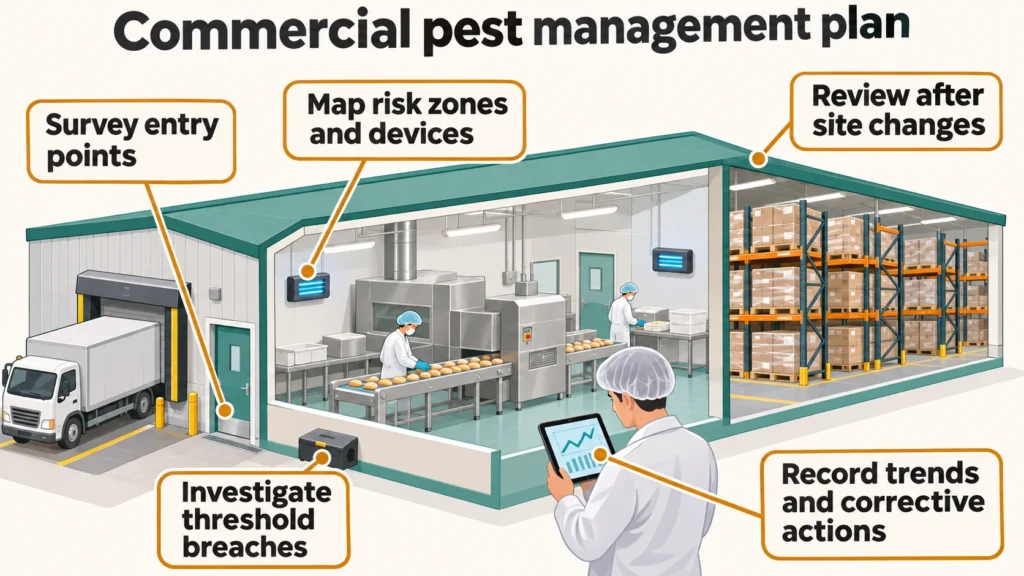
A thorough site survey forms the foundation of any commercial pest strategy. The attending technician inspects the building envelope, rooflines, service penetrations and drainage. The survey records immediate ingress routes alongside external pressures. Adjacent land, neighbouring waste storage and local vegetation all shape the final risk profile.
Structural transitions deserve close attention. Loading dock levellers, roller shutter brush seals and damaged floor slabs give rodents easy access. Technicians also check plant rooms and suspended ceiling voids. Warmth and seclusion in these spaces encourage nesting. Cataloguing every weakness first means the programme treats root causes rather than surface activity.
Operational Workflow and Commodity Vulnerabilities
Pest risk shifts with the commodities a site handles. Inbound raw ingredients, packaging cardboard and static inventory attract different species. Stored product insects, rodents and flying pests each respond to different conditions. Technicians therefore review goods-in procedures, internal traffic routes, stock turnover and hygiene standards within processing zones.
A high-throughput logistics depot faces different pressures from a chilled food line. A pharmaceutical packaging hall differs again. The technician maps the route materials take through the premises. That map exposes contamination cross-points. Monitoring assets then sit where biological pressure meets a critical process.
Zoning Principles and Surveillance Density
Graded Internal and External Zones
Zoning divides a facility into tiers by operational sensitivity and biological exposure. External perimeters, waste yards and intake bays form high-risk buffer zones. These areas need robust boundary defences. Intermediate storage and staff welfare spaces form secondary zones. High-care processing suites demand strict, non-invasive surveillance to protect product.
The division stops pests migrating from unsealed perimeter gates into packaging spaces. Each zone carries its own servicing protocol and equipment specification. Technicians mark boundary lines on facility drawings. Hygiene teams and engineering departments can then see how environmental separation supports physical exclusion.
Device Positioning and Layout Calculations
Device spacing follows measured logic rather than habit. Perimeter stations sit along external fences and exterior walls at set intervals. They intercept foraging rodents before entry. Inside, technicians place numbered monitoring boxes along wall runs, beneath racking and beside active doorways. Rodents travel habitually along structural margins.
Rats show neophobia and avoid unfamiliar objects. Technicians therefore position devices directly against runs revealed by smear marks and fur grease. House mice explore more freely, whilst still squeezing through pencil-thin gaps. Internal voids consequently need denser layouts. Every unit carries a permanent identifier matching the master site plan.
Did You Know?
Under regulation 19 of the Food Safety and Hygiene (England) Regulations 2013, conviction on indictment for a food hygiene offence carries an unlimited fine, up to two years’ imprisonment, or both.
Action Thresholds and Escalation Procedures
Tolerance Levels by Species and Location
An action threshold is the recorded activity level that triggers formal corrective work. Tolerances reflect the hygiene sensitivity of the zone. They also reflect the hazard posed by the species involved. In an external yard, a minor insect catch may warrant observation only. One rodent dropping in production triggers immediate investigation.
Thresholds are never arbitrary figures chosen for convenience. Certification bodies and retail audit standards expect technical justification for every recorded tolerance. Setting thresholds department by department prevents disproportionate chemical use. It also guarantees swift escalation whenever pressure threatens product safety or statutory hygiene compliance.
Investigation Protocols and Corrective Escalation
A breached threshold demands diagnosis before any chemical application. The servicing technician inspects adjacent structural fabric and checks recent intake manifests. Machinery voids are examined for primary harbourage. Management then receives prompt notice of the fabric repairs, deep cleaning or temporary operational changes required.
Corrective actions need named owners, explicit completion dates and verified close-out notes. All of this sits in a central tracking register. Suppose an inspection finds mouse activity inside a production void. Technicians fit non-toxic mechanical traps and proof the structure locally. Inspection intervals increase until surveillance confirms the activity has stopped.
Free Pest Control Audit Review
We will review your risk assessment, site plan, visit reports, trend analysis, open recommendations, product records and demo our AI Pest management System.
Regulatory Compliance and Rodenticide Stewardship
Stewardship Rules for Professional Rodent Control
UK rodent management operates under strict stewardship rules. Those rules exist to protect predatory wildlife from secondary poisoning. Routine permanent toxic baiting around building exteriors no longer meets the CRRU Code of Best Practice. Anticoagulants containing difenacoum or bromadiolone are restricted to use in and around buildings.
Professional operators must hold approved stewardship certification and keep current BASIS PROMPT registration. Permanent external bait boxes carry non-toxic monitoring blocks instead of poison. They function purely as an early warning network. Toxic bait enters a station only once inspection confirms active rodents. All toxic material is withdrawn once the infestation ends.
Statutory Hygiene Legislation and Due Diligence
Occupying commercial premises brings statutory hygiene duties. The Food Safety Act 1990 and the Food Safety and Hygiene (England) Regulations 2013 require clean, pest-free conditions. A structured preventative plan supplies the evidence behind the statutory due diligence defence. Without that written record, the defence becomes difficult to sustain.
Section 3 of the Prevention of Damage by Pests Act 1949 also applies. Occupiers must notify the local authority where rats or mice are present in substantial numbers. A documented commercial pest management plan helps businesses meet these duties. It also reduces exposure to hygiene emergency prohibition notices during unannounced inspections.
AI Pest Management
AI pest management is pest control delivered with continuous digital monitoring and analytics rather than paper records, with real time data access across a single or multiple sites.
Hardware Selection and Integrated Technology
Mechanical Devices and Flying Insect Systems
Hardware choice depends on the environment and the governing industry standard. Open food preparation areas need shatter-resistant glue-board electric fly killers. High-voltage grid units risk scattering insect fragments across product. LED UV systems control flying insects efficiently. They also generate catch data that helps teams locate external breeding sources.
Mechanical rodent traps, pheromone monitors and inspection mirrors make up the non-chemical inventory. Pheromone lures suit grain, milling and confectionery storage. They target stored product pests such as warehouse moths and flour beetles. Continuous catch data lets technicians isolate an infestation to a single racking bay before commodities suffer.
Digital Portals and Real-Time Surveillance
Paper service binders in plant rooms are giving way to digital reporting systems. Connected trap sensors and QR-coded checkpoints give immediate visibility of site activity. Visit records and timestamps reach a secure client platform before the technician leaves site. Auditors can then review the full service history without delay.
Digital platforms turn raw inspection entries into analytical heat maps. Activity trends become visible across departments and operating cycles. Technical managers can demonstrate prompt corrective action during an unannounced audit. Sensors still only report device activations, whilst a skilled technician must attend site to find the structural cause.
Documentation, Site Plans and Trend Analysis
Contents of a Complete Pest File
An incomplete pest file remains one of the most common audit non-conformances. Auditors expect the service agreement, technician competency certificates and public liability documentation. Comprehensive COSHH assessments belong in the same folder. Every active chemical and non-toxic monitoring product also needs its safety data sheet filed securely.
The file must hold a signed, dated site map showing every numbered device. Any mismatch between the drawing and the floor suggests weak service discipline. A sightings log completed by internal staff belongs there too. It keeps on-site teams involved in daily surveillance between scheduled visits.
Catch Data and Written Interpretation
Collected data means very little without written interpretation. Independent auditors penalise sites that present multi-year catch charts with no commentary. Effective trend analysis asks whether insect catches follow seasonal patterns. It tests whether rodent activity tracks raw ingredient deliveries. It also confirms whether proofing repairs actually closed the entry route.
Written analysis must confirm the effect of earlier interventions. If fly counts rise inside a processing room, the report explains why. Open dock doors and cleaning oversights are the usual causes. Formal field biologist audits add a higher level of technical review on high-risk sites.
Programme Reviews and Dynamic Operational Changes
Site Alterations and Revised Surveillance Grids
Commercial facilities rarely stay static for long. Machinery moves, internal walls go up, racking changes and loading docks expand. Each alteration disrupts the established surveillance grid. A resilient integrated pest management strategy therefore requires systematic re-evaluation. Any physical or operational change across the premises should trigger that review.
Construction work breaches the building envelope and displaces subterranean rodent populations. Ingress risk rises immediately. Extra production capacity or a larger storage footprint demands matching changes to the monitoring perimeter. The technician recalculates device density, reviews zone classifications and issues revised schematics whenever the defensive boundary changes.
Annual Reviews and Auditing Standards
A structured programme review must take place at least annually. The review confirms that protocols still match the active auditing scheme. Sites certified under BRCGS Food Safety Issue 9, SALSA Issue 7 or a retailer code face distinct documentation demands. Previous non-conformances and technician training records are checked at the same time.
Annual review also tests whether visit frequency still matches observed risk. Where data shows sustained control and sound proofing, the existing routine can be defended with evidence. Emerging external pressure may justify more frequent servicing. From experience across the sector, auditors want to see the documented rationale behind that decision.
Final Thoughts
An effective commercial pest management plan rests on technical precision, methodical documentation and consistent discipline. Treating pest control as a generic facilities task leaves operations exposed. The consequences include financial penalties, unannounced closures and failed certification audits. A structured IPM framework replaces reactive treatment with resilient, evidence-led defence.
A sound programme unites structural survey, clear risk zoning, strict rodenticide stewardship and transparent reporting. Regulatory expectations across the UK continue to tighten. Reviewing the defensive layout, inspecting physical barriers and auditing the pest file keeps a site audit-ready at every stage of operation.
Request a Free Site Survey
Frequently Asked Questions
A:
A site-specific plan assesses the physical layout, storage conditions and environmental pressures of one facility. Generic service models miss subtle ingress routes, warm internal voids and local hygiene weaknesses. Device layouts, inspection frequencies and action thresholds are built around genuine risks rather than a standard template. That approach supports reliable audit compliance and prevents stock losses. It also gives environmental health officers clear evidence that the business understands its own premises.
A:
Integrated pest management puts physical proofing, environmental hygiene and continuous monitoring ahead of automatic chemical treatment. Routine applications give way to non-toxic surveillance and structural exclusion. Pesticides and rodenticides enter the programme only once monitoring confirms an active infestation. The approach protects non-target wildlife and slows the development of resistance. It also matches current UK regulatory expectations. In practice, most activity is resolved through proofing and cleaning rather than poison.
A:
UK stewardship rules under the Campaign for Responsible Rodenticide Use prohibit routine permanent toxic baiting around building exteriors. Non-target species, including field mice and birds of prey, face secondary poisoning when bait sits outside indefinitely. Technicians now fit non-toxic monitoring blocks in external stations as an early warning system. Approved toxic bait is introduced only after inspection confirms active rodent ingress. It is then withdrawn once activity stops and the site returns to monitoring.
A:
Auditors examine the site-specific risk assessment, technician competence records, insurance certificates and signed device location plans. They also review product safety data sheets, COSHH assessments and dated visit logs. Written trend analysis matters most, because it shows that catch data has been interpreted rather than merely collected. A corrective action register must prove that maintenance and proofing recommendations were completed, with evidence and dates against each item. Gaps there cause most non-conformances.
A:
Programmes need formal technical review at least annually. An earlier review is appropriate after structural change, a layout alteration or a significant pest incursion. Adding machinery lines, altering racking or extending the building fabric changes harbourage and travel routes. The technician inspects those changes, adjusts device layouts and updates the master site map. Action thresholds are re-checked at the same time. Visit frequency is then confirmed or revised against recorded activity data.



By choosing Shield Pest Management, you’re partnering with a company that combines local expertise with industry-leading practices. Our commitment to quality, compliance, and customer satisfaction makes us an ideal choice for both residential and commercial pest control needs.
