

Exterminator or Pest Controller: Which Do You Need?
When pests appear inside a building, most people search for an exterminator. The word comes from film and television rather than British practice. Qualified UK professionals work as pest controllers or technicians. The difference matters. It shapes how a problem is diagnosed, treated, proofed and documented on your premises.
The real question is not what to call the service. It is how much intervention your situation actually needs. Some problems clear in a single visit. Others demand a contracted programme with scheduled inspections and audit-ready records. So which model fits your property, an exterminator-style call-out or a managed pest control contract?
Key Takeaways
- Exterminator is a cultural term; the UK trade operates as pest controllers and technicians under regulated management frameworks.
- Qualified technicians lead with inspection, species identification and proofing, applying biocides only when the evidence justifies a chemical treatment.
- Recognised credentials include the RSPH Level 2 Award, audited BPCA servicing membership and certification against BS EN 16636.
- Single visits suit seasonal pests such as wasp nests, where the colony dies and never returns to the same site.
- Audited food and hospitality sites need contracted programmes with signed site plans, trend analysis and a complete documentation file.
One-Off Call-Outs and Contracted Programmes Compared
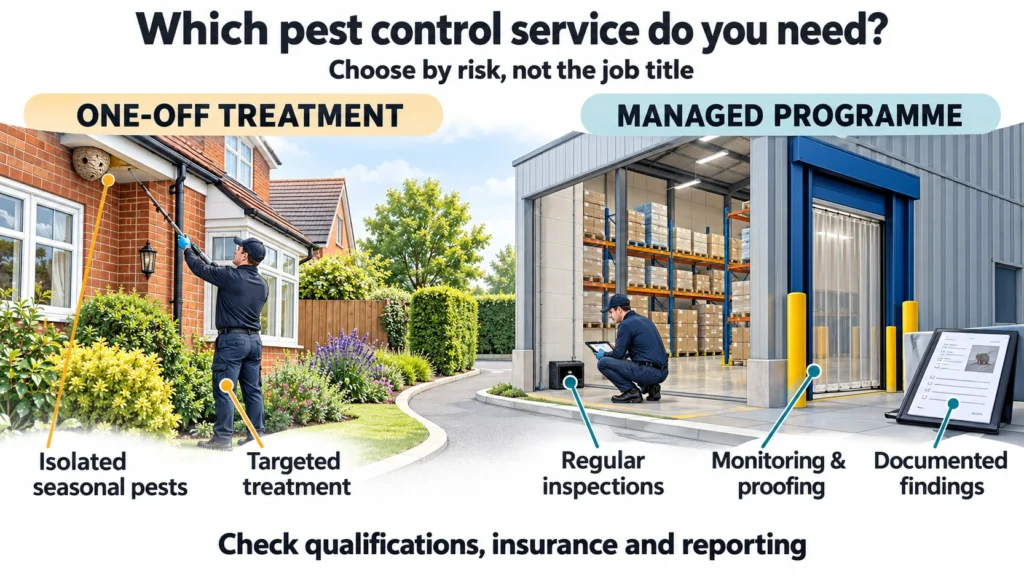
Service choice follows operational risk, not pest species alone. A one-off call-out targets an active population in one location and ends there. A contracted programme runs continuous monitoring, physical proofing and verified records across the whole building. The two models cost different amounts because they deliver different things.
The table below sets the two models against operational, diagnostic and administrative criteria. Read it against your own risk profile. A small office with a summer wasp nest sits at one end. A chilled distribution centre supplying a supermarket sits at the other. Most premises fall somewhere between the two.
| Criterion | Reactive One-Off Treatment | Contracted Management Programme |
|---|---|---|
| Primary objective | Rapid removal of a visible, active population | Long-term suppression, prevention and audit compliance |
| Operational method | Targeted physical removal or approved biocide knockdown | Integrated pest management, monitoring and structural proofing |
| Reporting detail | Basic treatment note or job invoice | Digital visit reports, mapped device logs and trend analysis |
| Follow-up schedule | None, or limited revisits within a short warranty window | Risk-based inspections throughout the contract year |
| Typical suitability | Domestic wasp nests and localised seasonal insect activity | Food manufacturing, warehousing, hospitality and healthcare |
Where the Exterminator Label Came From
American Film and Television Shaped the Term
Cinema and imported television planted the chemical exterminator in the British imagination. Screen versions showed pest work as a dramatic assault on a building. The image stuck. Members of the public still reach for that vocabulary when something scuttles across a kitchen floor at midnight.
The trope was useful drama. Characters arrived with cylinders, fogged a property and left. It made good television. It never described British environmental practice, which has been built around restraint and evidence for decades. Search behaviour simply lags behind the trade it is trying to reach.
From Chemical Eradication to Integrated Pest Management
Mid-century pest work leaned hard on contact chemicals. Technicians sprayed, dusted and moved on. Environmental toxicology then exposed the cost of that approach to non-target wildlife and water courses. Practice changed. The sector now works through exclusion, hygiene and monitoring, with biocides held back as a last resort.
So the search for an exterminator now lands on a regulated technician. The priority is no longer volume of chemical. In practice, we find the durable fix is almost always structural. Cut the food source. Seal the entry point. Treatment supports that work; it rarely replaces it.
What a Qualified UK Pest Controller Actually Does
Diagnostic Survey and Species Identification
A competent pest controller starts with a physical survey, not a treatment. The technician locates harbourage, maps transit runs and finds the entry tracks. Species identification drives everything that follows. German cockroaches need a different method from Oriental cockroaches, and the wrong call wastes the whole visit.
Misidentification is expensive. Treat pharaoh ants as black garden ants and the usual spray will fracture the colony into satellite nests. The problem then spreads through the building. Surveys examine droppings, rub marks, gnaw patterns and structural defects. That evidence sets a baseline before anyone selects a product.
Detection Devices, Proofing and Written Records
Detection devices carry modern pest suppression. Technicians place numbered monitors and pheromone traps across vulnerable zones. These units collect baseline data without poison. They flag activity weeks before anyone sees a pest in a production area. Early warning turns a potential shutdown into a quiet, targeted intervention.
Proofing follows the diagnosis. Technicians close pipe penetrations, door gaps and service risers that let rodents in. Worn door sweeps and drainage defects come up on most commercial surveys. Every visit then produces a written report. It records findings, risk assessment, any product used under COSHH and the remedial work the client must complete.
Did You Know?
Breaches of the Food Safety and Hygiene (England) Regulations 2013 carry an unlimited fine in England and Wales, alongside a prison sentence of up to two years. Pest activity in food premises regularly sits behind those prosecutions.
Industry Qualifications and Professional Standards
RSPH Level 2 and Continuing Professional Development
Entry-level competence in the UK sector runs through formal certification. The RSPH Level 2 Award in Pest Management is the industry benchmark. It confirms that a technician understands vertebrate biology, insect identification, biocidal toxicology and workplace safety law. Ask for the certificate before anyone opens a bait box on your site.
Uncertified operatives create real legal exposure for the occupier. Professional rodenticides carry label conditions, dosage limits and stewardship obligations. Registers such as BASIS PROMPT track continuing professional development. Statutory restrictions move, humane trapping law moves, and stewardship rules tighten. A technician who stopped learning a decade ago is a liability.
Trade Association Audits and European Certification
Servicing membership of the British Pest Control Association is an audited status, not a logo purchase. The association verifies insurance, technician competence and published codes of practice. Members submit to periodic audit to stay on the register. Check the BPCA directory yourself rather than trusting a badge on a website.
Certification to BS EN 16636 sits above that. CEPA awards it against service delivery, site risk assessment, training records and environmental responsibility. Auditors recognise it on sight. For a food or pharmaceutical site, it shortens an awkward conversation during an unannounced inspection. External verification beats self-assessment every time.
Free Pest Control Audit Review
We will review your risk assessment, site plan, visit reports, trend analysis, open recommendations, product records and demo our AI Pest management System.
Single Visits Versus Contracted Programmes
When a One-Off Treatment Is the Right Call
Isolated seasonal activity in a house or small office often needs one visit and nothing more. A summer wasp nest is the clearest example. Wasps build an annual colony and abandon it. Nothing reoccupies the void. Once the nest is dead, the risk ends, and a service contract adds no technical value.
The scope is clean. A technician attends, completes an environmental risk assessment and treats the nest with an approved insecticidal dust. The client gets exclusion advice and a safety window. The colony dies within days. Work closed, no recurring fee, no monitoring grid to maintain.
When a Managed Contract Becomes Necessary
Persistent pressure changes the calculation. Large commercial sites, food logistics chains and buildings with heated voids face recurring challenges that single visits cannot hold. A contract sets inspection cycles, a non-toxic monitoring grid and repeated structural assessment. The aim is to stop colonisation rather than respond to it.
Reactive visits on a large site buy an expensive cycle. Infestation, emergency call-out, downtime, repeat. From experience across the sector, the value of a contract is continuity. One technician learns the layout, the waste flow and the seasonal pressure points. That knowledge catches a failing door seal before it becomes a rodent corridor.
AI Pest Management
AI pest management is pest control delivered with continuous digital monitoring and analytics rather than paper records, with real time data access across a single or multiple sites.
Compliance Realities for Food, Hospitality and Audited Sites
Food Hygiene Law and the Due Diligence Defence
Food businesses carry statutory duties under the Food Safety Act 1990 and the Food Safety and Hygiene (England) Regulations 2013. Environmental Health Officers expect premises to be pest-free, proofed and clean. A due diligence defence rests on proof. You must show that management took every reasonable precaution before contamination occurred.
A call-out invoice proves only that you had an infestation. A pest management file proves continuous diligence. It holds visit history, safety data sheets, technician certificates and signed inspection reports. In practice, that folder is what protects a hygiene rating during an enforcement visit. Build it before you need it.
Third-Party Schemes and GFSI Expectations
Sites certified to BRCGS, SALSA or a supermarket supplier code work under explicit pest control clauses. These standards rule out unmanaged reactive treatment. The site must hold a dedicated pest register. That register includes a signed, dated site plan showing every numbered monitoring device across the building and its perimeter.
Auditors want interpretation, not raw counts. The provider must chart findings over time, read the fluctuations by zone and evidence the corrective actions taken. BRCGS Global Standard Food Safety Issue 9 also expects an annual review by a qualified field biologist. A contractor who cannot supply trend analysis will cost you a non-conformance.
Questions to Ask Before You Hire a Provider
Qualifications, Insurance and What the Quote Covers
Confirm that the attending technician holds an RSPH Level 2 qualification. Ask whether the company employs its staff directly or subcontracts the work. Directly employed technicians give you consistency and accountability. Subcontractors paid by job volume have an incentive to move fast rather than survey properly.
Request public liability cover appropriate to your building type and proof of BPCA servicing membership. Then pin down the quote. Out-of-hours attendance, emergency call-outs, follow-up verification visits and minor proofing often sit outside the headline price. Clients discover this at the worst moment. Get the inclusions and exclusions in writing before you sign.
Report Turnaround and Recurrence Protocol
Ask how quickly reports arrive and whether they come digitally. Professional providers complete records on site with a timestamp. A handwritten slip posted three days later helps nobody. Immediate reporting lets your maintenance team act on a proofing defect or hygiene failure while the detail is still fresh.
Then establish what happens if activity persists. A reliable contractor states realistic eradication timelines and commits to re-attendance within the agreed scope. Ask what sits outside their control. Adjoining building works, shared drainage and neighbouring premises all slow results. Honest providers say so at the quotation stage rather than the complaint stage.
Job Titles and Industry Terminology
Technicians, Surveyors and Field Biologists
Job titles in the sector describe real differences in capability. A pest control technician surveys sites, services monitoring stations, applies approved treatments and carries out basic exclusion. These operatives hold baseline vocational certification. They handle the bulk of domestic and commercial work and they are the people you will usually meet.
A field biologist is the senior technical tier. The role usually requires a relevant degree or long industrial experience. Field biologists run forensic inspections on complex manufacturing and distribution sites. Their reports analyse environmental dynamics, identify stored product insect activity and assess structural weakness. Audited sites rely on that level of input.
Informal Labels and Unregulated Titles
Searches throw up terms such as pest control engineer and specialist exterminator. Neither is a recognised UK vocational title. Engineering describes mechanical, civil and electrical professions governed by their own chartership bodies. The pest sector borrowed the word for marketing weight. It tells you nothing about the technician who will attend.
Inflated titles usually fill a gap where credentials are missing. Ignore the website copy and check the verifiable facts. Is the company on the BPCA directory? Can it produce technician certificates and insurance documents? Competence shows up in methodical inspection and clean documentation, not in a dramatic job title.
Final Thoughts
Exterminator remains the popular search term, but it describes a job the UK trade stopped doing decades ago. Professional pest management is an evidence-based discipline. It draws on animal behaviour, building fabric, hygiene systems and statutory compliance. Real protection comes from methodical investigation. It does not come from volume of chemical.
Match the service to the risk. An isolated domestic problem may need one competent visit and good proofing advice. Food production, warehousing and hospitality need contracted vigilance with audit-ready records. Check qualifications, check membership, and check what the reporting actually looks like. The right choice protects the premises long before the next inspection.
Request a Free Site Survey
Frequently Asked Questions
A:
Exterminator is a cultural term rather than a job title in the UK. It suggests reactive chemical killing. A pest controller or technician works to integrated pest management. That means a site survey, accurate species identification, non-toxic monitoring, physical proofing and hygiene advice. Biocides are used selectively, only where the evidence supports them. The method aims at long-term suppression rather than a short-lived knockdown. It also protects non-target wildlife, pets and the people using the building.
A:
A single treatment suits an isolated, seasonal problem with no ongoing structural or regulatory risk. A wasp nest in a domestic garden is the standard case. Wasps build an annual colony and never reuse it. Once a qualified technician treats the nest, the colony dies and the risk ends. An annual contract would add cost without adding protection. The same logic applies to a one-off ant trail in a small office with no food handling.
A:
If you handle food or hold a third-party certification such as BRCGS or SALSA, yes. Auditors expect continuous monitoring, a signed site plan with numbered device locations, interpreted trend analysis and verified technician competence. Reactive visits do not satisfy the documented due diligence that law and commercial schemes require. Without a contract and a complete file, you risk non-conformances, a reduced hygiene rating or an enforcement notice. The documentation matters as much as the treatment.
A:
Check that attending technicians hold the RSPH Level 2 Award in Pest Management or an equivalent qualification. Confirm audited servicing membership of the British Pest Control Association. Certification to BS EN 16636 through CEPA is the strongest signal for commercial sites. Ask whether technicians maintain continuing professional development through a register such as BASIS PROMPT. Finally, request the public liability insurance certificate and read the cover level against your own building.
A:
No. Routine permanent baiting with toxic rodenticide is no longer acceptable under UK stewardship rules. Permanent external boxes should hold non-toxic monitoring blocks. These detect ingress without poisoning barn owls, kestrels and other non-target species. Under Campaign for Responsible Rodenticide Use guidance, toxic bait is deployed only where inspection confirms and documents active rodent presence. Once the infestation clears, the technician removes the toxic bait and returns the site to non-toxic monitoring.

By choosing Shield Pest Management, you’re partnering with a company that combines local expertise with industry-leading practices. Our commitment to quality, compliance, and customer satisfaction makes us an ideal choice for both residential and commercial pest control needs.
