
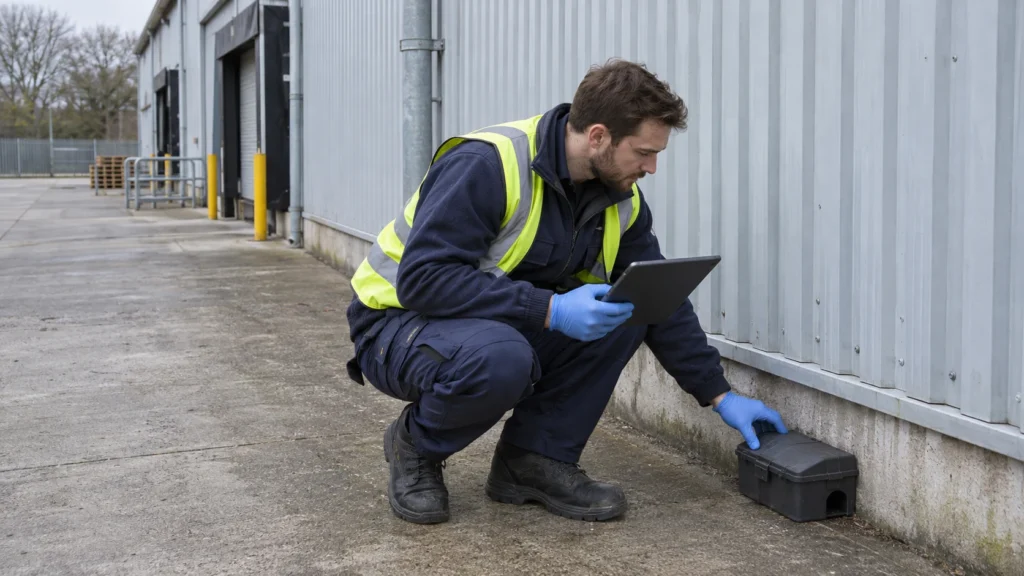
Pest Control for Business: What You Actually Get
Pest control for business premises is often bought as a routine administrative item. Managers sign an agreement expecting eradication, then find the contract delivers something broader. A commercial programme supplies scheduled risk inspections, physical exclusion advice, chemical stewardship records and documented due diligence. Knowing which services, documents and technical checks arrive with that agreement matters. It decides whether a site passes an environmental health visit, and whether pests get detected early or discovered by a customer.
Every commercial site risks production downtime, failed audits and reputational damage once pests establish harbourage indoors. Food businesses face enforcement action as well. The distinction between an active defensive programme and a reactive call-out service is therefore practical rather than semantic. So which of the two does your current contract actually provide?
Key Takeaways
- A commercial contract buys scheduled risk inspections, proofing advice and documented due diligence, not simply emergency eradication after pests appear.
- The initial survey sets the baseline: structural vulnerabilities, environmental pressures and the numbered device map used on every later visit.
- Routine servicing relies on non-toxic monitoring and proofing recommendations, with rodenticides reserved for confirmed activity under product label conditions.
- Digital portals record device observations on site, giving duty holders timestamped visit evidence and an auditable corrective action trail.
- Reactive call-outs between scheduled visits contain sudden sightings quickly and identify the structural breach that allowed entry.
Core Components of Commercial Pest Management Agreements
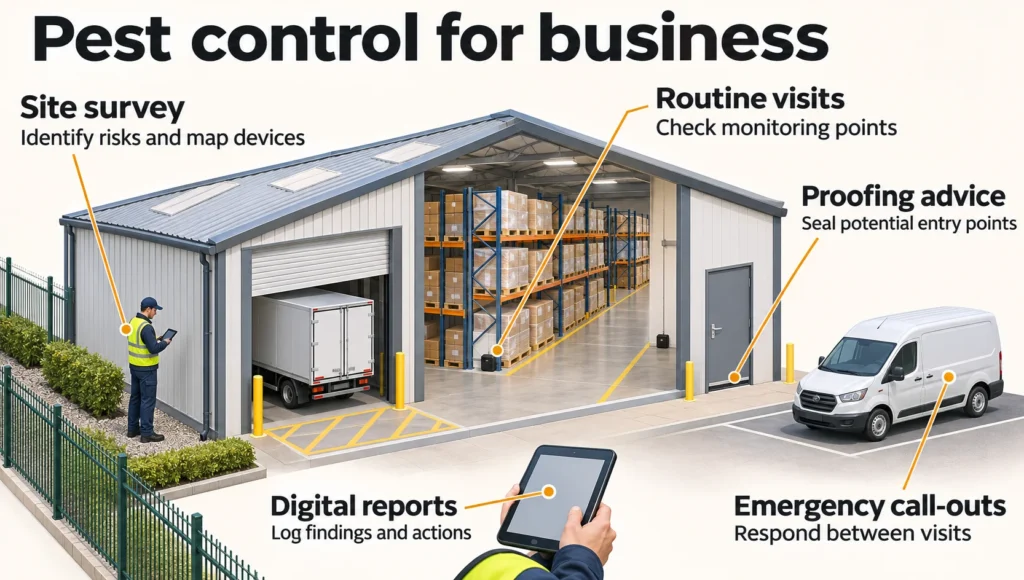
Commercial agreements deliver protection through preventative monitoring, scheduled inspection and formal compliance records. Domestic treatments react to a visible pest. A business programme builds a continuous defensive barrier across the site perimeter, storage areas and production zones. The table below sets out the deliverables included in a standard commercial package.
Each component answers a specific operational or regulatory requirement in a UK workplace. Clear contractual definitions matter before service starts. The facilities manager needs to know what the technician does on site and how often. They also need to know what happens between visits and which documents arrive afterwards. Vague wording here is where compliance gaps begin.
| Deliverable | Operational Function | Primary Benefit |
|---|---|---|
| DeliverableInitial Site Survey | Operational FunctionBaseline property and risk evaluation | Primary BenefitIdentifies structural ingress routes |
| DeliverableDevice Mapping | Operational FunctionPositioning numbered monitoring points | Primary BenefitStandardises the inspection route |
| DeliverableRoutine Servicing | Operational FunctionPeriodic physical device inspections | Primary BenefitDetects pest activity early |
| DeliverableDigital Reporting | Operational FunctionTimestamped logs and action tracking | Primary BenefitProvides immediate audit evidence |
| DeliverableEmergency Call-Outs | Operational FunctionUnscheduled reactive pest treatments | Primary BenefitMinimises operational downtime |
Initial Site Survey and Facility Risk Assessment
Perimeter and Environmental Survey Findings
An initial commercial survey starts outside the building. The technician examines the external envelope, boundary vegetation, drainage points, waste compounds and incoming service conduits. These checks reveal established rodent runs and active harbourage. They also expose the operational habits attracting pests to the site, which matters more than any single trap reading.
In practice, we find most ingress traced to loading bays and dock levellers on distribution sites. Technicians also record structural gaps, defective masonry and overgrown boundaries. Neighbouring land use is assessed as well. A railway embankment, watercourse or adjacent food unit changes seasonal pressure on a perimeter. The defensive layout is then designed around that pressure.
Internal Vulnerability Profiling and Device Mapping
Internal profiling identifies production areas, plant voids, ducting and storage layouts where pests find warmth, moisture and food residues. Technicians then fix the position of every monitoring device and give it a unique number. Each device appears on a site plan, which becomes the reference document for every subsequent visit.
The plan forms a permanent part of the technical folder. Numbered stations create an auditable trail that technicians follow in sequence on every visit. Fixed placement matters for two reasons. It prevents devices drifting as the site changes, and it stops neophobic rodents learning to avoid hardware that moves about.
Business Pest Prevention Plan Design and Frequency
Risk-Based Inspection Schedules and Visit Frequency
Visit frequency reflects a site’s risk profile, not a generic calendar. High-risk food manufacturing sites commonly run monthly or fortnightly. Dry non-food warehouses often operate safely on quarterly visits. The business pest prevention plan records the technical justification for the frequency chosen, so an auditor can see why that interval applies.
Retailer technical standards and third-party certification schemes often set minimum frequencies for food processors. Those requirements override commercial preference. When conditions change, the risk assessment needs updating. Seasonal production spikes, new build work or a site extension all justify a review. From experience across the sector, frequency driven by recorded activity beats frequency driven by habit.
Non-Chemical Exclusion and Proofing Protocols
Physical exclusion is the foundation of preventative commercial pest management. Technicians survey doors, windows, pipe penetrations, cable entries and ventilation grilles, then specify durable proofing materials. Closing these gaps reduces reliance on chemicals in sensitive environments. It also removes the condition that allows an infestation to repeat after treatment.
A few millimetres of clearance under an external door is enough for a mouse. Technicians specify heavy-duty bristle strips, aluminium kick plates, wire mesh and proprietary pipe collars. Each recommendation carries a location and a priority. That gives maintenance teams a defined task list rather than a general warning about proofing.
Did You Know?
Section 3 of the Prevention of Damage by Pests Act 1949 places a notification duty on occupiers. Where rats or mice are living on or resorting to land in substantial numbers, the occupier must notify the local authority in writing, forthwith. Agricultural land is excluded from that duty.
Routine Technician Servicing Procedures
Sequential Device Audits and Inspection Routes
Routine visits follow a fixed sequence through every numbered station. Technicians inspect internal catch boxes, pheromone traps and external tamper-resistant bait boxes without skipping planned locations. Each technician cleans the station, checks it for droppings and gnawing, then refreshes non-toxic blocks or approved lures.
A consistent inspection order keeps historical data comparable from visit to visit. Technicians read non-toxic blocks for fresh tooth marks, which flag activity long before a population becomes visible. Fixed routes also force attention into awkward places. Machinery voids, drop ceilings, sub-floor ducts and roof spaces get inspected because the route requires it.
Environmental Hygiene and Building Fabric Checks
Servicing extends well beyond the devices. Technicians walk operational zones to assess hygiene standards. They examine floor-wall junctions, the areas beneath production equipment and the space around staff canteens. They look for food debris, standing water and spillage. Structural defects such as leaking pipes and broken drain covers become recorded findings.
Uncleaned spillage under pallet racking or inside machinery casings feeds insect populations indefinitely. Routine inspection exposes those conditions and identifies where cleaning routines need strengthening. The finding is only half the value. Denying pests harbourage, water and food residue prevents breeding populations establishing indoors at all.
Free Pest Control Audit Review
We will review your risk assessment, site plan, visit reports, trend analysis, open recommendations, product records and demo our AI Pest management System.
Integrated Pest Management and Chemical Stewardship
Hierarchical Control Principles and Action Thresholds
Commercial pest management follows a control hierarchy. Exclusion and sanitation come first, chemicals last. Technicians set action thresholds for each zone, separating a low-risk external yard from a critical food preparation line. Intervention follows only when recorded activity breaches the threshold for that zone, which keeps the response proportionate.
When non-toxic monitoring shows exploratory rodent activity, the first step is diagnostic rather than chemical. Technicians check local proofing, then review stock movement, waste collection frequency and housekeeping records. In practice, a change in one of those three explains most sudden activity. That discipline avoids unnecessary chemical use and keeps contamination risk controlled.
Rodenticide Stewardship and Product Label Conditions
Product label conditions under the Biocidal Products Regulation govern rodenticide use. The CRRU UK Code of Best Practice sits behind those conditions as industry stewardship. Permanent baiting around a building exterior is lawful only where the label specifically permits that non-standard use. A documented environmental risk assessment must support it.
Uncontrolled anticoagulant use poisons non-target predators, including barn owls and kestrels, through the food chain. Technicians therefore deploy non-toxic blocks as the standard early-warning device. Toxic formulations go down only for an active, time-limited treatment. Every deployment needs a risk record, regular carcass searches and full bait removal once activity stops.
AI Pest Management
AI pest management is pest control delivered with continuous digital monitoring and analytics rather than paper records, with real time data access across a single or multiple sites.
Emergency Response and Reactive Interventions
Contractual Response Protocols for Sudden Sightings
Service agreements define how unscheduled call-outs work. The contract should state the reporting route, the attending conditions and the expected response time for a high-priority incident. Those three details decide what happens on the afternoon a chef reports a mouse. Immediate attendance stops a minor incursion becoming a site-wide problem.
A confirmed rodent sighting in a customer-facing retail area or a food preparation kitchen demands containment that day. The service desk dispatches a local technician, who tracks the activity, locates internal ingress holes and installs targeted traps. Speed protects continuity and reputation. Once a customer sees the pest, the commercial damage is done.
Root-Cause Investigation and Population Containment
Reactive visits concentrate on cause rather than symptom. Technicians examine recent deliveries, newly installed utility conduits and open building works to find the breach. Containment follows immediately once the entry point is identified. Trapping removes the animals physically, which avoids carcasses decomposing inside wall cavities, ceiling voids or service risers.
Technicians interview the staff member who logged the sighting to establish direction of travel. That account usually narrows the search to one or two structural defects. Tracking of this kind serves two purposes. It clears the immediate risk and produces the evidence for a permanent repair rather than a repeat treatment.
Technical Documentation and Digital Reporting Systems
Digital Site Portals and Auditable Records
Most commercial programmes have replaced paper logbooks with digital portals. Technicians scan a barcode or QR code at each station, recording device integrity, bait condition and any activity seen. The report uploads before the technician leaves site. Facilities managers get timestamped verification of the visit rather than a signature.
The portal also holds supporting paperwork: safety data sheets, COSHH assessments, technician qualifications and insurance certificates. Environmental health officers and supply-chain auditors can see the record without working through a disorganised ring binder. Electronic storage has a second benefit. Statutory documentation stays accessible throughout the retention period an auditor expects.
Activity Trend Analysis and Corrective Actions
An auditable pest file needs interpretation, not raw counts. Reporting systems produce zone-specific charts showing seasonal shifts and localised spikes in activity. Written commentary should accompany each chart, explaining what moved and what the technician did about it. A graph without that commentary tells an auditor very little.
Every structural defect or hygiene failure should generate a formal corrective action in the portal. Each action needs a named site owner, photographic evidence and a target completion date. Closing actions out with proof demonstrates management rather than record-keeping. Open actions repeated across three visits are the finding auditors pursue hardest.
Equipment, Hardware and Preventative Infrastructure
Bait Boxes and Tamper-Resistant Enclosures
External hardware has to survive weather, traffic and tampering. Technicians install lockable plastic or steel bait boxes along the perimeter and anchor them to a fixed surface. Internally, low-profile housings protect snap traps and sticky insect monitors. Anchoring and locking are not cosmetic; both support lawful external bait placement.
Placement must also work around the operation. High-traffic warehouse floors need covers that survive a forklift wheel without dislodging the mechanism inside. Labelling matters too. Each station should identify its contents, the contractor and the active substance details required under workplace safety and biocide labelling rules.
Electronic Fly Killers and Physical Screening
Flying insect control relies on electronic fly killers, strip curtains and fine mesh screening. Technicians specify low-energy LED units or shatter-resistant fluorescent systems according to ambient light and room geometry. Siting rules apply. No catch unit should sit directly above an open production line or remain visible from an external doorway.
Routine servicing includes catch tray analysis, which identifies the species trapped and points to the breeding site. High vinegar fly counts suggest fermenting residues around bar areas or drains. Blowflies point to a carcass or a waste bin problem. Combining catch data with heavy-duty PVC curtains on loading doors gives a workable defence.
Final Thoughts
Knowing what a business pest control programme includes lets a facilities manager buy genuine protection rather than paper compliance. Pest control for business premises works as a partnership. The contractor supplies inspection, monitoring, stewardship records and proofing specifications. The site supplies maintenance, housekeeping and prompt reporting. Neither half works alone.
Sites that act on proofing findings, train staff to report sightings and review trend data quarterly rarely face serious infestations. Measuring current deliverables against recognised industry standards shows where the defensive perimeter is thin. That check is better done now than during an audit.
Request a Free Site Survey
Frequently Asked Questions
A:
A sound contract covers a baseline site survey, numbered device mapping, scheduled preventative inspections and timestamped digital reporting. It should also provide trend analysis with written commentary, a corrective action register, access to contractor safety documentation and defined response arrangements for emergency call-outs. Routine work focuses on non-toxic detection, proofing recommendations and hygiene auditing rather than continuous chemical treatment. Check that the agreement states visit frequency, the justification for that frequency, and what happens between visits.
A:
Frequency depends on operational risk and any third-party audit requirements, not a standard interval. High-risk food manufacturing and food preparation sites typically need monthly or fortnightly inspections. General warehousing and non-food commercial offices often run safely on quarterly visits. The technician sets the schedule during the initial risk assessment and records the reasoning. Frequency should then be reviewed whenever site conditions change, including seasonal production spikes, building work or a change of use nearby.
A:
Permanent external baiting with anticoagulants caused secondary poisoning in predators such as barn owls and kestrels. Rodenticide labels now carry conditions set under the Biocidal Products Regulation, and the CRRU UK Code of Best Practice provides the stewardship framework behind them. Permanent, pulsed or burrow baiting is lawful only where the product label specifically permits that use. Routine external boxes therefore hold non-toxic monitoring blocks, with toxic baits reserved for confirmed, time-limited treatments.
A:
Expect to hold the signed contract, technician qualifications, public liability insurance and a dated site plan showing every numbered device. The folder also needs site-specific risk assessments, product safety data sheets, COSHH assessments, timestamped visit reports, a staff sightings log and interpreted trend analysis. Auditors look hardest at the corrective action register. They want evidence that findings raised on earlier visits were resolved, with photographs or sign-off, rather than carried forward repeatedly.
A:
Traditional pest control reacts to visible pests, usually with a chemical treatment after an infestation appears. Integrated pest management is a preventative decision framework. It combines structural exclusion, habitat removal, operational hygiene and continuous non-toxic monitoring, with defined action thresholds for each zone. Chemical treatment becomes a targeted, temporary measure used only when recorded activity breaches a threshold. The practical difference shows in the records: one documents treatments, the other documents conditions and corrections.


By choosing Shield Pest Management, you’re partnering with a company that combines local expertise with industry-leading practices. Our commitment to quality, compliance, and customer satisfaction makes us an ideal choice for both residential and commercial pest control needs.
