

Pest Control Site Survey for Commercial Premises
A pest control site survey forms the technical foundation of every commercial servicing contract. A qualified technician must inspect the premises before devices are mapped or agreements signed. The survey records structural weaknesses, hygiene standards, operational workflows and historical pest pressure. Skipping this baseline leaves generic programmes that fail audits and miss active ingress routes.
Facilities managers and procurement teams often ask what happens during a commercial pest control survey. The answer shapes proofing budgets, device layouts and audit evidence for years. So how does a structured inspection of buildings, boundaries and storage create an audit-compliant foundation?
Key Takeaways
- A comprehensive initial survey evaluates building fabric, drainage systems, hygiene practices and surrounding habitats to identify active ingress points before servicing begins.
- Qualified technicians establish baseline risk profiles across high-care and storage zones to specify monitoring placement without relying on unjustified chemical applications.
- The survey inspects physical barriers and pest harbourage across external perimeters to ensure monitoring programmes align with current rodenticide stewardship rules.
- Operational workflows and staff waste routines receive scrutiny because internal handling procedures frequently influence pest attraction far more than building age.
- Findings translate into an actionable report that prioritises structural proofing repairs and establishes the mapped device layout third-party audit standards require.
Survey Assessment Areas and Their Operational Impact
A commercial survey assesses environmental risk, building proofing and hygiene standards before contract deployment. Reviewing these parameters guarantees that monitoring points reflect genuine pest pressure rather than arbitrary placement. The table below sets out the inspection areas covered during the initial visit. It also shows how each area shapes the service design that follows.
Technicians examine structural boundaries and internal practices to grade risk across operational zones. This systematic review prevents unnecessary chemical usage from day one. It supports full compliance with Campaign for Responsible Rodenticide Use guidance. It also supplies the data needed to build a compliant site plan for food safety and third-party audit bodies.
| Survey Assessment Area | Technical Focus | Operational Impact |
|---|---|---|
| Survey Assessment AreaBuilding Envelope | Technical FocusDoors, louvres, eaves, service penetrations | Operational ImpactDetermines immediate physical proofing priorities |
| Survey Assessment AreaDrainage Infrastructure | Technical FocusGullies, uncapped pipework, interceptor pits | Operational ImpactPrevents sub-surface brown rat access routes |
| Survey Assessment AreaWaste Management | Technical FocusCompactor cleanliness, bin lids, perimeter distance | Operational ImpactReduces external fly and rodent attraction reservoirs |
| Survey Assessment AreaInternal Storage | Technical FocusPallet stacking, racking inspection gaps, FIFO | Operational ImpactPrevents harbourage and stored product insect spread |
| Survey Assessment AreaSurrounding Grounds | Technical FocusVegetation boundaries, neighbouring land, water | Operational ImpactInforms perimeter monitoring density and device types |
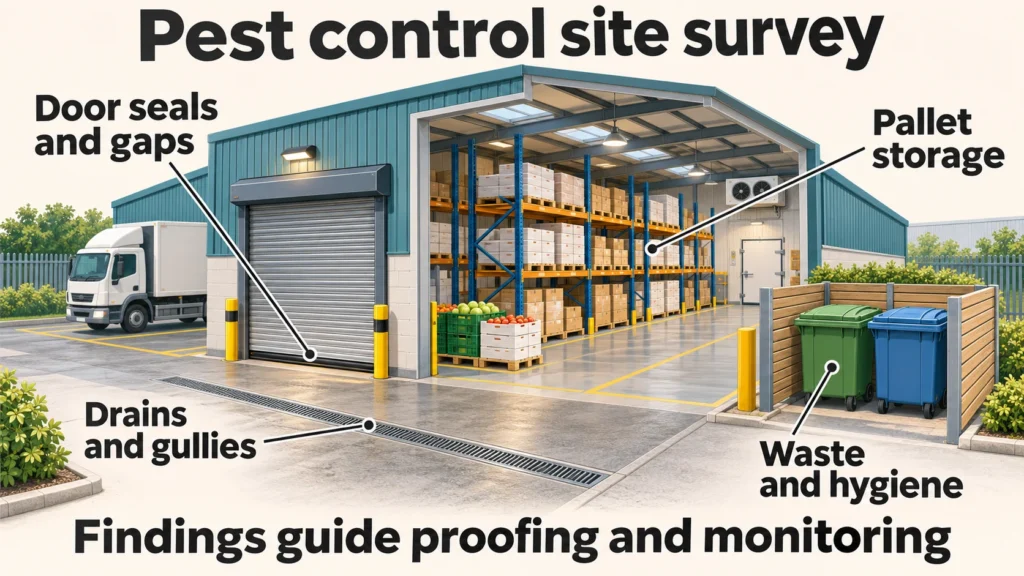
Building Envelope Inspection Points
External Perimeter Walls and Expansion Joints
Surveying external walls reveals the structural gaps that pests exploit to enter commercial premises. Technicians examine brickwork pointing, cladding interfaces, weep vents and expansion joints along the entire building line. Minor settling fractures or damaged render can grant rodents and crawling insects immediate harbourage inside cavity walls.
During a thorough survey, technicians check every elevation systematically. Rats gnaw through soft metals, damaged timber and weakened mortar joints to gain entry. Identifying these weaknesses before service delivery allows permanent sealing of external gaps. Eliminating wall penetrations protects sensitive internal zones from onward migration.
Door Thresholds and Loading Bay Seals
Loading bay dock levellers and external personnel doors are the most common entry point on industrial premises. Technicians inspect rubber compression seals, nylon brush strips and frame alignment. They record any clearance gap wider than five millimetres. A gap the width of a pencil gives house mice straightforward access to warm storage.
High-traffic roller shutters often suffer forklift impacts. Those impacts distort guide channels and leave substantial floor-level voids. Technicians assess mechanical seal integrity and day-to-day staff habits together. A well-specified industrial door propped open for ventilation defeats the barrier entirely. In practice, we find operational discipline matters as much as the hardware itself.
Drainage Infrastructure and Sub-Surface Access
Below-Ground Ingress Routes for Rodents
Sub-surface drainage defects are the primary route for brown rats entering food handling premises. Technicians survey inspection chambers, soil vent pipes, redundant sewer connections and interceptor traps. They look for burrowing, displacement and smear marks. Uncapped runs or broken earthenware pipes let subterranean populations reach internal floor recesses.
Rats exploit pipe fractures caused by ground movement. They establish habitual runs that bypass perimeter monitoring stations entirely. When indoor activity appears with no envelope damage, drains are the definitive starting point. Stainless steel non-return valves or relined pipework provide permanent exclusion. That work prevents recurring populations beneath concrete slabs.
Internal Floor Gullies and Effluent Systems
Internal floor gullies and process effluent trenches create significant hazards when neglected during a survey. Technicians inspect drainage gratings, water traps and discharge channels. They locate standing organic sludge that supports drain fly and cockroach breeding. Grease deposits beneath drainage covers provide ideal harbourage for persistent populations.
Oriental cockroaches thrive in cool, damp underground services and subterranean ductwork. They migrate upward through dry drainage traps. The surveyor checks whether water seals remain charged. The surveyor also checks whether drain baskets receive routine sanitisation. Identifying foul effluent lines early builds preventative cleaning actions directly into the site plan.
Did You Know?
Section 3 of the Prevention of Damage by Pests Act 1949 places a statutory duty on the occupier of any land. They must notify the local authority in writing, forthwith, once they know that rats or mice are living on or resorting to that land in substantial numbers.
Operational Hygiene and Housekeeping Reviews
Machinery Voids and Production Residues
Internal machinery voids, conveyor frames and motor housings create warm, sheltered microclimates. Surveyors inspect the crevices beneath production equipment where organic matter, flour dust and food scraps gather. These hidden deposits act as primary breeding reservoirs for German cockroaches and stored product beetles.
Routine cleaning regimes often miss concealed equipment voids. Complex guarding and restricted maintenance access are the usual reasons. An experienced surveyor identifies these points and recommends modified cleaning schedules or removable panels. Removing food reservoirs is far more effective than chemical intervention. Insect populations cannot sustain breeding cycles without a food source.
Waste Storage Compounds and Compactor Hygiene
External waste compounds and refuse compactors are major attractants that draw pests toward the building envelope. Technicians assess bin lid integrity, drainage beneath compactors, wash-down facilities and collection frequency. Organic residues pooling on concrete aprons quickly attract foraging rodents, nuisance gulls and several species of filth fly.
Siting waste skips beside production fire exits creates an avoidable pest bridge. The survey measures compound distance from intake doors. It then advises on physical containment measures. Tidy, bunded and frequently washed refuse areas remove the feeding stimuli. Without that stimulus, external pests have little reason to colonise the perimeter.
Free Pest Control Audit Review
We will review your risk assessment, site plan, visit reports, trend analysis, open recommendations, product records and demo our AI Pest management System.
Storage Systems and Inbound Material Flows
Raw Ingredient Intake and Goods Inspection
Pests frequently enter distribution centres and food factories inside inbound pallets rather than through structural holes. The survey examines receipt protocols, quarantine zones and inspection practices at goods-in docks. Palletised dry goods, grain sacks and cardboard packaging often carry stored product insects or rodents already.
Without stringent intake checks, shipments introduce foreign pests straight into ambient warehouses. The surveyor records how staff inspect consignments. They also record whether rejected loads are isolated promptly. Building rapid intake checks into daily procedures stops introduced infestations spreading across racking. It also protects stored stock from contamination.
Pallet Racking Spacing and Stock Rotation
Internal storage layouts strongly influence how effectively a business can monitor pest activity. Surveyors evaluate pallet racking placement across every store. They check whether clear inspection strips exist between stacked materials and perimeter walls. Product stored tightly against structural walls creates harbourage and blocks thorough visual checks.
The assessment also reviews stock discipline, particularly first-in, first-out rotation across ambient stores. Stagnant stock left undisturbed for months offers a stable breeding environment. Flour beetles, grain weevils and warehouse moths all benefit. Clean floor margins and regular stock turnaround deny insect larvae the stability they need to establish.
AI Pest Management
AI pest management is pest control delivered with continuous digital monitoring and analytics rather than paper records, with real time data access across a single or multiple sites.
Proofing Priorities Drawn from Survey Findings
Risk Hierarchy for Physical Exclusion Works
Physical exclusion is the primary barrier in modern pest prevention. It prioritises durable structural repairs over repeated chemical applications. Technicians sort survey findings into a risk-ranked schedule. External doors, service penetrations and drainage come before internal cosmetic flaws. High-priority ingress routes receive immediate attention to stop nesting inside the envelope.
Survey reports specify exact materials for each exclusion task. Heavy-gauge weldmesh, bristle strip seals and metal backing plates are common recommendations. A structured approach to proofing stops minor building wear developing into severe infestation risk. Sealing entry points permanently reduces reliance on reactive intervention across the facility.
Contractor Responsibility versus In-House Maintenance
A successful exclusion strategy needs a clear division of responsibility. The pest contractor and the internal maintenance team must each know their scope. Survey findings separate specialist proofing tasks from general fabric maintenance. Bird netting is specialist work. Refitting a damaged door seal usually is not.
Assigning clear ownership stops recommendations languishing on audit observation logs. When proofing actions lack owners and target dates, auditors treat the stagnation as a management failure. The survey report establishes transparent accountability from the outset. Facilities teams can then absorb structural repairs into planned maintenance routines.
Device Layout and Action Thresholds
Non-Toxic Baseline Placement and Mapping
Initial surveys establish the precise layout and density of monitoring points across the site. Technicians position numbered devices along perimeter walls, internal corridors and external risk points. Each location is recorded on a CAD site plan. Devices carry non-toxic monitoring baits initially, confirming pest presence without introducing chemical hazards.
Under Campaign for Responsible Rodenticide Use stewardship principles, permanent toxic baiting is no longer acceptable without confirmed activity. Non-toxic indicators in secure tamper-resistant stations create an effective early-warning network. Technicians record any feeding on the non-toxic blocks. Only then do they select targeted, justified chemical interventions.
Environmental Thresholds and Risk Zones
Modern Integrated Pest Management programmes rely on zone-specific action thresholds set during the initial survey. A food preparation hall operates under zero tolerance for insect activity. External yard perimeters permit managed environmental limits. Clear baseline thresholds ensure reactive attendance happens before minor incursions reach production.
Surveyors analyse past pest history, seasonal pressure and surrounding land use to tune threshold sensitivity. An electronic fly killer catching three nuisance flies in a packaging warehouse indicates seasonal drift. The same catch in high-care processing triggers immediate investigation. Defining these limits early prevents unnecessary treatments whilst maintaining strict controls.
Audit Documentation and Baseline Reporting
Report Contents and Photographic Evidence
The commercial pest survey report brings physical observations, risk assessments and layout schematics into one compliance document. It details building construction, current infestations, environmental risks, proofing defects and housekeeping recommendations. Photographic evidence accompanies each finding. Facilities managers use the document to set budgets and commission site repairs.
A high-quality report states the exact scope of service, agreed visit frequency and targeted pest species. It becomes the benchmark for all future servicing visits and trend analysis. Without this formal record, a facility lacks evidence of due diligence under the Food Safety Act 1990.
Compliance Alignment for Third-Party Standards
Certification bodies require documented proof of an initial technical assessment before certifying food-processing premises. The BRCGS Global Standard Food Safety Issue 9 expects detailed site risk assessments, signed device maps and defined contractor responsibilities. The initial survey ensures every station and procedure satisfies the relevant scheme clauses.
Auditors review the survey file to verify that monitoring frequency matches genuine environmental risk. The same scrutiny applies under BRCGS, the current SALSA Food and Drink Production Standard, and retailer-specific manufacturing codes. A thorough survey prevents non-conformances. It proves the strategy is prevention-led, justified and professionally competent.
Final Thoughts
A rigorous pest control site survey does more than catalogue visible pests. It sets the structural, biological and operational boundaries of a commercial pest management partnership. Rushing into servicing without a methodical survey leaves facilities exposed to recurring infestations, wasted expenditure and failed audits. Systematic assessment removes harbourage before contamination risk escalates.
Regulatory scrutiny around chemical stewardship continues to tighten, and third-party standards now enforce stricter traceability. Baseline documentation will remain essential for operational compliance. Time invested in a professional survey makes physical proofing, internal housekeeping and mapped monitoring work together. That evidence-based approach protects brand reputation, structural assets and regulatory standing for years.
Request a Free Site Survey
Frequently Asked Questions
A:
A technician walks the whole property, starting with site sign-in and safety induction. They examine external perimeters, waste compounds, drainage covers and building fabric for entry points and harbourage. Internally, the surveyor inspects production lines, roof spaces, machinery voids and storage areas. They look for evidence of pests, poor hygiene or proofing defects. The visit ends with an initial debrief. That debrief forms the basis of a risk assessment, a device map and a proofing schedule.
A:
The report details the physical and operational findings from the initial inspection. It includes an environmental risk assessment, photographic evidence of proofing defects, hygiene observations and notes on active or historical infestations. It also provides a numbered site plan showing proposed device locations. A schedule of recommended exclusion works follows, with priorities assigned to each item. The report closes with an agreed service specification covering visit frequency and targeted pest species.
A:
Under Campaign for Responsible Rodenticide Use guidelines, routine permanent baiting with toxic rodenticides is no longer accepted practice. Anticoagulant rodenticides pose secondary poisoning risks to predatory wildlife, including barn owls and kestrels. Technicians therefore install secure monitoring boxes containing non-toxic blocks as an early-warning tool. Rodenticides are introduced only once physical signs confirm active rodents. That sequence keeps treatment justified, targeted and compliant with current stewardship rules.
A:
Certification schemes such as BRCGS Food Safety Issue 9 and the current SALSA standards require documented proof that pest management is based on site-specific risk assessment. The pre-contract survey establishes the device map, defines action thresholds and identifies operational weaknesses before an auditor arrives. Without that baseline, a facility cannot show why its monitoring frequency was chosen. It also cannot prove due diligence under the Food Safety and Hygiene (England) Regulations 2013.
A:
Responsibility depends on the nature of the defect and the terms agreed in the commercial contract. The survey report separates general building maintenance from specialist pest proofing. In-house facilities or engineering teams typically handle general maintenance. Specialist tasks are usually quoted and installed by qualified pest management technicians. Those tasks include external bird netting, solar panel proofing and rodent-resistant brush strips on high-traffic dock levellers.



By choosing Shield Pest Management, you’re partnering with a company that combines local expertise with industry-leading practices. Our commitment to quality, compliance, and customer satisfaction makes us an ideal choice for both residential and commercial pest control needs.
