

BPCA Compliance Standards and BS EN 16636
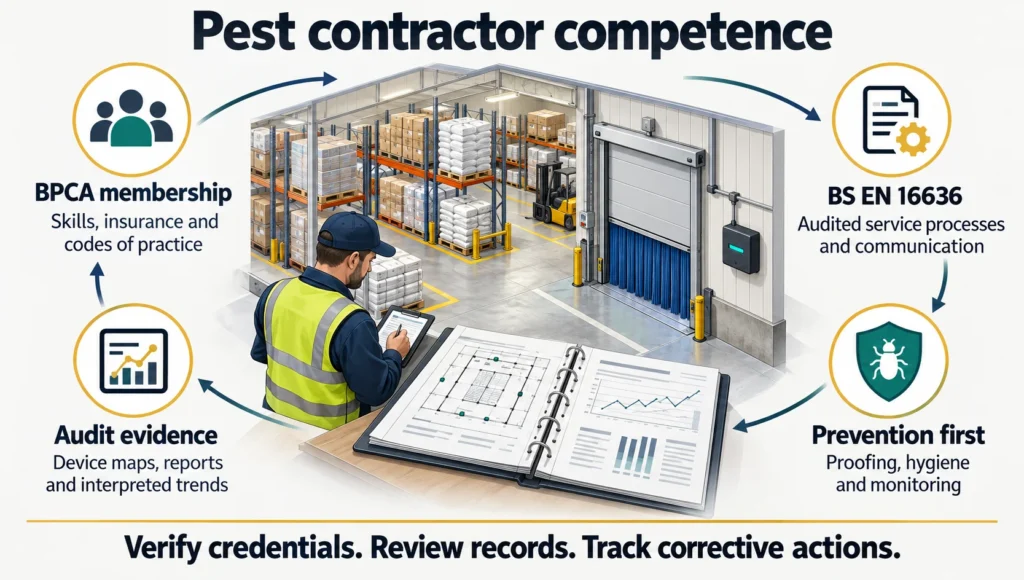
Commercial sites face hard scrutiny during third-party audits. Pest control records are often the first file an auditor opens. Meeting strict BPCA compliance standards shows that your provider works to verified codes of practice. It replaces unverified sales claims with evidence. Auditors from food, storage and logistics schemes want proof of competence, statutory adherence and systematic monitoring.
Many technical managers cannot separate basic trade membership from independently audited standards. The difference matters when a customer certification is at stake. Weak evidence of competence creates non-conformances that are hard to close out. How can a technical team confirm its pest contractor meets third-party requirements before the auditor arrives?
Key Takeaways
- BPCA servicing membership requires proven technician qualifications, mandatory insurance cover and periodic external auditing against published codes of best practice.
- BS EN 16636 certification is an independently audited European benchmark covering service process, technician competence and client communication.
- Auditors demand objective proof of competence to support a due diligence defence under the Food Safety Act 1990.
- Integrated Pest Management puts proofing, hygiene and monitoring ahead of routine chemical treatment across food manufacturing and storage sites.
- Digital reporting gives auditors timestamped visits, numbered device mapping and written trend interpretation that paper folders rarely deliver reliably.
Pest Management Compliance Benchmarks
Commercial compliance regimes need verifiable proof of contractor competence. They also need repeatable operational processes behind that proof. The table below sets out how each professional framework governs capability, audit method and documentation quality. In practice, we find that technical managers use it as a vetting checklist before a supplier contract is signed.
An accredited provider keeps site documentation aligned with retailer codes and GFSI-recognised standards. That alignment prevents avoidable non-conformances during supplier evaluations. It also produces transparent records that satisfy Environmental Health Officers. From experience across the sector, the weakest files belong to contractors holding no third-party certification at all.
| Accreditation Scheme | Governing Body | Core Focus | Audit Method |
|---|---|---|---|
| BPCA Servicing Member | British Pest Control Association | Code adherence and technician skills | Periodic association auditing |
| BS EN 16636 / CEPA | Confederation of European Pest Management Associations | Standardised service process and competence | Third-party certification audit |
| BASIS PROMPT | Independent professional register | Continuing professional development | Annual CPD point verification |
| RSPH Level 2 | Royal Society for Public Health | Baseline technician qualification | Formal written examination |
| CRRU Code | Campaign for Responsible Rodenticide Use | Environmental stewardship and bait limits | Supply chain purchase controls |
British Pest Control Association Membership Criteria
Technical Competence Requirements
BPCA servicing membership requires proof that field technicians hold verified professional qualifications. Technicians must hold at least the RSPH Level 2 Award in Pest Management to work unsupervised. That baseline covers pest biology, chemical formulations and target species behaviour. Without it, a technician cannot manage commercial risk safely.
Membership is not a transaction where a company simply pays an annual fee. The association sets entry thresholds and tests baseline capability across commercial environments. Servicing members must also hold public liability insurance at an adequate level. That cover protects client assets against operational error or chemical damage during a contract.
Codes of Best Practice
BPCA publishes Codes of Best Practice that set operational standards across commercial sectors. Members must align survey methods, treatment strategy and reporting with those published guidelines. The codes push technicians towards responsible pesticide use. Proofing or better housekeeping must be considered first where either can resolve the pressure.
The codes cover rodent control, insect management and wildlife work in commercial settings. Verification visits inspect member documentation, vehicle stock and storage depots. Inspectors check that daily practice matches the written procedure. A member who fails to maintain these standards faces disciplinary review and possible removal from the register.
European Standard BS EN 16636 and CEPA Certification
Process Framework Requirements
BS EN 16636 certification is the leading European benchmark for pest management providers. It sets explicit operational stages that a certified contractor must follow. The cycle runs from initial survey and risk analysis to action plan, treatment and review. Every intervention therefore rests on recorded site data rather than habit.
What BS EN 16636 means for your pest contractor is simple. The business operates under an independently assessed quality management system. CEPA, the Confederation of European Pest Management Associations, owns the scheme across Europe. Independent certification bodies audit the contractor’s processes and confirm that administration supports field performance.
Client Communication and Traceability
The standard demands full traceability across communications, recommendations and applied products. Providers must explain pest causes, site conditions and preventative action in plain terms. Routine chemical treatment without that explanation does not meet the requirement. Records must also give the rationale behind every product application.
Certified providers issue clear contracts covering scope, inspection frequency and target species. Technicians document each visit in full. They record active ingredient quantities, treatment locations and bait station checks. Those trails let a quality manager evidence due diligence on the spot when an environmental health inspector challenges the programme.
Did You Know?
Since 1 January 2025, using any second-generation anticoagulant rodenticide in open areas or waste dumps has been illegal. From 1 January 2026, suppliers may only sell professional rodenticides to buyers holding CRRU UK approved training or CPD membership.
Auditor Expectations for Contractor Competence
Due Diligence Under UK Legislation
The Food Safety Act 1990 created the due diligence defence. A business must show it took all reasonable precautions against contamination. That evidence has to include genuine technical ability on the part of its pest contractor. An unaccredited supplier working to questionable methods weakens the defence badly.
The Food Safety and Hygiene (England) Regulations 2013 require adequate, continuous pest control procedures. Enforcement officers can serve a Hygiene Improvement Notice where standards slip. Where infestation creates a serious public health risk, a Hygiene Emergency Prohibition Notice can close the operation. An accredited contractor is defensible proof of proactive control.
Third-Party Food Safety Standards
Major audit schemes demand proof of contractor competence. BRCGS Food Safety Issue 9 and SALSA Issue 7 both treat pest management as a site standard. Auditors review training certificates, continuing professional development records and supervisory arrangements. They want confirmation that the technician on site meets current industry requirements.
Retailer codes often go beyond baseline GFSI expectations. Many require a dedicated field biologist survey alongside routine contract visits. Auditors also check ongoing training registrations such as BASIS PROMPT, which validates annual development. Engaging an accredited provider avoids non-conformances that delay certification or disrupt a customer supply agreement.
Free Pest Control Audit Review
We will review your risk assessment, site plan, visit reports, trend analysis, open recommendations, product records and demo our AI Pest management System.
Integrated Pest Management Principles in Practice
Survey and Threshold Setting
Integrated Pest Management starts every commercial programme with a thorough site risk assessment. Technicians map structural weaknesses, operational movements and sanitation standards zone by zone. The survey exposes harbourage potential and entry routes. Contractors then design a proactive exclusion programme instead of relying on reactive poisoning.
Action thresholds define the activity level that triggers a formal remedial response. High-care manufacturing zones run zero-tolerance thresholds. External yard perimeters operate at different levels. Auditors ask who set those thresholds and why. The justification must link to product risk, raw material exposure and building design.
Intervention Hierarchy and Prevention
The IPM hierarchy places physical exclusion and hygiene ahead of chemical application. Contractors inspect the external building envelope at every visit. Damaged door brush seals, pipe penetrations and open drainage channels need prompt repair. Removing food and water sources denies incoming pests the resources to breed indoors.
Chemical treatment is a targeted, temporary measure. It follows only where non-chemical controls fail to suppress a confirmed population. Technicians choose the least hazardous effective formulation. They apply it inside approved containment boxes or directly into harbourage crevices. That discipline limits contamination risk inside the facility.
AI Pest Management
AI pest management is pest control delivered with continuous digital monitoring and analytics rather than paper records, with real time data access across a single or multiple sites.
Rodenticide Stewardship and Legal Constraints
CRRU Code of Best Practice
The Campaign for Responsible Rodenticide Use runs the Think Wildlife stewardship regime. Its purpose is to cut secondary poisoning in predatory wildlife. Residue studies in barn owls, kestrels and red kites drove tighter purchase and use controls. Technicians must record an environmental risk assessment before any external toxic placement.
Stewardship rules make non-toxic monitoring bait the default in permanent stations. Permanent toxic baiting is not acceptable practice as a routine measure. It requires a demonstrated and ongoing risk to human or animal health. Service records must show evidence of active rodent presence before a technician introduces a toxic product.
Active Substance Restrictions
Open-area use of second-generation anticoagulants became illegal on 1 January 2025. The restriction covers difenacoum, bromadiolone and brodifacoum. Authorised professional use now centres on treatment in and around buildings. Any external baiting must be justified in writing and recorded in the site compliance file.
Since 1 January 2026, suppliers may only sell professional rodenticides to buyers with approved stewardship training or CPD scheme membership. Product labels are legally binding under biocide law. Off-label use is an enforceable offence. Auditors examine application dates, bait recovery logs and carcass search records to confirm adherence.
Documentation Architecture for the Pest Control File
Site Plans and Device Mapping
A compliant pest control file opens with an accurate, signed and dated site plan. Every external bait station, internal trap and electronic fly killer carries a unique number. That number must match the physical unit on the floor. Any mismatch between plan and site is an immediate non-conformance.
The file must also hold current product labels, safety data sheets and COSHH assessments. Technicians record an inspection outcome for each numbered station at every visit. Visit reports are retained across the full certification cycle. In practice, we find that gaps in this run are the fastest route to a downgraded audit grade.
Interpreted Trend Analysis
Food safety standards expect contractors to analyse monitoring data over time. Collecting raw figures is not enough. Effective trend analysis charts activity by species, facility zone and season. A chart without written interpretation still fails the audit clause, because data alone proves nothing about management control.
Written commentary must state whether activity is rising or falling. It should identify the site change behind the movement and the corrective action taken. Site teams keep their own sightings log, which the technician cross-references at each visit. Repeated recommendations across several reports signal poor preventative oversight.
Digital Systems and Verification Protocols
Digital Portals and Audit Trails
Digital reporting platforms replace the vulnerable paper folder with cloud-based records. Technical teams and visiting inspectors reach the same data set. Technicians log findings on a hand-held device whilst standing at the monitoring point. That creates a timestamp an auditor can trust. Reports and hygiene recommendations appear immediately after the visit.
Secure client portals give external auditors read-only access to historical compliance data. Verification takes minutes rather than an afternoon in a filing cabinet. Corrective action workflows assign ownership and a deadline to each proofing or maintenance issue. Photographic evidence of the repair closes the loop for technical and quality assurance teams.
Remote Monitoring Technologies
Connected sensors detect rodent activity between scheduled technician visits. Facility managers receive an alert within hours of first ingress. Response times fall sharply against a conventional monthly inspection cycle. Sensors also pinpoint the time and location of activity, which directs the technician straight to the entry point.
Sensors signal activity but cannot diagnose the cause. Structural damage and housekeeping failings still need a trained eye on site. Qualified technicians interpret environmental risk, assess hygiene practice and specify corrective proofing. Technology sharpens monitoring precision. Human expertise still carries the integrated pest management system.
Final Thoughts
Strong BPCA compliance standards protect a business from contamination, financial penalty and regulatory sanction. Credentials such as BS EN 16636 certification give a quality manager certainty about audited protocols. When an auditor examines the hygiene system, the compliance folder supplies the documentary evidence. Due diligence has to be shown, not asserted.
Retailer specifications and environmental restrictions continue to tighten across the UK. Contractor documentation deserves a critical review at least once a year. A prevention-led programme backed by continuous digital reporting builds genuine operational resilience. Sites that treat competence and transparent monitoring as standing requirements stay audit-ready between visits.
Request a Free Site Survey
Frequently Asked Questions
A:
BPCA servicing membership shows that a pest control company follows the association's codes of practice. It also confirms qualified technicians and adequate insurance cover. BS EN 16636 is a European quality standard for service provision, process consistency and client communication. The key difference is the audit route. Membership is checked by the trade association. BS EN 16636 requires independent third-party certification under the CEPA scheme. Many strong contractors hold both.
A:
Third-party schemes such as BRCGS and SALSA require demonstrably competent personnel. Reviewing RSPH Level 2 certificates confirms that the technician understands pest biology and safe pesticide use. BASIS PROMPT records show continuing professional development each year. Together they prove the pest programme supports a due diligence defence under the Food Safety Act 1990. An auditor will ask for the certificates by name, so keep current copies in the file.
A:
No. Routine permanent toxic baiting around building exteriors is not acceptable under CRRU stewardship rules. Open-area use of second-generation anticoagulants has been illegal since 1 January 2025. Outdoor treatment in and around buildings is allowed only after a documented inspection confirms active rodent presence. Permanent stations should carry non-toxic monitoring bait as an early-warning tool. Toxic treatment stays short, justified and recorded, which limits secondary poisoning in non-target wildlife.
A:
The folder needs the current service agreement, contractor insurance certificates and technician qualifications. It must hold a dated, signed site plan showing every numbered device. Safety data sheets and COSHH assessments cover each product in use. Visit reports, a staff sightings log and interpreted trend analysis complete the technical record. Auditors also expect an open corrective action log. Each recommendation should be tracked through to documented resolution.
A:
Raw data is a list of visit dates, station numbers and pest counts. On its own it does not satisfy the audit clause. Written trend analysis plots that data over time and across facility zones. It then adds professional commentary on what the figures mean. The commentary states whether activity is rising, names the likely operational cause and judges the preventative measures. It closes with specific remedial actions.

By choosing Shield Pest Management, you’re partnering with a company that combines local expertise with industry-leading practices. Our commitment to quality, compliance, and customer satisfaction makes us an ideal choice for both residential and commercial pest control needs.